Tipu Sultan and Chitradurga
Tipu Sultan and Chitradurga
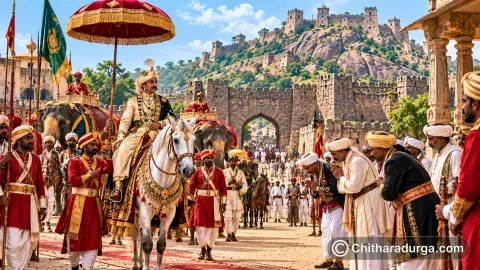
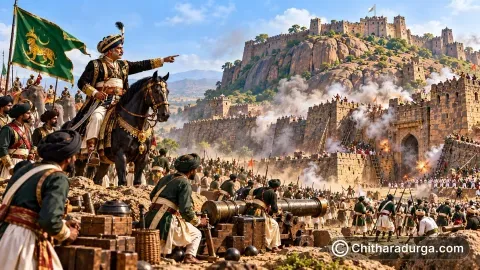
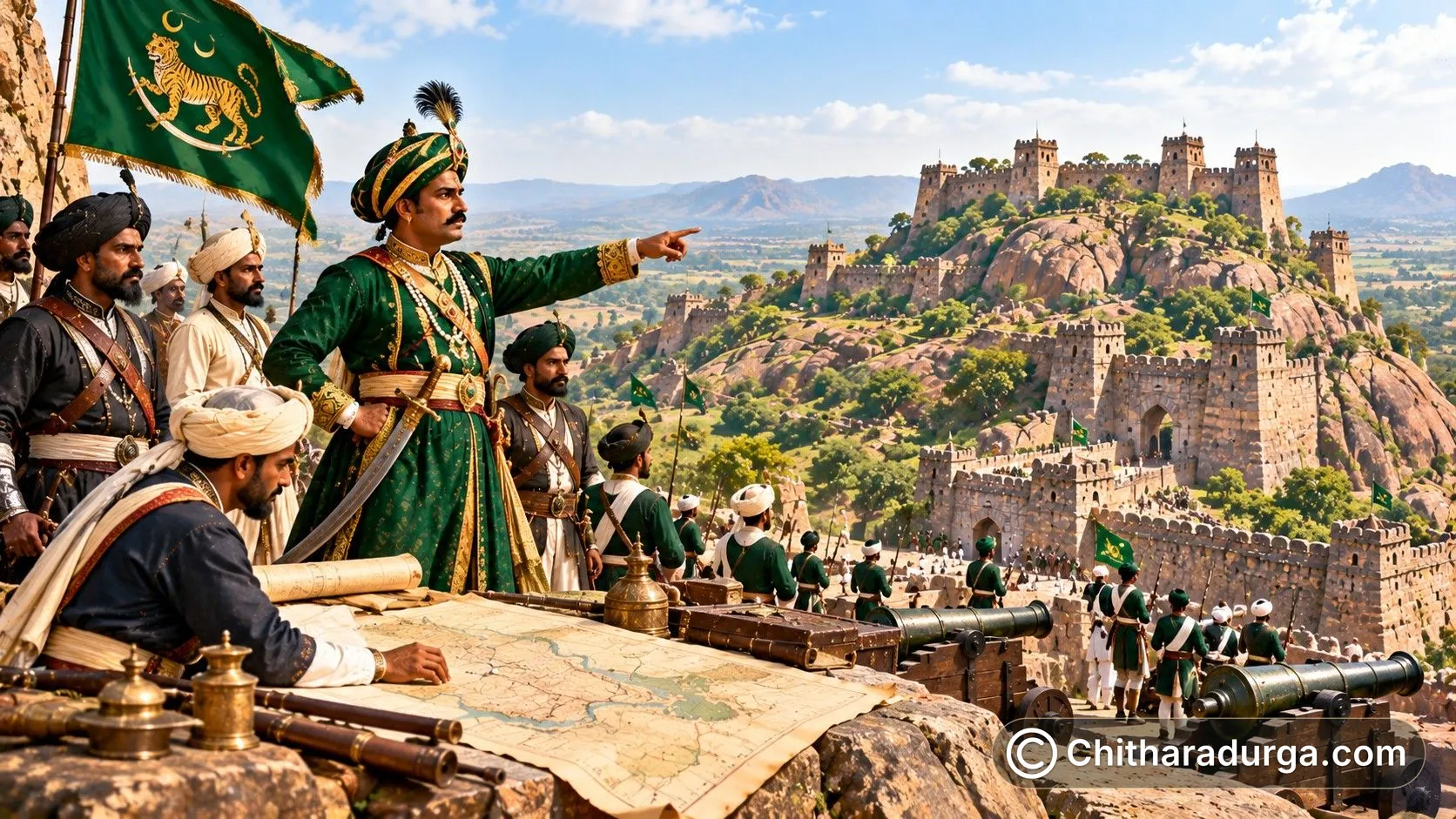
The history of Tipu Sultan and Chitradurga belongs to an important period of political and military change in Karnataka during the late eighteenth century. Chitradurga, which had flourished for generations under its powerful Nayaka rulers, became part of the expanding Mysore kingdom in 1779, when Hyder Ali, father of Tipu Sultan, captured the famous Chitradurga Fort from the last Nayaka ruler, Madakari Nayaka V.
It is important to distinguish between the two periods: the conquest of Chitradurga was carried out by Hyder Ali, while Tipu Sultan later inherited and ruled Chitradurga as part of the Mysore kingdom after succeeding his father.
Fall of the Chitradurga Nayakas
During the eighteenth century, Chitradurga was an important regional power under the Nayakas. Its strategically located hill fort, strong defensive walls and military organisation made it one of the significant fortified centres of central Karnataka.
The last ruler, Madakari Nayaka V, faced increasing pressure from neighbouring powers, particularly Mysore and the Marathas.
After a prolonged struggle, Hyder Ali captured Chitradurga in 1779. Madakari Nayaka and members of his family were taken as prisoners to Srirangapatna.
With this event, the independent rule of the Chitradurga Nayakas came to an end, and Chitradurga became part of the Mysore kingdom.
Chitradurga under Tipu Sultan
Hyder Ali died in 1782, after which his son Tipu Sultan assumed control of Mysore.
As a result, Chitradurga came under Tipu Sultan's administration as an important part of his kingdom. Its strategic location in central Karnataka and its formidable hill fort gave the region considerable military importance.
Tipu Sultan's reign was dominated by continuous political and military struggles involving Mysore, the British East India Company, the Marathas and the Nizam of Hyderabad. In this larger struggle, fortified centres such as Chitradurga formed part of Mysore's network of strategically important positions.
Strengthening of Chitradurga Fort
The magnificent Chitradurga Fort, originally developed and greatly expanded by the Nayaka rulers, continued to have military significance under Mysore.
After its capture, Hyder Ali and Tipu Sultan strengthened and modified parts of the fortifications according to the military requirements of their period.
The fort's massive stone walls, bastions, gateways, defensive passages, storage facilities and strategic position made it valuable for the defence and administration of the region.
Some of the military features visible within the fort today reflect different historical phases, including the Nayaka and Mysore periods.
Military Importance of Chitradurga
Chitradurga occupied an important geographical position between different parts of the Mysore kingdom and the territories lying further north.
The fort could serve as a military station, a defensive stronghold and a centre from which surrounding territories could be supervised.
Its natural granite hills combined with elaborate man-made fortifications made Chitradurga particularly difficult to attack. This military value explains why control over the fort had been so important to the Nayakas, Hyder Ali and later Tipu Sultan.
Administration under Mysore
After the fall of the Nayaka kingdom, Chitradurga was no longer an independent principality. It was incorporated into the broader administrative and military structure of Mysore.
Under Tipu Sultan, Mysore pursued a comparatively centralised system of administration. Revenue collection, military organisation, agriculture, trade and the management of strategically important territories were closely connected to the needs of the state.
Chitradurga therefore became part of a much larger kingdom whose administration was centred on Mysore and Srirangapatna.
Chitradurga and the Anglo-Mysore Struggle
Tipu Sultan's reign was closely associated with the Anglo-Mysore Wars, through which Mysore resisted the growing political and military power of the British East India Company in southern India.
Because Chitradurga was already under Mysore control, its history during this period became connected with the broader military fortunes of Tipu Sultan's kingdom.
The struggle finally reached its decisive stage in 1799, during the Fourth Anglo-Mysore War.
End of Tipu Sultan's Rule
Tipu Sultan was killed at Srirangapatna in 1799 during the Fourth Anglo-Mysore War. His death brought his rule to an end and resulted in a major reorganisation of Mysore.
The British subsequently restored the Wodeyar dynasty to the Mysore throne. Chitradurga remained within the reorganised Mysore kingdom and later became part of the Princely State of Mysore.
Thus, Chitradurga was under the authority of Hyder Ali and Tipu Sultan for approximately two decades between the fall of the Nayakas in 1779 and the defeat of Tipu Sultan in 1799.
Historical Legacy
Tipu Sultan's connection with Chitradurga represents a relatively short but important chapter in the district's long history.
The period marked the transition of Chitradurga from an independent Nayaka principality to a strategic territory within the larger Mysore kingdom. The fort that had symbolised the power of the Chitradurga Nayakas continued to serve as an important military stronghold under Hyder Ali and Tipu Sultan.
After Tipu Sultan's fall, Chitradurga entered another phase under the restored Wodeyar dynasty.
From the fall of Madakari Nayaka in 1779 to the fall of Tipu Sultan in 1799, Chitradurga witnessed a decisive political transition. Its mighty fort, once the heart of the Nayaka kingdom, became part of Mysore's military network and today stands as a monument to the many historical eras that shaped the district.