Hyder Ali and the Capture of Chitradurga
Hyder Ali and the Capture of Chitradurga
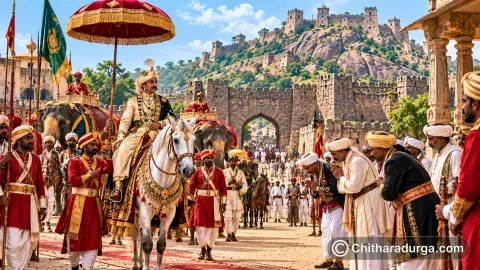
The capture of Chitradurga by Hyder Ali in 1779 was one of the most decisive events in the history of central Karnataka. It brought an end to the long rule of the Chitradurga Nayaka dynasty and incorporated the strategically important Chitradurga region into the expanding Kingdom of Mysore.
At the time, Chitradurga was ruled by Madakari Nayaka V, the last and one of the best-known rulers of the Nayaka dynasty. Protected by its massive hill fort and a long military tradition, Chitradurga had maintained its independence despite the changing political conditions of eighteenth-century South India.
Chitradurga under Madakari Nayaka
The Chitradurga Nayakas had ruled the region for more than two centuries. Their rulers developed a strong local kingdom centred on the formidable Chitradurga Fort, strengthening its walls, gateways, watchtowers, reservoirs, temples and defensive passages.
During the reign of Madakari Nayaka V, Chitradurga found itself surrounded by powerful forces. The Marathas, the Nizam of Hyderabad and the rising Mysore power under Hyder Ali were competing for political and military influence across the Deccan and southern India.
Maintaining the independence of a relatively smaller kingdom became increasingly difficult.
Hyder Ali and Chitradurga
Hyder Ali had risen to become the effective ruler of Mysore and sought to consolidate his authority over strategically important territories in Karnataka.
Chitradurga was particularly valuable because of its powerful fort, central geographical position and military importance. Control of the region would strengthen Mysore's position and improve its ability to operate towards northern Karnataka.
Relations between Hyder Ali and Madakari Nayaka changed according to the complicated political circumstances of the period. At different times, alliances and rivalries involving Mysore, Chitradurga, the Marathas and other powers shaped their relationship.
Eventually, the struggle developed into direct military confrontation.
Earlier Attacks on Chitradurga
Hyder Ali did not capture Chitradurga in his first attempt. The strength of the fort and the resistance of the Nayaka forces made conquest difficult.
The rocky landscape surrounding the fort provided natural protection, while its multiple defensive walls and narrow entrances created additional obstacles for attacking armies.
One of the most celebrated traditions associated with these conflicts is the story of Onake Obavva, who is remembered for defending a narrow opening in the fort wall, known as Obavvana Kindi, against enemy soldiers.
Armed with an onake, a wooden pestle used for pounding grain, Obavva is said to have fought soldiers attempting to enter through the passage. Her courage became one of the most enduring symbols of resistance in Karnataka's history.
The Final Campaign of 1779
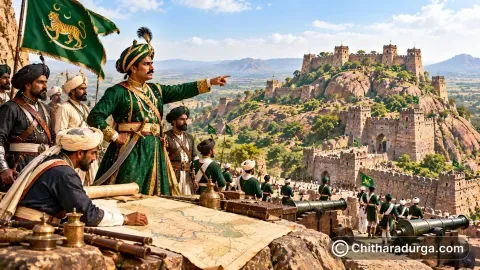
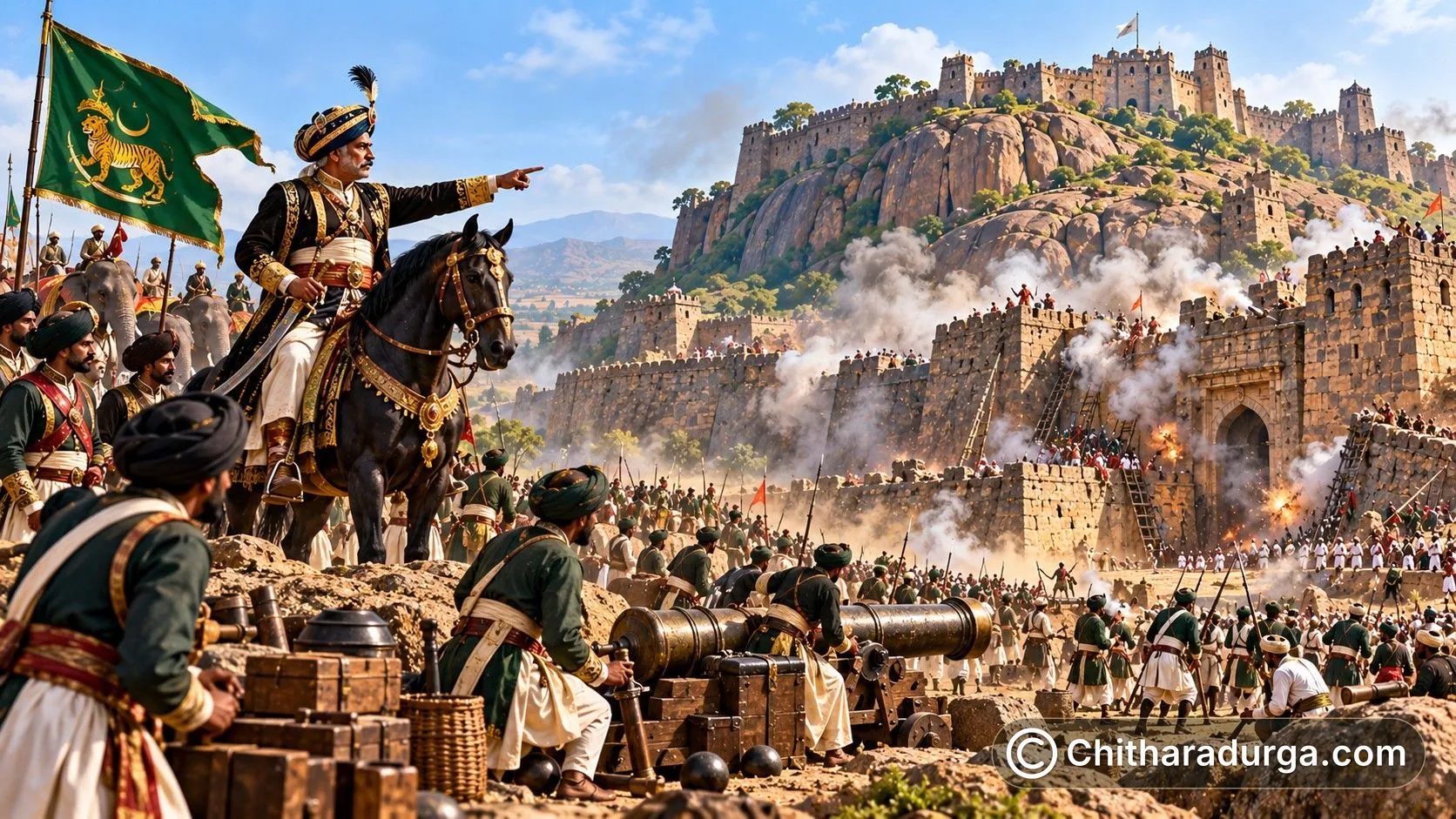
Despite earlier resistance, Hyder Ali launched another major campaign against Chitradurga in 1779.
By this time, Mysore possessed a large and increasingly organised military force. Chitradurga, although protected by its formidable fortifications, faced enormous pressure from Hyder Ali's army.
The campaign culminated in the fall of the fort and the defeat of Madakari Nayaka V.
With the capture of Chitradurga in 1779, more than two centuries of Nayaka rule came to an end.
Fate of Madakari Nayaka
After the fall of Chitradurga, Madakari Nayaka was taken into custody and removed from his former kingdom.
Historical accounts generally state that he was taken towards Srirangapatna, the political and military centre of Mysore.
His defeat marked not merely the fall of an individual ruler but the end of Chitradurga as an independent Nayaka principality.
The territory was subsequently incorporated into Hyder Ali's Mysore kingdom.
Chitradurga Fort under Mysore
After conquering Chitradurga, Hyder Ali recognised the military value of its extraordinary fortifications.
The fort continued to function as an important strategic centre under Mysore. Some defensive structures were strengthened or adapted according to the military requirements of the new administration.
After Hyder Ali's death in 1782, his son Tipu Sultan succeeded him. Chitradurga therefore remained part of the Mysore kingdom during Tipu Sultan's reign.
The fort that had once symbolised the independence and authority of the Nayakas now became part of Mysore's wider military network.
End of the Chitradurga Nayaka Dynasty
The fall of Chitradurga in 1779 marked the end of one of Karnataka's notable regional ruling houses.
The Chitradurga Nayakas had shaped the political, military and cultural identity of the region for generations. Their most visible legacy remains the magnificent Chitradurga Fort, but their influence can also be seen in temples, tanks, local traditions, folklore and the historical identity of the district.
Rulers such as Bharamanna Nayaka and Madakari Nayaka, together with legendary figures such as Onake Obavva, remain deeply associated with the history of Chitradurga.
A Turning Point in Chitradurga's History
The year 1779 therefore represents a major dividing line in the political history of Chitradurga.
Before 1779, Chitradurga was the centre of an independent Nayaka kingdom. After Hyder Ali's conquest, it became part of the expanding Mysore State. Following Hyder Ali's death, the region passed under Tipu Sultan, and after Tipu's fall in 1799 it became part of the restored Wodeyar kingdom of Mysore.
Thus, the capture of Chitradurga connected the district's history with the larger political struggles that transformed southern India during the late eighteenth century.
Historical Legacy
Hyder Ali's capture of Chitradurga was more than a military victory. It marked the end of the independent Chitradurga Nayaka dynasty and the beginning of a new political era under Mysore.
The event also brought together two powerful historical narratives: the expansion of Mysore under Hyder Ali and the final resistance of the Chitradurga Nayakas.
The fall of Chitradurga in 1779 ended the political sovereignty of the Nayakas, but it did not erase their legacy. The massive fort, the memory of Madakari Nayaka, the courage associated with Onake Obavva and the traditions of the Nayaka period continue to make Chitradurga one of Karnataka's most historically significant regions.