Chitradurga during the Mysore Wodeyars Period
Chitradurga during the Mysore Wodeyars Period
The history of Chitradurga during the Mysore Wodeyars period represents an important transition from the age of the Chitradurga Nayakas to a more centralised system of administration under the Mysore State. During the nineteenth and early twentieth centuries, Chitradurga gradually developed through changes in administration, agriculture, irrigation, education, transport and public institutions.
The region's relationship with Mysore, however, passed through several distinct phases. The rule of the Chitradurga Nayakas ended in 1779, when Hyder Ali captured Chitradurga. It subsequently remained under Mysore during the period of Hyder Ali and Tipu Sultan. After the fall of Tipu Sultan in 1799, the Wodeyar dynasty was restored to the Mysore throne, and Chitradurga became part of the reorganised Mysore State.
From the Nayakas to Mysore Rule
For centuries, Chitradurga had developed a distinctive political and military identity under its Nayaka rulers. The massive Chitradurga Fort became the principal symbol of this era.
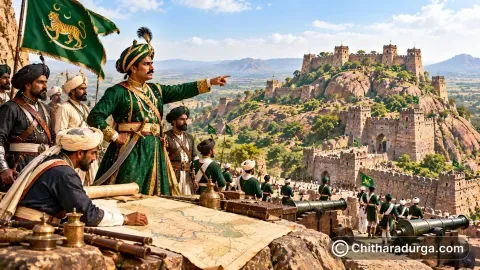
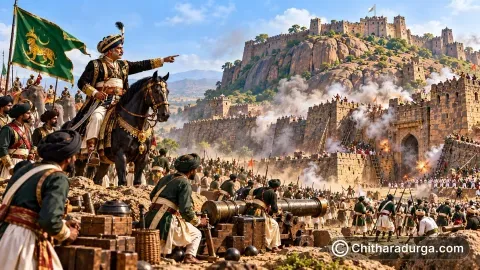
The independent rule of the Chitradurga Nayakas came to an end in 1779, when Hyder Ali of Mysore captured the fort during the reign of the last Nayaka ruler, Madakari Nayaka V.
Chitradurga thereafter came under Mysore. Following Hyder Ali's death, Tipu Sultan ruled Mysore until 1799.
The defeat and death of Tipu Sultan in the Fourth Anglo-Mysore War of 1799 resulted in a major political reorganisation. The Wodeyar dynasty was restored, and a reduced Mysore kingdom was established under British influence.
Chitradurga under the Restored Wodeyars
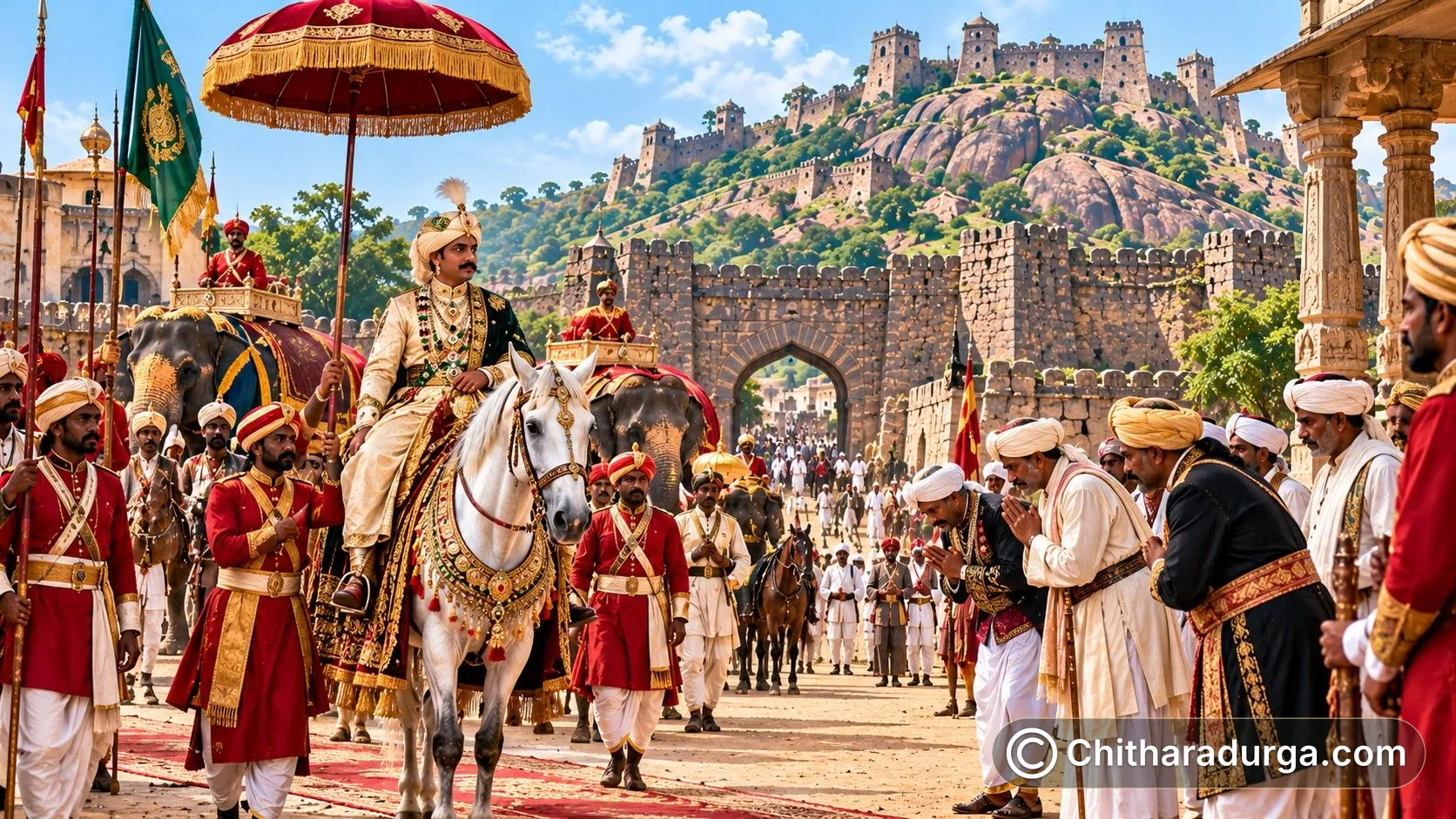
After 1799, Chitradurga formed part of the restored Mysore kingdom. The region gradually became integrated into the wider administrative framework of the state.
District and taluk-level administration became increasingly important. Revenue collection, village administration, maintenance of law and order and public works were gradually brought within a more organised administrative structure.
However, Wodeyar rule was interrupted by a significant period of direct British administration. From 1831 to 1881, Mysore was governed by British Commissioners.
In 1881, through an event known as the Rendition of Mysore, administration was restored to Maharaja Chamarajendra Wodeyar X. From then until Independence, Chitradurga remained part of the Princely State of Mysore under the Wodeyar rulers, while Mysore continued under British paramountcy.
Agriculture and Revenue
Agriculture was the main occupation of the people of Chitradurga. The district's semi-arid climate and irregular rainfall made farming challenging, and drought frequently affected rural life.
Millets, pulses, oilseeds, cotton and other dry-land crops formed an important part of the agricultural economy.
Land revenue remained an important source of government income. Surveying land, maintaining revenue records and organising tax collection became increasingly systematic under the Mysore administration.
Efforts were also made over time to improve tanks, water resources and irrigation facilities.
Vani Vilas Sagar and Irrigation Development
One of the most significant developments associated with the Mysore Wodeyar period in the Chitradurga region was the construction of Vani Vilas Sagar, also popularly known as Mari Kanive.
Built across the Vedavati River near Hiriyur, the reservoir was developed during the reign of Maharaja Krishnaraja Wodeyar IV and named after Maharani Kempananjammani Vani Vilasa Sannidhana.
The project became an important landmark in the history of irrigation and water management in the region. It supported agriculture and demonstrated the increasing importance given to large public works in Mysore State.
Roads and Transport
The Wodeyar period also witnessed gradual improvements in roads and transport.
Traditional bullock-cart routes remained important, especially in rural areas, but improved roads increasingly connected Chitradurga with neighbouring towns and commercial centres.
Road development helped farmers transport agricultural produce to markets and made travel between villages, taluk headquarters and district centres easier.
During the early twentieth century, motor vehicles gradually appeared, while railway connections in the wider region contributed to improved movement of passengers, goods and mail.
Education
Education expanded gradually during the later Wodeyar period.
Primary schools were established in more towns and villages, while formal curricula, examinations and administrative supervision became increasingly common. Kannada remained important in local education, while English education gained significance for higher studies and government employment.
Opportunities for girls' education also gradually increased, although access remained limited in many rural communities.
Schools, teachers, writers and social organisations contributed to the growth of literacy and social awareness in the district.
Public Health and Civic Administration
The expansion of modern administration also brought gradual improvements in public health and civic services.
Municipal institutions and local administrative bodies became increasingly important in larger settlements. Attention was given to sanitation, drinking water, roads, public buildings and basic health facilities.
Hospitals, dispensaries and public-health measures developed gradually, although rural access remained limited.
Social and Political Awareness
The later Wodeyar period witnessed growing social and political awareness across Mysore State, and Chitradurga was part of these developments.
Education, newspapers, public associations and nationalist ideas encouraged greater discussion about social reform, representative institutions and responsible government.
Gandhian principles such as Satyagraha, Ahimsa, Swadeshi, Khadi and rural upliftment influenced activists in the district.
Leaders such as S. Nijalingappa, along with numerous local activists, teachers, students, women and villagers, became associated with movements for political rights and India's freedom.
Chitradurga towards Independence
By the first half of the twentieth century, Chitradurga had changed considerably from the region that had entered Mysore rule after the fall of the Nayakas.
Traditional agriculture and village society continued to dominate everyday life, but modern administrative departments, schools, improved roads, irrigation projects, municipal institutions and new forms of political participation had gradually emerged.
When British paramountcy ended in 1947, the Princely State of Mysore acceded to the Indian Union. Chitradurga subsequently continued as part of Mysore State and later became part of the modern state of Karnataka.
Legacy of the Wodeyar Period
The Wodeyar era occupies an important place in Chitradurga's transition from a historic Nayaka stronghold to a district within a modern administrative state.
The period witnessed the gradual expansion of organised administration, irrigation, education, roads, public works, civic institutions and social awareness. At the same time, Chitradurga retained its distinctive cultural identity and the historical memory of its Nayaka rulers.
From the fortified capital of the Nayakas to an important district of the Mysore State, Chitradurga's history during the Wodeyar period reflects a long transition in governance, infrastructure, education and public life that helped shape the district's development in modern Karnataka.