Sri Pailwan Nanjappa – The Wrestling Legend of Chitradurga
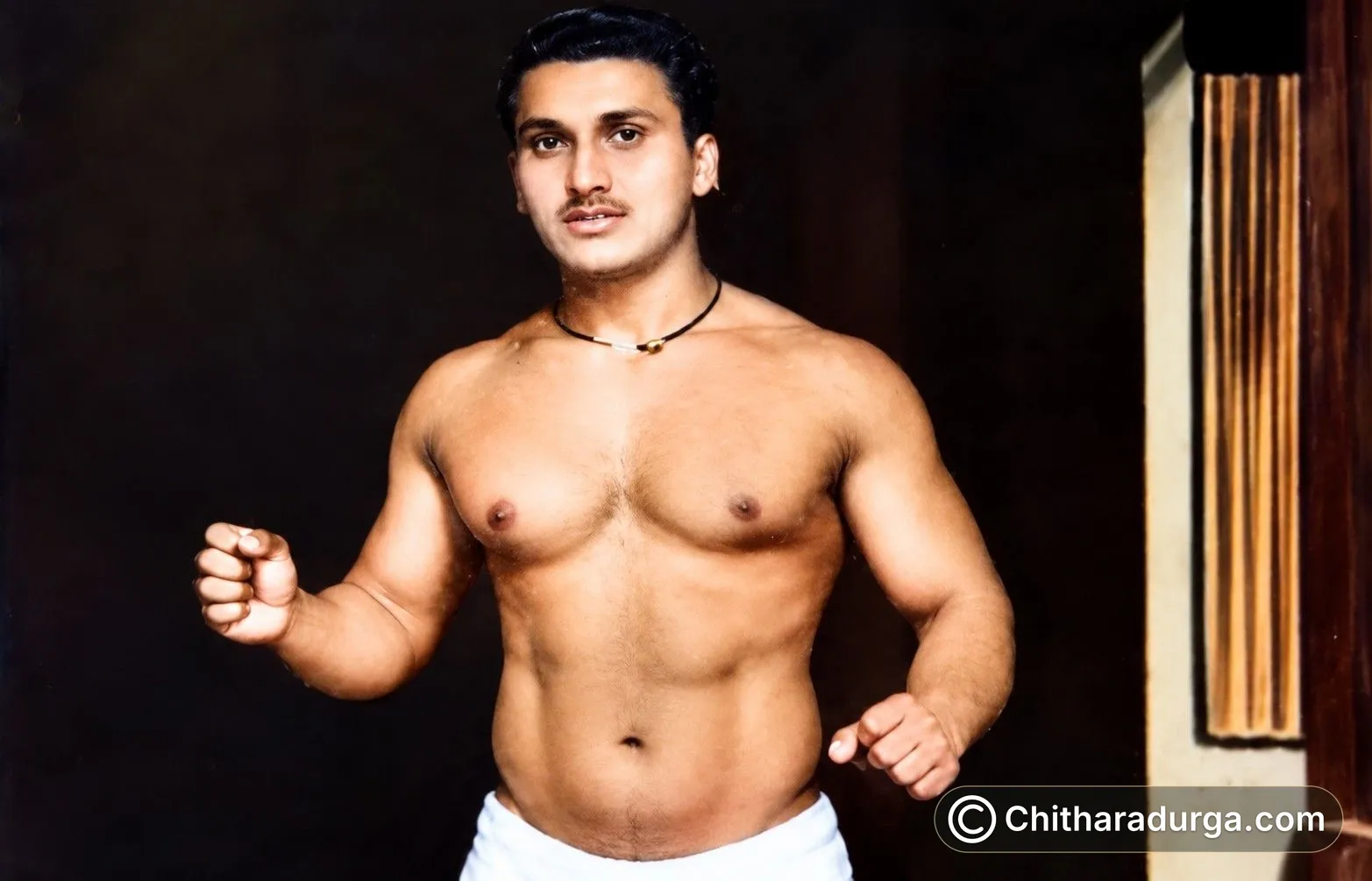
A Wrestler, Patriot and Cultural Personality of the Land of Valour
When one thinks of Chitradurga, its magnificent fort, Chandravalli, Jogimatti, ancient monasteries and heroic history immediately come to mind. But another important part of Chitradurga's cultural identity is its centuries-old tradition of Garadi Manes — traditional wrestling schools or akhadas.
Among the great personalities who emerged from this wrestling tradition, Pailwan Nanjappa holds a special place. A powerful wrestler, wrestling master, patriot, freedom movement participant, tabla enthusiast and cultural personality, Nanjappa became one of the most memorable sporting figures of twentieth-century Chitradurga.
Even decades after his death, his name continues to evoke pride among Chitradurga's wrestling enthusiasts.
Chitradurga – A Land of Wrestling Tradition
Known as “Gandu Mettida Nadu” — the Land of Valour, Chitradurga has a long association with physical courage and martial traditions.
The wrestling heritage of the region can be traced back several centuries. During the Vijayanagara period, traditional wrestling and physical training flourished in this region. Historical traditions also associate a cave among Chitradurga's rocky landscape with a Garadi belonging to Gopenayakaiah.
The tradition continued during the rule of the Nayakas of Chitradurga. Wrestlers and martial practitioners known as Jattis are said to have trained the rulers and warriors in wrestling and physical combat.
Over generations, Garadi Manes became centres not merely for wrestling but also for discipline, physical fitness, courage and community life.
Among Chitradurga's well-known traditional wrestling centres were Dodda Garadi, Sanna Garadi, Burujanahatti Garadi, Hagalu Deevatige Garadi, Anjaneya Swamy Garadi and the Anjuman Garadi of Horapete.
Religious institutions of Chitradurga also encouraged wrestling. The famous Jayadeva Jangi Kusti competitions held in earlier decades reflected the popularity that traditional wrestling once enjoyed in the region.
It was from this vibrant wrestling culture that Pailwan Nanjappa emerged.
Birth and Early Life
Pailwan Nanjappa was born on 9 August 1924, the third son of Ladara Eshwarappa and Nanjamma.
His family belonged to the Ladaru community, whose roots were associated with northern India.
Formal education did not attract young Nanjappa as much as physical training did. From an early age, he developed an extraordinary fascination for wrestling.
The Garadi became his classroom, physical discipline became his education, and wrestling became the passion that would eventually define his life.
Training at Dodda Garadi
Nanjappa became closely associated with Dodda Garadi, one of Chitradurga's celebrated traditional wrestling schools, and later became its Ustad.
He initially learned the finer techniques of wrestling under Buddanna. His abilities were subsequently refined under the guidance of Ustad Paripaigar, who had come from Lahore.
Under such rigorous training, Nanjappa developed into an accomplished wrestler.
The relationship between Nanjappa and Ustad Paripaigar was significant beyond sport. Their close bond between disciple and teacher also came to represent the spirit of Hindu-Muslim harmony and mutual respect.
A Star of Chitradurga's Wrestling Arena
Pailwan Nanjappa's physical strength, courage, wrestling technique and commanding personality earned him enormous admiration.
At a time when wrestling bouts were important public events, a successful Pailwan was more than an athlete. He represented the honour of his Garadi, his teachers and his hometown.
Nanjappa became one such symbol for Chitradurga.
His name became so deeply connected with the wrestling culture of the district that, for an earlier generation of Chitradurga residents, the very mention of Kusti could immediately bring Pailwan Nanjappa to mind.
He trained and inspired other wrestlers as well. Among the better-known wrestlers associated with his tradition was his disciple Gowligara Linganna, popularly known as Muga.
Nanjappa the Patriot
Nanjappa's courage was not limited to the wrestling arena.
Following Indian independence in 1947, political movements were taking place demanding the integration and democratisation of princely states. The Mysore Chalo movement had an impact in Chitradurga as well.
Nanjappa and members of Dodda Garadi actively participated in the agitation.
In a courageous act, Nanjappa participated in hoisting the Indian Tricolour on a government office. The confrontation resulted in police action, including a lathi charge and firing. Nanjappa narrowly escaped the bullets.
The incident is remembered as an important episode in Chitradurga's political history and demonstrates that the strength he displayed in the wrestling arena was matched by his patriotism and willingness to confront danger.
Tabla, Theatre and the Cultural World
There was another fascinating side to Pailwan Nanjappa.
Behind the powerful physique of the wrestler was a man who deeply loved music and theatre.
Nanjappa was particularly fond of the tabla and performed as an amateur tabla player in association with drama companies. His musical ability reportedly earned appreciation from prominent theatre personalities, including Hirannaiah.
He was also connected with Chitradurga's lively theatre culture.
The Nava Bharata Taruna Kalavidara Sangha of Doddapete, largely unfamiliar to today's generation, was part of this cultural environment. Plays based on Chitradurga's heroic history, including “Raja Veera Madakari Nayaka,” reflected the close relationship between local history, theatre and popular culture.
Nanjappa moved naturally within this world of wrestlers, musicians and theatre artists.
Association with Kannada Cinema
His connections with drama companies also brought Nanjappa into contact with personalities from the Kannada film world.
He developed an acquaintance with Kannada cinema icon Dr. Rajkumar.
Nanjappa eventually appeared as a guest actor in the historical Kannada film “Ranadheera Kanteerava,” fittingly portraying a Pailwan.
Thus, the real-life wrestler of Chitradurga briefly entered the world of cinema while retaining the very identity that had made him famous.
A Multifaceted Personality
Nanjappa cannot be remembered merely through the number of wrestling matches he fought or won.
He represented a generation in which the Garadi was a school of character.
He was a wrestler, Ustad, patriot, tabla player, theatre enthusiast and cultural personality. His life connected several worlds that formed the cultural fabric of old Chitradurga — wrestling grounds, Garadi Manes, nationalist movements, theatre stages and popular entertainment.
A Tragic End
Unfortunately, the final chapter of this remarkable life was tragic.
Alcohol addiction affected Nanjappa's health and life during his later years. He died in 1965, at only about 41 years of age.
One touching story associated with his death concerns his beloved dog. The animal was deeply attached to its master. According to the recollection preserved about Nanjappa, within days of his death, his faithful dog too died near Nanjappa's grave.
The story remains a poignant reminder of the affection and loyalty that surrounded the legendary wrestler.
Memorial and Living Legacy
Chitradurga has not completely forgotten its Pailwan.
A memorial to Nanjappa was erected near Kaman Bagilu, beside Maharani College, in recognition of his contribution to wrestling.
His association with Dodda Garadi is also remembered during traditional celebrations. During Noola Hunnime, a large portrait of Pailwan Nanjappa is carried in procession, symbolically bringing the legendary wrestler back into the cultural life of Chitradurga.
Writer T. R. Radhakrishna has documented his life and the wider wrestling culture surrounding him in the work “Kusti Lokada Dhruvataare Pailwan Nanjappa” — Pailwan Nanjappa, the Pole Star of the Wrestling World.
Through the story of Nanjappa, the work also preserves memories of Chitradurga's Garadi culture, wrestling patrons, masters, wrestlers, theatre traditions and a cultural world that is rapidly disappearing from public memory.
Pride of Chitradurga
Pailwan Nanjappa belonged to an era when wrestling was not merely a sport. It represented physical strength, discipline, honour, courage and community pride.
His story is therefore also the story of Chitradurga's traditional Garadi culture.
The wrestler who trained at Dodda Garadi became a symbol of courage in the arena; the patriot who raised the Tricolour stood fearlessly before authority; the tabla player found joy in music; and the cultural enthusiast connected the world of wrestling with theatre and cinema.
Conclusion
Pailwan Nanjappa remains one of the brightest stars in the wrestling history of Chitradurga.
His life had glory as well as tragedy, achievement as well as struggle. Yet his courage, patriotism, wrestling prowess and cultural interests ensured that his name survived long after his lifetime.
For today's generation, remembering Pailwan Nanjappa is not merely about remembering an individual wrestler. It is about preserving the memory of Chitradurga's Garadi Manes, its traditional wrestling culture and the men who carried forward its reputation as a true Land of Valour.
Pailwan Nanjappa was not merely a wrestler of Chitradurga — he became a symbol of its strength, courage and sporting heritage.