Smt. Siriyajji – The Living Encyclopedia of Chitradurga’s Folk Heritage
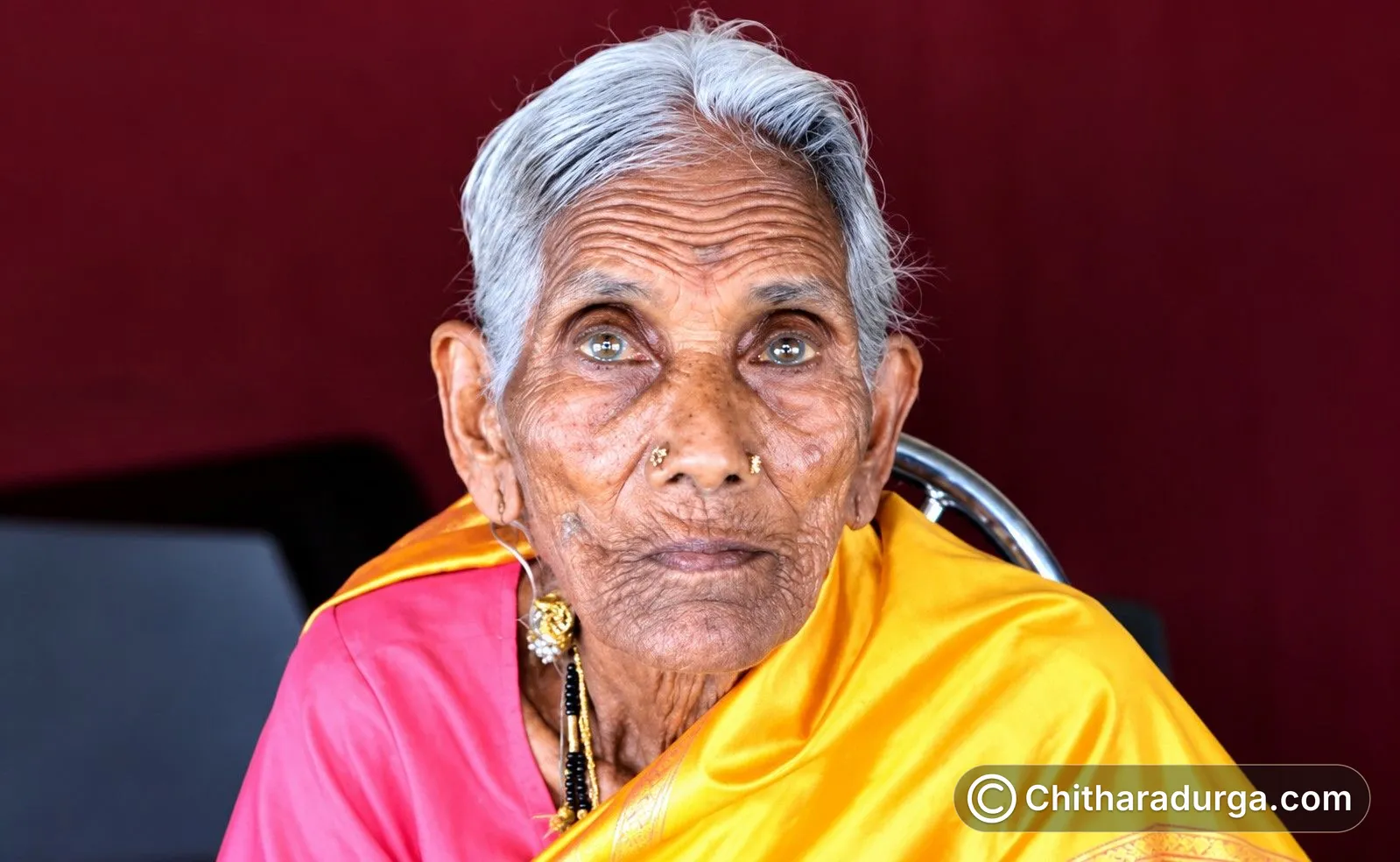
The extraordinary voice that preserved thousands of songs without ever writing them down
The cultural history of Chitradurga district is not confined to its magnificent fort, heroic rulers, temples and monuments. Its villages and hamlets have preserved an equally precious heritage through oral traditions — folk songs, legends, epics, rituals, beliefs and customs passed from one generation to another.
Among the greatest custodians of this oral heritage was Smt. Siriyajji, popularly remembered as Janapada Siri, the treasure of Karnataka folklore.
Born into the Kadugolla community of Yalagatte Gollarahatti in Challakere Taluk of Chitradurga district, Siriyajji never received formal education. Yet she possessed something that astonished scholars and folklore researchers — an extraordinary memory capable of preserving thousands of folk songs, narrative poems and oral epics.
She became known as a “Walking Encyclopedia of Folklore.”
Early Life
Siriyajji was born to Eerappa and Kadamma in Yalagatte Gollarahatti.
She grew up in an environment where folk literature was not written in books but lived in everyday life. Women sang while working in the fields, grinding grain and performing household chores. Songs accompanied weddings, festivals, religious observances and community celebrations.
Siriyajji listened carefully to the songs sung by her mother and grandmother and preserved them in her memory.
Without notebooks, manuscripts or formal musical training, she became the custodian of an enormous oral archive.
The Folk Culture of the Kadugollas
The Kadugolla community has preserved distinctive customs, beliefs, deities, rituals and oral traditions.
For Siriyajji, therefore, folk music was not merely entertainment. It was part of life itself.
Marriage ceremonies had their songs. Agricultural work had its songs. Festivals had their songs. Gods and cultural heroes had their own narratives. Joy, grief, devotion, family relationships and social experiences all found expression through oral poetry.
Siriyajji became one of the greatest voices through whom this cultural world survived.
A Treasure House of Thousands of Songs
Siriyajji's greatest gift was her phenomenal memory.
She was widely celebrated as the custodian of thousands of folk verses and songs, with popular accounts describing her repertoire as extending to around ten thousand songs or verses.
She could sing continuously from memory, recalling long narrative sequences without relying on written texts.
This remarkable ability earned her descriptions such as Janapada Siri, Janapada Kanaja, Janapada Kogile and a Walking Encyclopedia of Folk Culture.
Her songs included wedding songs, devotional songs, ritual compositions and long narrative ballads.
Among the narrative songs associated with her repertoire, “Mahasati Katavva” and “Kattale Daari Doora” became particularly well known.
Belagere Krishnashastri and the Recognition of Siriyajji
An important figure in bringing Siriyajji's extraordinary talent to wider attention was noted writer and cultural personality Belagere Krishnashastri.
His encouragement helped introduce the vast oral treasure carried by Siriyajji to scholars, writers and cultural audiences beyond her immediate community.
What had survived for generations through memory and oral transmission began attracting serious attention as an invaluable part of Kannada folk literature.
Siriyajji gradually became not merely a village singer but an important representative of Karnataka's oral literary tradition.
Scholars Came to Listen
One of the remarkable aspects of Siriyajji's life was the attention she attracted from the scholarly and literary world.
Her extraordinary command over oral narratives made her an important source for those interested in folklore, language, anthropology and Kannada culture.
For scholars, listening to Siriyajji was like entering a library that had never been written down.
Her memory demonstrated how a community could preserve history, beliefs, relationships and cultural knowledge for generations without depending on printed literature.
Songs Rooted in Life
Siriyajji's songs cannot be separated from the soil that produced them.
They carried the vocabulary, rhythms, emotions and worldview of rural Chitradurga and the Kadugolla community.
The songs expressed marriage customs, relationships between family members, devotion to local deities, women's experiences, agricultural life, hardship, celebration and community memory.
This is precisely what gives oral literature its historical importance: it records aspects of ordinary people's lives that formal histories often overlook.
More Than a Singer
Calling Siriyajji simply a folk singer would therefore be inadequate.
She was a carrier of collective memory.
Before recording technology became easily available in rural society, people such as Siriyajji themselves functioned as archives.
Every song she remembered was a page.
Every epic she sang was a book.
And her memory itself was a library.
Her contribution demonstrates the vital role rural women have played in preserving Kannada's oral heritage.
Recognition and Honours
As recognition of her extraordinary contribution grew, Siriyajji received several honours from cultural organisations, institutions and the State.
Former Karnataka Chief Minister R. Gundu Rao honoured her with the title “Janapada Siri.”
She was also honoured with the prestigious Nadoja recognition by Kannada University, Hampi, and received recognition from the Karnataka Janapada Academy.
Numerous cultural organisations, folk festivals, religious institutions and literary bodies honoured her contribution.
Yet perhaps her greatest honour was the affection with which ordinary people continued to call her “Siriyajji” — their beloved grandmother of folklore.
Siriyajji and the Next Generation
A tradition survives only when it is passed on.
Siriyajji's influence continued through other folk singers of the region. Among those associated with this continuing tradition is Siriyamma of Yalagatte Kadugolla Hatti, who sang alongside Siriyajji at numerous programmes and carried forward songs and epics associated with Kadugolla culture.
Siriyamma became known for singing Sobane, Kolu, Gaggara and other traditional songs as well as epics associated with cultural heroes such as Eththappa, Junjappa and Kyathappa.
By teaching younger women, this later generation has helped ensure that the songs preserved by Siriyajji do not disappear with the elders who knew them.
Thus Siriyajji's legacy is not merely a memory — it is a continuing cultural tradition.
Final Years
Siriyajji continued to be remembered for her songs and remarkable memory into old age.
She passed away in April 2009 at Yalagatte Gollarahatti, bringing to an end the life of one of Karnataka's extraordinary custodians of oral folklore.
But the voice did not disappear with the singer.
Her songs, the memories of those who heard her, the work of folklore scholars and the singers who followed her continue to preserve her cultural inheritance.
Chitradurga's True “Janapada Siri”
Chitradurga has produced warriors, rulers, writers, saints and artists. Siriyajji occupies a very different but equally important place among them.
She did not build a fort.
She did not write books.
She did not receive formal schooling.
Yet she preserved something that could easily have disappeared forever — the collective voice of generations.
The songs she carried contained the joys, sorrows, gods, customs, relationships and experiences of an entire community.
Conclusion
Smt. Siriyajji was not merely a folk singer; she was an oral archive of Karnataka's cultural memory.
An elderly rural woman who could neither read nor write became a source of knowledge for writers, researchers and scholars.
Her life reminds us that literature does not exist only in books.
Sometimes literature lives in memory.
Sometimes history survives as a song.
And sometimes an entire cultural library lives in the voice of one remarkable woman.
For Chitradurga, that remarkable woman was Siriyajji — the true Janapada Siri of the land.