The Gandhian Movement in Chitradurga District
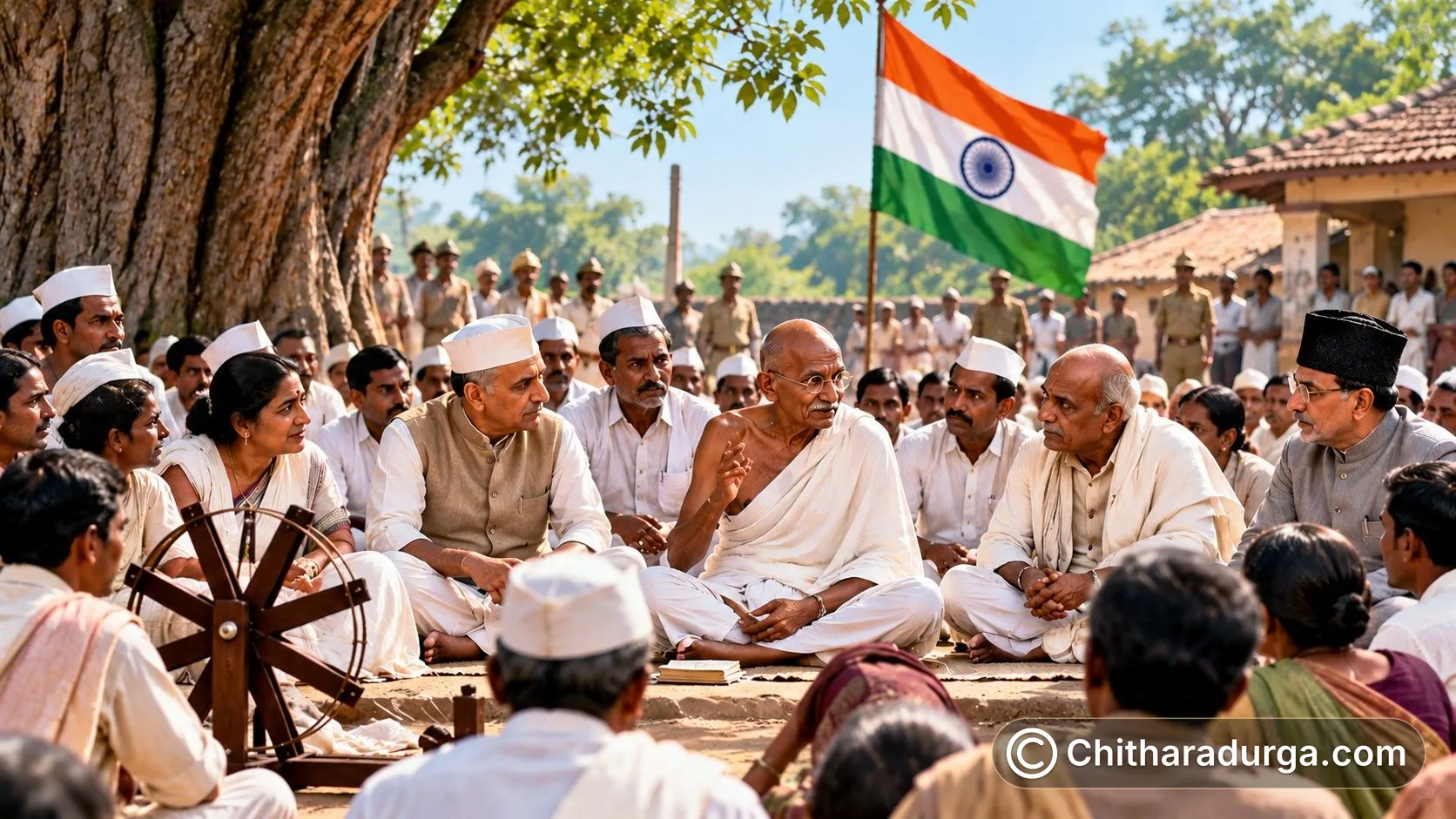
The Gandhian Movement in Chitradurga District
The Gandhian Movement in Chitradurga district occupies an important place in the region’s modern history. During India’s freedom struggle, Mahatma Gandhi’s principles of Satyagraha, Ahimsa, Swadeshi, Khadi, prohibition, social equality, simplicity and village upliftment inspired political workers, teachers, students, women and ordinary villagers across the region.
Chitradurga, historically remembered as a land of warriors and resistance, witnessed a different form of struggle during the Gandhian era — one based on non-violence, civil resistance, self-discipline, constructive social work and mass participation.
Spread of Gandhian Ideals
As Mahatma Gandhi transformed India's freedom struggle into a mass movement, his ideas gradually reached the towns and villages of the princely State of Mysore. Chitradurga was also influenced by this growing national consciousness.
Khadi and Swadeshi became symbols of self-reliance and patriotism. Prohibition, the campaign against untouchability, village development, education and the idea of Swaraj helped take Gandhian thought beyond political meetings and into the everyday lives of ordinary people.
Gandhian thought found committed followers in the Chitradurga region. Personalities such as S. Nijalingappa, Siddavanahalli Krishna Sharma, Belagere Krishna Shastri and several other local activists, teachers and social workers represented different dimensions of this Gandhian tradition.
Turuvanur — A Centre of Gandhian Activism
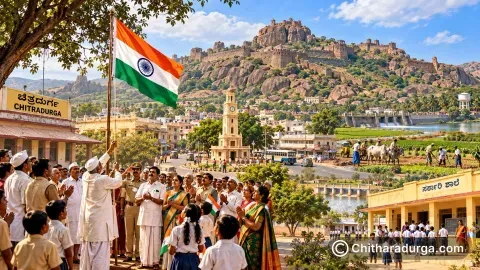
One of the most significant places associated with Gandhian activism in Chitradurga district was Turuvanur.
The village became known for an anti-liquor agitation associated with the cutting of toddy-producing palm trees. Inspired by Gandhi's campaign for prohibition, local people challenged the production and consumption of intoxicating liquor.
S. Nijalingappa, who later became one of Karnataka's prominent political leaders, played an important role in this agitation. Women also participated, and noted freedom fighter Bellary Siddamma was associated with the movement.
Such campaigns were important because they transformed Gandhi's principles into practical action at the village level. Prohibition was not viewed merely as a political issue, but also as part of Gandhi's programme for moral, social and economic reform.
S. Nijalingappa and Gandhian Leadership
Siddavanahalli Nijalingappa was one of the important political personalities associated with Gandhian nationalism in the Chitradurga region.
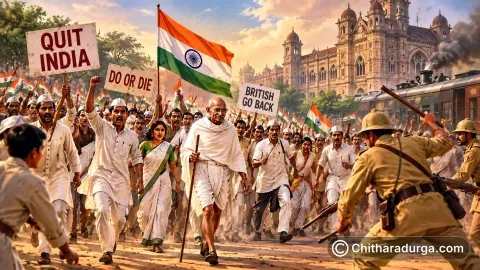
He participated in movements connected with representative government in the princely State of Mysore and became involved in the Turuvanur agitation. He later participated in the Quit India Movement of 1942 and suffered imprisonment.
His public life illustrates how Gandhian activism in Chitradurga connected the national struggle for independence with demands for responsible government, political participation and social reform.
Siddavanahalli Krishna Sharma and Gandhian Thought
Another significant figure associated with Chitradurga's Gandhian tradition was Siddavanahalli Krishna Sharma, a writer, nationalist, social worker and educationist.
His association with Gandhi's ashram environment influenced his intellectual and social outlook. Through his writings and public activities, he helped communicate Gandhian ideas to Kannada readers.
His work “Wardha Yatre”, published in 1939, recorded his experiences and observations connected with Gandhi's ashram life. Through literature, education and social service, Krishna Sharma demonstrated that the Gandhian movement was not limited to political protest; it was also a movement for transforming individuals and society.
Belagere Krishna Shastri — A Life Shaped by Gandhian Ideals
An important name in Chitradurga's Gandhian heritage is Belagere Krishna Shastri (1916–2013) of Belagere village in Challakere taluk. He became widely known as a Kannada writer, teacher, social worker and committed Gandhian. Contemporary accounts remember him for his simple way of life and his dedication to education and rural society.
Krishna Shastri encountered the spirit of the freedom movement while still a student. Accounts of his life state that when Mahatma Gandhi visited Mysore in 1936, Krishna Shastri served as a volunteer. His life was subsequently shaped by Gandhian values such as simplicity, service, self-discipline and concern for rural communities.
He worked for many years as a teacher and contributed to the development of schools with the participation of villagers. In Belagere, he was associated with the Shree Sharada Mandira Educational Institution and devoted himself to education and social service. His work demonstrated a particularly important aspect of Gandhian philosophy: nation-building through education, village service and individual character, rather than through politics alone.
Krishna Shastri was also influenced by figures such as Mahatma Gandhi and Vinoba Bhave. He later participated actively in Vinoba Bhave's Bhoodan Movement, which sought voluntary donations of land for redistribution to the landless.
His importance to Chitradurga's Gandhian history therefore extends beyond the years of the freedom struggle. He belonged to a generation that attempted to carry Gandhian principles into post-Independence society through teaching, rural education, literature, simplicity and social service.
Women in the Gandhian Movement
Women also made significant contributions to Gandhian activities associated with the Chitradurga region.
Bellary Siddamma, a noted freedom fighter, promoted spinning, weaving and Khadi and participated in campaigns against alcohol. She was associated with the Turuvanur agitation and later participated in the Quit India Movement.
The participation of women broadened the social character of the freedom struggle. Through Khadi, prohibition campaigns, public mobilisation, assistance to freedom fighters and constructive social work, women became active participants in the Gandhian national movement.
Gandhian Education and the Younger Generation
Gandhian ideals also influenced the younger generation of Chitradurga.
Karnamadakal Sreenivasa Radhakrishna, born at Siddavanahalli in Chitradurga district, grew up in a Gandhian family and was influenced by the idea of Swaraj. As a young man, he accompanied his maternal uncle Siddavanahalli Krishna Sharma to Sevagram Ashram in 1939, where he studied and worked in the environment of Gandhi's Nai Talim, or Basic Education. He later participated in the Quit India Movement and was imprisoned in 1942.
His life demonstrates how Gandhian principles of education, manual work, service, simplicity and patriotism influenced young people from the Chitradurga region.
Gandhi and the Wider Chitradurga Region
Gandhi's influence in the region was strengthened through his travels and the activities of his followers throughout the Mysore State.
The Gandhian message reached Chitradurga not merely as a national political programme but as a programme for changing village society. Khadi, prohibition, education, social equality, sanitation, dignity of labour and rural reconstruction became important components of the movement.
This explains why the Gandhian legacy of Chitradurga cannot be understood only through political protests. It must also be seen through the lives of teachers, writers, social workers and village activists who attempted to put Gandhi's principles into practice.
From Armed Valour to Non-Violent Resistance
The Gandhian period represents a fascinating transition in Chitradurga's history.
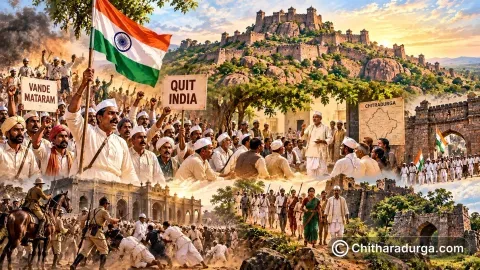
Centuries earlier, the district had become famous for the military resistance and courage associated with the Nayaka rulers, Madakari Nayaka and Onake Obavva. During the twentieth century, the region's tradition of courage found another form.
The weapons of this new struggle were Satyagraha, Ahimsa, Khadi, non-cooperation, prohibition, social reform, education and constructive village work.
Thus, the Gandhian movement added a new dimension to Chitradurga's long-standing identity as a land of courage and resistance.
Gandhian Legacy after Independence
The influence of Gandhi did not end with Independence in 1947.
Figures such as Belagere Krishna Shastri are especially important in understanding this continuity. While the freedom struggle had achieved political independence, Gandhi's broader vision of rural development, education, social responsibility and simple living remained unfinished tasks.
Krishna Shastri continued working in education and social service in rural Chitradurga for decades after Independence. His life became an example of how Gandhian ideals could continue through schools, literature, village development and service to society. His contributions were later recognised with honours including the Karnataka Rajyotsava Award in 2004.
Legacy of the Gandhian Movement in Chitradurga
The Gandhian Movement in Chitradurga was therefore much more than a political campaign against colonial rule. It represented a social and moral awakening based on freedom, self-reliance, equality, education, village development and non-violence.
The political leadership of S. Nijalingappa, the literary and intellectual contribution of Siddavanahalli Krishna Sharma, the activism of Bellary Siddamma, the educational and social service of Belagere Krishna Shastri, and the involvement of younger Gandhians such as K. S. Radhakrishna reveal the different ways in which Gandhian thought took root in the district.
From Turuvanur's anti-liquor movement to Belagere's educational and social initiatives, Gandhian philosophy found expression not only in protests but also in everyday acts of service and social transformation.
The Gandhian era gave Chitradurga a new language of courage — replacing the sword with Satyagraha, violence with Ahimsa, dependence with self-reliance, social division with service, and colonial submission with the dream of Swaraj.