Chitradurga District at the Time of Indian Independence
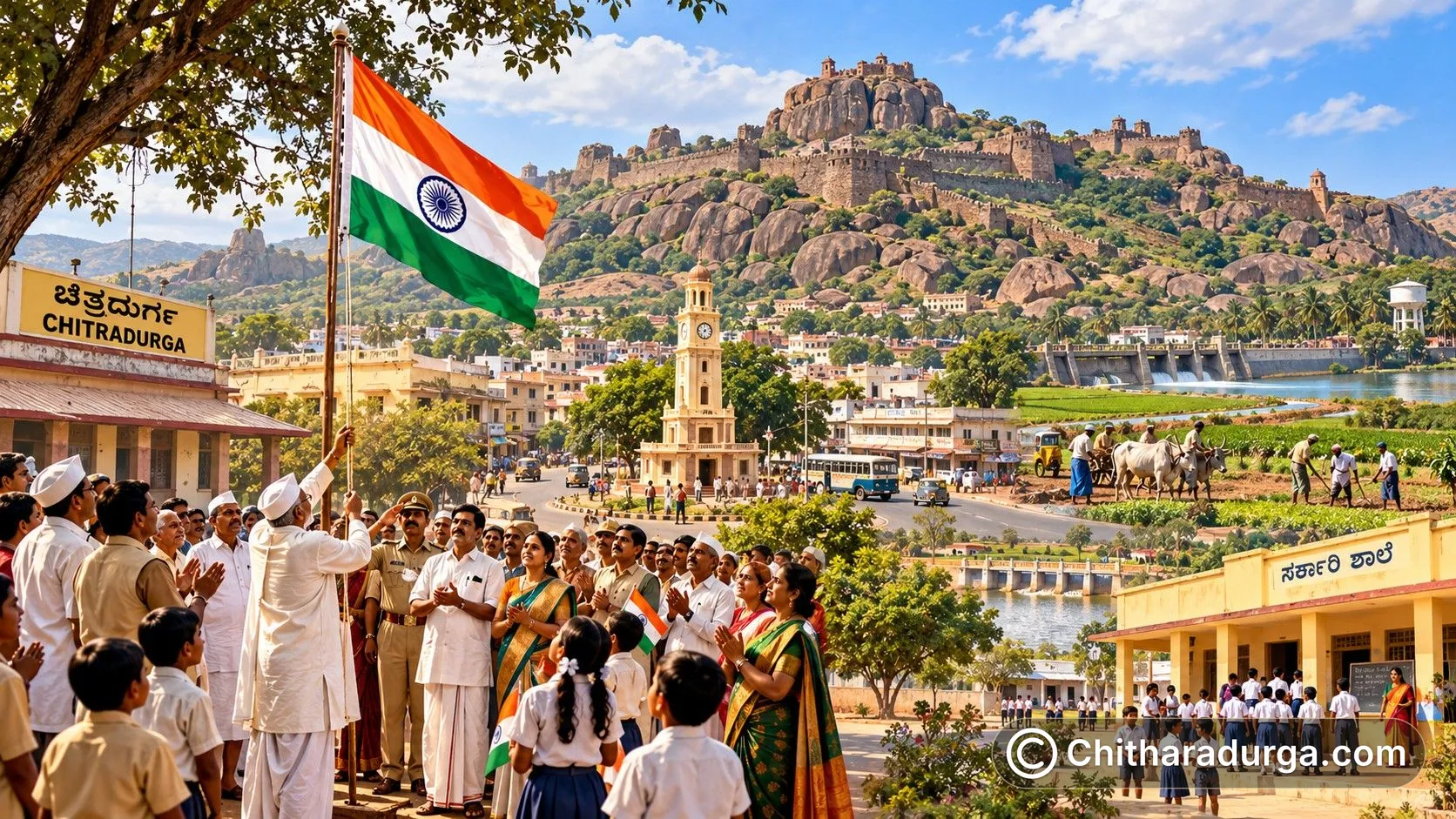
Chitradurga District at the Time of Indian Independence
When India attained independence on 15 August 1947, the Chitradurga region stood at an important point of transition. A land known for its formidable fort, Nayaka rulers, warrior traditions and historic resistance, Chitradurga was entering a new democratic era after centuries of changing political rule.
From Mysore State to Independent India
At the time of Independence, Chitradurga was part of the princely State of Mysore. Mysore acceded to the Indian Union in 1947, and Chitradurga consequently became part of independent India. The region's administration gradually changed from the structures of princely rule to the representative institutions of the new Indian democracy.
The district then had a predominantly rural and agriculture-based economy. Most people depended upon farming, livestock and traditional occupations. The semi-arid climate and uncertain rainfall made agriculture challenging, and tanks, wells and reservoirs were extremely important to rural life.
Chitradurga and the Freedom Movement
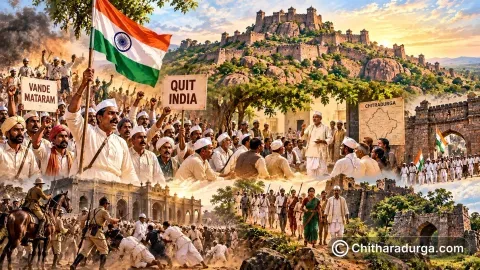
Although Chitradurga is most famous for the earlier resistance associated with the Nayaka rulers and Chitradurga Fort, the district also participated in the broader Indian national movement during the twentieth century.
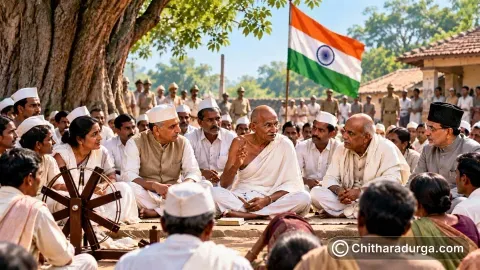
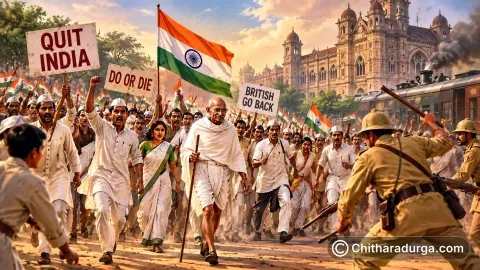
The ideals of Mahatma Gandhi and the Indian National Congress reached towns and villages across the Mysore region. Nationalist activities, public meetings, the promotion of khadi, campaigns against colonial rule and participation in movements such as the Quit India Movement of 1942 helped spread the spirit of freedom among the people.
Students, teachers, local leaders, farmers and ordinary citizens were influenced by the growing demand for Swaraj — self-rule. Alongside the all-India freedom struggle, movements seeking greater responsible and representative government within the princely State of Mysore also shaped political awareness in the region.
Society and Life Around 1947
Chitradurga at Independence was very different from the district seen today. Urban centres were relatively small, transportation and communication facilities were limited, and most villages had only basic access to education, healthcare and public services.
Agriculture formed the backbone of society. Traditional markets, weekly fairs, temples, maths, village institutions and community networks played an important role in everyday life. Kannada was the principal language of the region, while its diverse communities contributed their own customs, occupations, folklore and cultural traditions.
A New Beginning
Independence brought new expectations to Chitradurga. The years following 1947 witnessed the gradual expansion of democratic local administration, schools, healthcare, roads, irrigation, electricity and agricultural development.
A major administrative transformation came with the reorganisation of Indian states in 1956, when the enlarged Mysore State brought together major Kannada-speaking regions. The state was later renamed Karnataka in 1973.
For Chitradurga, therefore, 15 August 1947 represented more than the end of British paramountcy. It marked the beginning of a new chapter in which an ancient land of forts, warriors, farmers and folk traditions became part of the world's largest democratic experiment.
Legacy
The story of Chitradurga at Independence connects two important strands of its history: its celebrated heritage of courage and resistance, and its transition into modern democratic Karnataka. From the stone walls of Chitradurga Fort to the villages and towns that participated in the changing political life of the twentieth century, the district carried its historic identity into a new age of freedom.
Chitradurga at Independence was thus a meeting point of history and hope — a land with a proud past stepping forward into a free India.