Chitradurga in India's Freedom Struggle
Chitradurga in India's Freedom Struggle
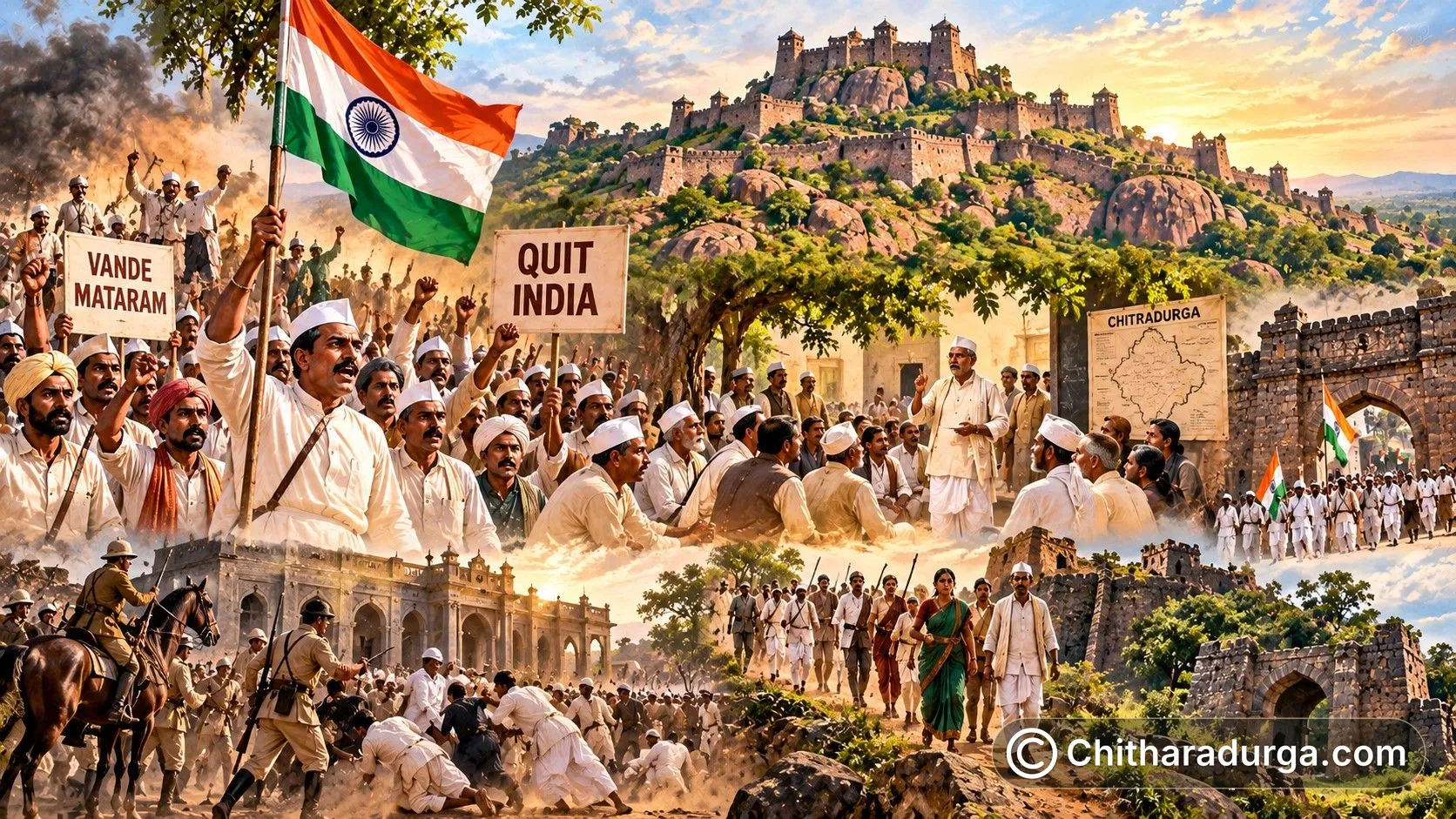
Chitradurga, historically celebrated as a land of courage, sacrifice and resistance, played a meaningful role in India’s freedom struggle. The district that had once witnessed the valour of the Nayaka rulers and legendary figures such as Onake Obavva later became a centre of Gandhian activism, Satyagraha, social reform and nationalist awakening during the twentieth century.
The freedom movement in Chitradurga was not confined to prominent political leaders. Villagers, women, students, teachers, writers and social workers participated in different phases of the national movement and helped carry the message of Swaraj into rural society.
Rise of National Consciousness
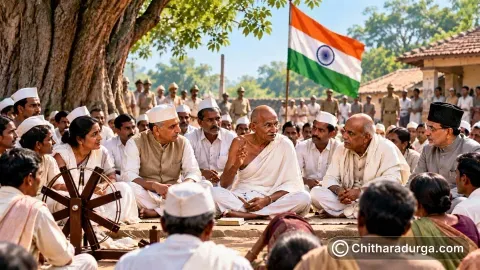
As the Indian National Movement expanded under the leadership of Mahatma Gandhi, ideas such as Satyagraha, Ahimsa, Swadeshi, Khadi, prohibition and civil disobedience reached the towns and villages of the princely State of Mysore.
Chitradurga became part of this growing political awakening. Nationalist workers encouraged people to wear Khadi, support Swadeshi, oppose social inequalities and participate in movements demanding greater political rights and responsible government.
The struggle for independence in this region therefore developed alongside movements for social reform, rural awakening and democratic participation.
Turuvanur — A Centre of Resistance
Among the places associated with Chitradurga’s freedom movement, Turuvanur occupies a particularly important position.
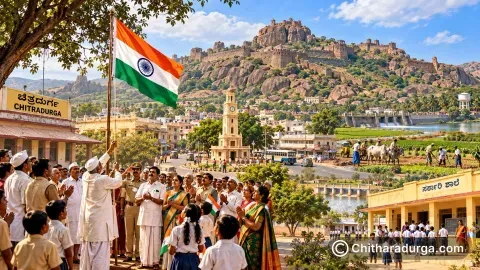
In 1939, a significant Satyagraha was launched there under the leadership of S. Nijalingappa. Villagers participated in cutting toddy-producing palm trees as part of an anti-liquor and Forest Satyagraha campaign. Historical accounts record participation by dozens of villagers, including women.
When the authorities imposed additional taxation following the agitation, villagers resisted payment. The struggle therefore developed into a broader expression of civil disobedience.
The movement attracted attention beyond Chitradurga. Gandhi’s close associate Mahadev Desai later visited Turuvanur and expressed support for the villagers’ struggle.
Turuvanur thus became an important symbol of grassroots participation in the freedom movement.
S. Nijalingappa and the Freedom Movement
Siddavanahalli Nijalingappa emerged as one of the important leaders associated with Chitradurga during the freedom struggle.
As president of the Chitradurga District Congress Committee, he participated in the movement demanding responsible government in the princely State of Mysore. His involvement in the 1939 Satyagraha at Turuvanur resulted in his arrest and imprisonment.
Nijalingappa later joined the Quit India Movement of 1942 and was arrested again. His political journey connected the local struggles of Chitradurga with the wider national movement for independence.
Women in the Freedom Struggle
Women also played an important role in spreading nationalist consciousness in the Chitradurga region.
Bellary Siddamma, one of Karnataka’s notable women freedom fighters, travelled through rural areas, encouraged women to participate in nationalist activities and promoted Khadi, spinning, weaving and prohibition.
She participated in the toddy-tree campaign at Turuvanur under the leadership of S. Nijalingappa. During the Quit India Movement, she also assisted underground freedom fighters.
Her contribution illustrates how the national movement created opportunities for women to participate directly in political and social action.
Writers, Teachers and Young Gandhians
Chitradurga’s contribution to the freedom movement was not limited to demonstrations and arrests. Literature, education and Gandhian social work also became important instruments of national awakening.
Siddavanahalli Krishna Sharma, a writer and committed Gandhian, helped spread Gandhi’s philosophy among Kannada readers. His work Wardha Yatre, based on his experiences at Gandhi’s Wardha Ashram, introduced readers to Gandhian life, simplicity and national ideals.
Young people were also drawn into the struggle. Karnamadakal Sreenivasa Radhakrishna, born at Siddavanahalli, spent time at Sevagram and was influenced by Gandhi’s educational philosophy. As a student, he participated in the Quit India Movement and was imprisoned in 1942.
Such examples demonstrate that Chitradurga’s freedom movement was also a movement of ideas, education and social transformation.
Chitradurga and the Quit India Movement
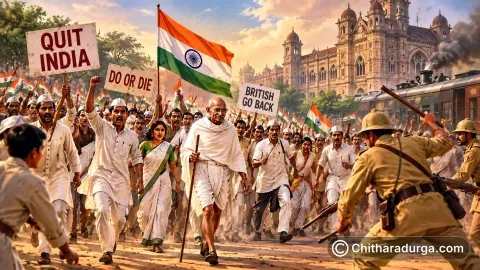
The Quit India Movement of 1942 gave new momentum to the struggle for independence throughout India.
Its impact was also felt in Chitradurga. Political activists who had participated in earlier Satyagrahas became involved in the movement, while students, women and local supporters contributed in different ways.
S. Nijalingappa was arrested for his participation. Bellary Siddamma supported underground activists, while young Sreenivasa Radhakrishna joined the movement during his student years.
The Quit India Movement strengthened the connection between Chitradurga’s local political struggles and the nationwide demand for the end of British rule.
From the Sword to Satyagraha
Chitradurga’s role in the freedom movement represents an interesting continuity in the district’s history.
During the era of the Nayakas, resistance was symbolised by forts, warriors and the sword. During the freedom struggle, resistance increasingly took the form of Satyagraha, Khadi, civil disobedience, imprisonment, social reform and non-violent protest.
The methods had changed, but the willingness to resist injustice remained.
This transformation gave Chitradurga’s traditional identity as a land of courage a new meaning in the age of India’s national movement.
A People's Movement
One of the most important aspects of Chitradurga’s freedom struggle was the participation of ordinary people.
Many individuals who joined demonstrations, village campaigns, Satyagrahas and nationalist activities never became nationally famous. Some provided shelter, food, information or organisational support to activists. Others promoted Khadi, joined prohibition campaigns or carried nationalist ideas into rural communities.
The history of Chitradurga’s freedom struggle must therefore be understood not only through famous leaders but also through the collective contribution of numerous ordinary citizens whose names are less widely remembered.
Legacy
Chitradurga’s contribution to India’s freedom struggle was a continuation of the region’s long tradition of courage, but expressed through the new ideals of Swaraj, Satyagraha, Ahimsa and democratic participation.
The struggles at Turuvanur, the leadership of S. Nijalingappa, the activism of Bellary Siddamma, the intellectual contribution of Siddavanahalli Krishna Sharma, the participation of young Gandhians and the sacrifices of numerous lesser-known activists together form an important chapter in the district’s modern history.
When India attained independence in 1947, the people of Chitradurga shared in a freedom achieved through decades of political struggle, imprisonment, sacrifice, social awakening and collective action.
From the heroic resistance of its earlier centuries to the Satyagrahas of the freedom movement, Chitradurga carried forward its tradition of courage — replacing the sword with non-violence and transforming resistance into a collective quest for Swaraj and a free India.