Freedom Fighters of Chitradurga District
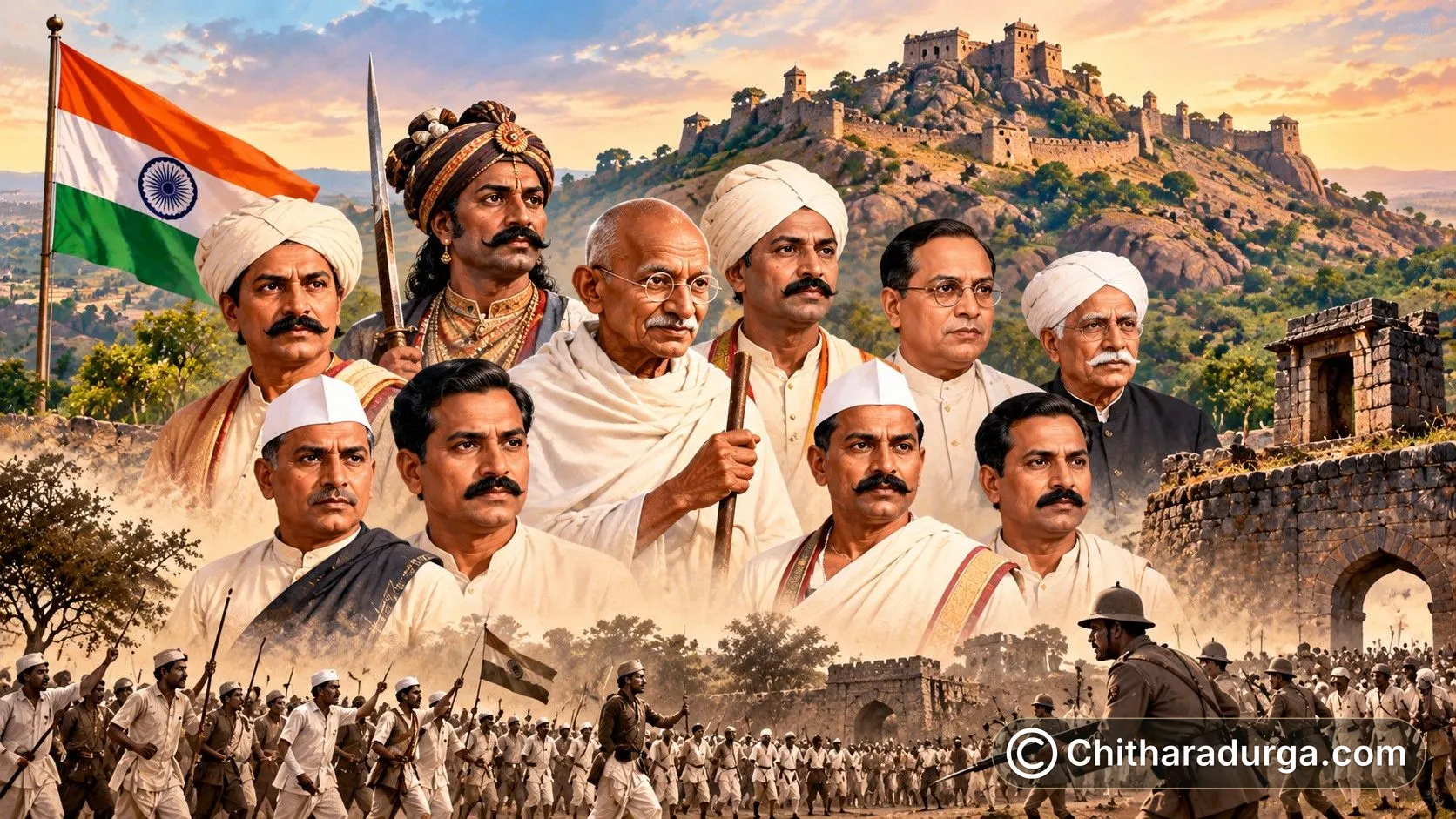
Freedom Fighters of Chitradurga District
Chitradurga is widely remembered as the land of courage and resistance. Centuries before India's modern freedom movement, the region had witnessed the valour of the Nayaka rulers and legendary figures such as Onake Obavva. During the twentieth century, this tradition of resistance took a new form as people of Chitradurga joined the national struggle against colonial rule.
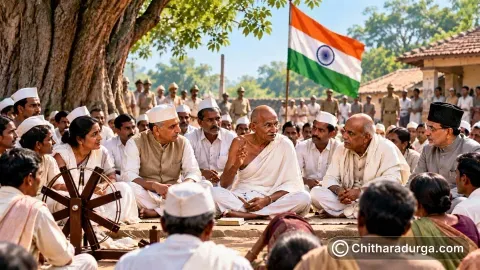
The freedom movement in Chitradurga was shaped largely by Gandhian ideals, Satyagraha, Khadi, prohibition, civil disobedience, demands for responsible government and the Quit India Movement. Political leaders, teachers, writers, students, women, villagers and ordinary workers all contributed in different ways.
Among the names closely associated with this history are S. Nijalingappa, Siddavanahalli Krishna Sharma, Bellary Siddamma, Karnamadakal Sreenivasa Radhakrishna, A. Bhimappa Naik, and numerous lesser-known village-level activists whose contributions deserve remembrance. Historical research also points to participation by members of marginalised communities whose role has often remained outside mainstream accounts.
S. Nijalingappa — A Leading Freedom Fighter
Siddavanahalli Nijalingappa was one of the most prominent political leaders associated with the freedom movement in the Chitradurga region.
Influenced by nationalist thought and later by Mahatma Gandhi, Nijalingappa joined the Congress at a young age. He became an important leader in the movement for representative and responsible government in the princely State of Mysore.
He played a leading role in the Turuvanur agitation, associated with the campaign against liquor and the cutting of toddy-producing trees. He was arrested and sentenced to imprisonment. After his release, he participated in the Quit India Movement and was arrested again.
After Independence, Nijalingappa continued in public life and played a major role in the unification of Kannada-speaking regions.
Turuvanur — A Village of Freedom Fighters
The history of Chitradurga's freedom struggle cannot be told without mentioning Turuvanur.
Inspired by Gandhi's call for prohibition, villagers participated in the famous Eachalu Marada Chaluvali, or Toddy Palm Tree Movement. Men and women joined together in cutting toddy-producing palms, challenging a source of liquor production and government revenue.
When additional taxation was imposed following the agitation, villagers resisted payment, linking their local struggle with the broader tradition of civil disobedience and no-tax campaigns. Mahatma Gandhi's secretary Mahadev Desai also visited Turuvanur and supported the agitation.
The importance of Turuvanur lies not merely in one or two famous leaders. The village demonstrated how ordinary rural people could become participants in India's national movement.
Bellary Siddamma — Courageous Woman Freedom Fighter
Bellary Siddamma occupies an important place among the women freedom fighters connected with Chitradurga's struggle.
She participated in nationalist activities, promoted Khadi, spinning and weaving, campaigned against alcohol and encouraged women to participate in public life.
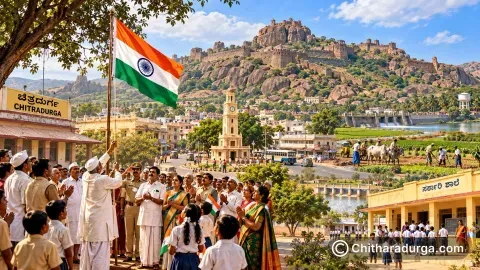
At the historic Shivapura Flag Satyagraha, Siddamma unfurled the national flag and was arrested. She later participated in the toddy-tree campaign at Turuvanur under the leadership of S. Nijalingappa.
During the Quit India Movement of 1942, she assisted underground freedom fighters while under police surveillance. Her contribution was later recognised by the Government of India with a Tamra Patra.
Her story illustrates the significant role played by women in taking the freedom struggle into villages and households.
Siddavanahalli Krishna Sharma — Writer and Gandhian
Siddavanahalli Krishna Sharma, born in Chitradurga district in 1904, was a nationalist writer and an ardent follower of Mahatma Gandhi.
His contribution to the freedom movement was closely connected with Gandhian thought, literature, education and social awakening.
Krishna Sharma spent time at Gandhi's Wardha Ashram and recorded his experiences in his Kannada work “Wardha Yatre”, written in 1939. The book presented the daily life of Gandhi's ashram and Gandhi's ideals to Kannada readers.
Through his writing, Krishna Sharma helped carry the message of Gandhi beyond political meetings and into the intellectual and cultural life of Karnataka.
Karnamadakal Sreenivasa Radhakrishna — A Young Gandhian Freedom Fighter
Another important figure was Karnamadakal Sreenivasa Radhakrishna, born in Siddavanahalli in Chitradurga district in 1924.
Raised in a Gandhian family, he was influenced by the call for Swaraj from an early age. In 1939, while still young, he accompanied Siddavanahalli Krishna Sharma to Sevagram Ashram, where he studied and worked in Gandhi's Nai Talim educational environment.
As a student, Radhakrishna participated in the Quit India Movement and was imprisoned at Banaras in 1942. His life demonstrates how the freedom movement inspired even young people from rural Chitradurga to participate directly in the national struggle.
A. Bhimappa Naik — Freedom Fighter and Public Leader
A. Bhimappa Naik was another notable freedom fighter associated with Chitradurga.
Accounts of his public life describe him as having been involved in the freedom movement from the mid-1930s. He served in the Mysore representative assembly and later continued his public service after Independence.
Following Independence, he became closely associated with the development of modern Chitradurga, including civic administration and public infrastructure. He later represented Molakalmuru in the legislature and served in the government headed by S. Nijalingappa.
His career represents an important transition experienced by many freedom fighters — from resistance against colonial and princely restrictions to institution-building in independent India.
The Lesser-Known Freedom Fighters
Chitradurga's freedom struggle was not created by prominent leaders alone.
Recent historical research into the Chitradurga–Davanagere region has highlighted the participation of lesser-known activists from socially and economically marginalised communities. Individuals identified in such research include A. K. Yarappa, T. Marappa, Congress Rangappa, Hanumanthappa, A. K. Thimmappa, Shivalli Siddappa, B. Shyamappa, Mannappa, Dodda Siddavanahalli Aatada Pennayya and M. Kenchappa, among others.
Their activities included participation in the Forest Satyagraha, Quit India Movement, Congress campaigns, processions, public mobilisation, communication and logistical support. Because many grassroots contributions were poorly documented, the complete story of their participation is still being recovered by researchers.
These lesser-known participants remind us that India's freedom was achieved not only through nationally famous personalities but also through the collective efforts of thousands of ordinary citizens.
The Role of Women, Students and Villagers
One of the most important features of Chitradurga's freedom movement was its grassroots character.
Women participated in Khadi programmes, prohibition campaigns and nationalist mobilisation. Students carried the message of Swaraj to a younger generation. Teachers and writers promoted national consciousness, while villagers joined Satyagrahas, public demonstrations and campaigns against government policies.
The Turuvanur movement is particularly significant because large numbers of ordinary villagers, including women, participated in direct action. Historical accounts describe the village as an important centre of freedom-struggle activity in Chitradurga.
Gandhian Influence on Chitradurga
Mahatma Gandhi's influence transformed the character of political resistance in Chitradurga.
The district historically celebrated military courage, but during the twentieth century a new form of courage emerged — non-violent resistance.
Satyagraha, Khadi, prohibition, civil disobedience, refusal to cooperate with unjust policies, social reform and constructive village work became instruments of struggle.
The leadership of S. Nijalingappa, the writings of Siddavanahalli Krishna Sharma, the activism of Bellary Siddamma and the participation of young Gandhians such as Sreenivasa Radhakrishna illustrate the different forms this Gandhian influence took in the district.
Chitradurga and the Quit India Movement
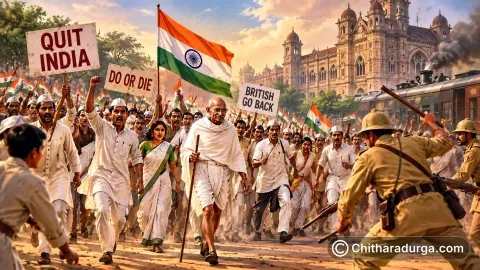
The Quit India Movement of 1942 marked another important stage in the district's nationalist history.
After Gandhi's call for the British to leave India, activists associated with the Chitradurga region intensified their participation. Nijalingappa joined the movement after his earlier imprisonment and was arrested again. Bellary Siddamma supported underground activists, while young Sreenivasa Radhakrishna participated in the movement as a student and was imprisoned in Banaras.
The movement helped connect local struggles in Chitradurga with the final nationwide phase of India's struggle for independence.
From a Land of Warriors to a Land of Satyagrahis
There is a remarkable continuity in the history of Chitradurga.
During the era of the Nayakas, courage was expressed through the defence of forts and kingdoms. In the twentieth century, courage appeared in another form — Satyagraha, imprisonment, sacrifice, social service and peaceful resistance.
The sword had given way to Khadi and Satyagraha, but the underlying spirit of resistance remained.
Political leaders went to prison. Women challenged authority. Students abandoned the safety of ordinary life to join national movements. Writers spread nationalist ideas. Villagers resisted policies they considered unjust, while numerous unnamed activists provided food, shelter, communication and organisational support.
Legacy of Chitradurga's Freedom Fighters
The freedom fighters of Chitradurga contributed not only to the struggle to end colonial domination but also to the growth of political consciousness, social reform, education, village organisation and democratic participation.
Some later became prominent political leaders. Others returned quietly to their villages, professions and families. Many grassroots activists received little recognition, and some names survive mainly through local memory and later historical research. Scholarship on undivided Chitradurga consequently emphasises that the region's freedom struggle was broader than the stories of its best-known leaders.
Their collective contribution forms an important part of Chitradurga's modern identity.
The freedom struggle of Chitradurga was not the story of one leader, one village or one movement. It was the collective story of leaders and ordinary people, men and women, teachers and students, writers and villagers who transformed the district's ancient tradition of courage into a modern struggle for Swaraj and a free India.