Administration of Chitradurga during the British Period
Administration of Chitradurga during the British Period
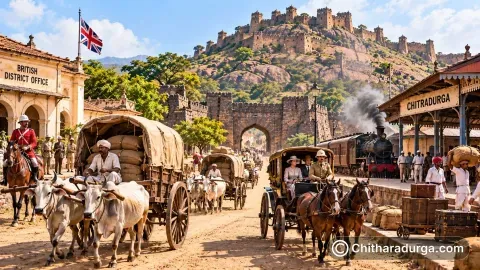
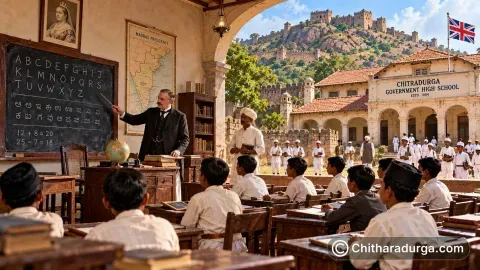
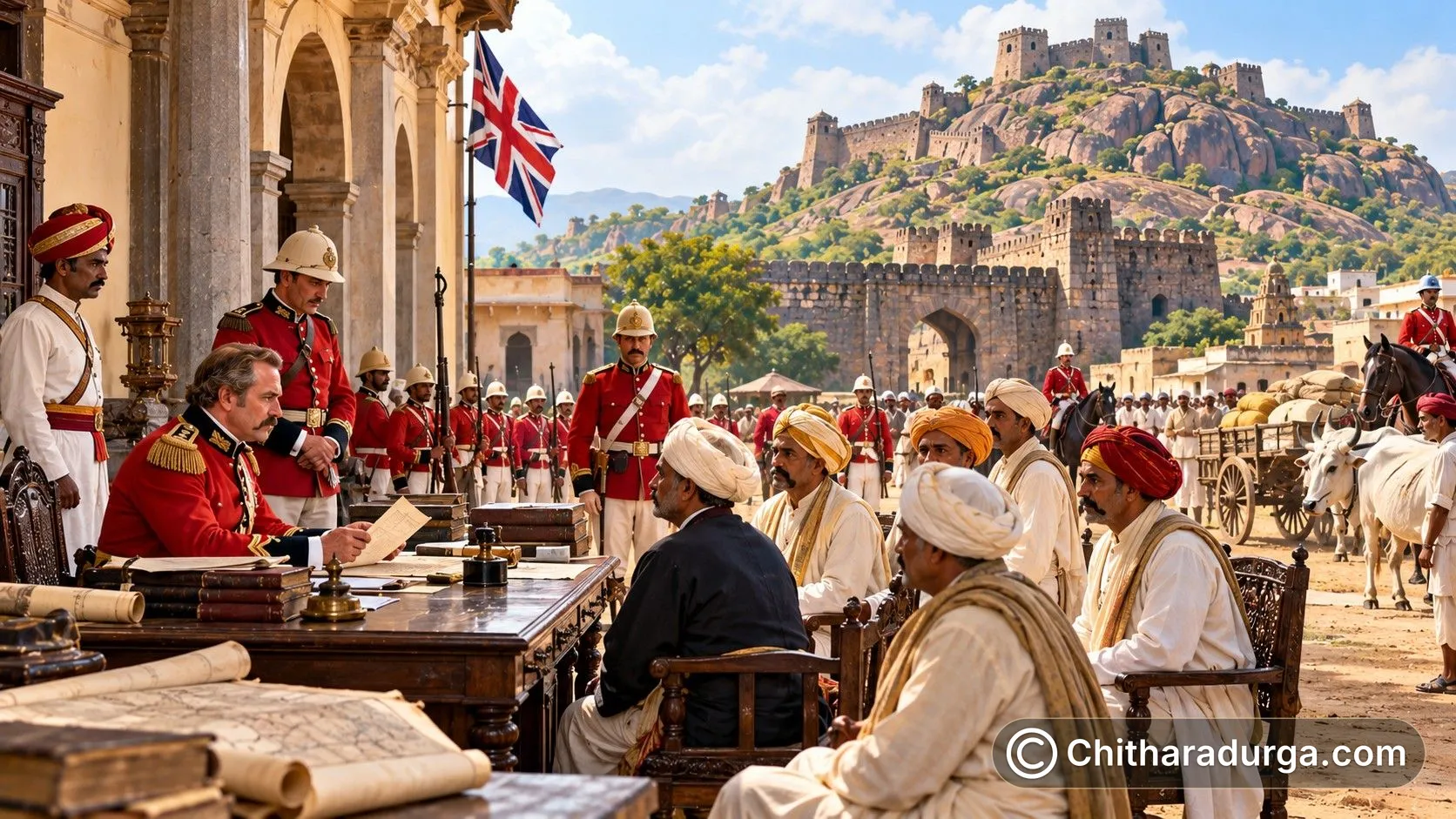
The British period brought major changes to the political and administrative structure of Chitradurga. After the fall of the Chitradurga Nayakas in the eighteenth century, the region passed through the control of Hyder Ali and Tipu Sultan of Mysore before coming under British authority following the Fourth Anglo-Mysore War in 1799.
Chitradurga’s experience under British rule, however, needs to be understood in two phases: a period of direct British administration of Mysore from 1831 to 1881, followed by administration under the restored Princely State of Mysore, which remained under British paramountcy until Indian Independence.
From the Nayakas to Mysore Rule
The independent rule of the Chitradurga Nayakas ended in 1779, when Hyder Ali captured Chitradurga. The region subsequently became part of the Mysore kingdom and remained under the control of Hyder Ali and later Tipu Sultan.
After Tipu Sultan was defeated and killed in the Fourth Anglo-Mysore War in 1799, the British East India Company restored the Wadiyar dynasty in Mysore. Chitradurga consequently became part of the reorganised Mysore State.
Although Mysore had its own ruler, the British exercised considerable political influence over the state.
Direct British Administration
In 1831, the British took over the administration of Mysore, citing problems in governance. From then until 1881, Mysore was administered through British Commissioners.
During this period, Chitradurga came within a more centralised administrative system. British-style methods were introduced in revenue collection, policing, judicial administration, record keeping and district governance.
The administration increasingly depended on officials responsible for revenue, law and order and implementation of government policies. Taluks and villages formed important units in the local administrative structure.
Land revenue remained a major source of government income, and systematic surveys, assessment of agricultural land and maintenance of revenue records became increasingly important.
District and Taluk Administration
Under the administrative system that developed in Mysore, Chitradurga functioned as an important district centre.
The district administration coordinated revenue collection, maintenance of law and order, judicial functions and implementation of government regulations. Below the district level, taluks became important administrative divisions, with local officials responsible for revenue and other government duties.
At the village level, traditional functionaries continued to play a role, although they increasingly worked within a more formal and centralised administrative structure.
This combination of older local institutions and modern bureaucratic practices gradually shaped the administrative system of the district.
Revenue and Agriculture
Agriculture formed the economic foundation of Chitradurga during the nineteenth and early twentieth centuries. Consequently, land revenue administration was one of the government's most important responsibilities.
Land was surveyed, classified and assessed for taxation. Revenue records became increasingly systematic, allowing the administration to document agricultural holdings and determine the taxes payable by cultivators.
For a predominantly dry and drought-prone district such as Chitradurga, variations in rainfall had a major impact on agricultural production and rural life. Periods of drought and scarcity therefore presented serious challenges to the administration.
Roads, Irrigation and Public Works
The British administrative period also witnessed gradual improvements in public infrastructure.
Roads connecting Chitradurga with other important towns were developed and improved to facilitate administration, trade and movement. Public works increasingly included the maintenance of roads, government buildings, tanks and irrigation facilities.
Later, under the Mysore administration, irrigation and water-management projects became increasingly important. The development of Vani Vilas Sagar across the Vedavati River near Hiriyur became one of the most significant irrigation achievements associated with the district.
Police and Judicial Administration
The nineteenth century also brought changes to policing and judicial administration.
Instead of relying primarily on older local systems of maintaining order and settling disputes, a more organised system of police stations, courts and administrative officials gradually developed.
Civil and criminal matters increasingly came under formally organised judicial procedures. These reforms formed part of the wider transformation of Mysore into a bureaucratically administered state.
The Rendition of 1881
A major turning point came in 1881, when direct British administration of Mysore ended.
Through an event known as the Rendition of Mysore, administrative authority was restored to Maharaja Chamarajendra Wadiyar X. Chitradurga thereafter formed part of the Princely State of Mysore under the Wadiyar government.
However, Mysore remained under British paramountcy, meaning that the British continued to exercise influence over important political and external matters.
Thus, from 1881 until Independence, Chitradurga was not directly governed as an ordinary province of British India. It was administered as part of the Princely State of Mysore.
Administration under the Princely State of Mysore
During the late nineteenth and early twentieth centuries, Mysore developed a reputation for organised administration and public works.
These developments also affected Chitradurga. Government departments dealing with revenue, education, agriculture, public works, health, irrigation and local administration gradually expanded.
Municipal and local administrative institutions developed in towns, while district and taluk authorities continued to manage government functions in rural areas.
Education, transportation, irrigation and public health gradually became more prominent areas of administration alongside the traditional responsibilities of revenue collection and law and order.
Growth of Political Awareness
By the early twentieth century, administrative reforms and the spread of education contributed to increasing political awareness in Chitradurga.
People began demanding greater participation in government and more representative institutions. Nationalist and Gandhian ideas also reached the district, eventually giving rise to political movements involving leaders, students, women and villagers.
Figures such as S. Nijalingappa emerged from this political environment and participated in movements demanding responsible government in Mysore as well as in the wider Indian freedom struggle.
End of the British Era
When India became independent in 1947, British paramountcy over the princely states came to an end. Mysore acceded to the Indian Union, and Chitradurga entered a new phase of administration within independent India.
The British period had significantly transformed Chitradurga's administrative structure. Traditional systems inherited from earlier rulers gradually gave way to more formal arrangements based on district administration, taluks, revenue records, courts, police, public works and specialised government departments.
The period therefore represents an important transition in Chitradurga's history — from the political order of the Nayakas and Mysore rulers to a structured modern administrative system that eventually became part of democratic Karnataka.