Sri Bichchugatthi Bharamanna Nayaka - “Samara Marthanda”
Among the celebrated Palegars of Chitradurga, Bichchugatthi Bharamanna Nayaka occupies a commanding place. Remembered for his courage on the battlefield, political determination, administrative ability and remarkable programme of construction, he was one of the rulers who greatly strengthened Chitradurga during the Nayaka period.
His reign, broadly associated with 1689–1721, was marked by warfare as well as development. He defended his territory against powerful adversaries, strengthened forts, developed water resources, established settlements and supported temples, monasteries and other public institutions.
For his extraordinary military valour, Bharamanna Nayaka is remembered with the honourable description “Samara Marthanda” — the radiant hero of the battlefield.
Chitradurga in a Period of Political Turmoil
Bharamanna Nayaka emerged during a turbulent chapter in Chitradurga's history.
Following the killing of Linganna Nayaka, the powerful Dalavayi Muddanna rose to dominance. Although Suryakanthirangappa Nayaka was nominally placed on the throne, Muddanna exercised effective authority and is remembered in the traditional narrative as controlling the affairs of Chitradurga from behind the throne.
This situation created political instability within the Nayaka state.
It was against this background that Bharamanna Nayaka emerged as a decisive figure.
The struggle against Muddanna became one of the dramatic episodes associated with Bharamanna's rise. By overcoming Muddanna and freeing Chitradurga from his control, Bharamanna Nayaka opened a new chapter in the history of the principality.
The Killing of Muddanna
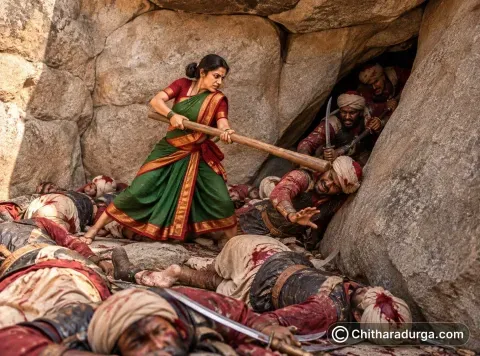
One of the defining episodes in Bharamanna Nayaka's story is his confrontation with Dalavayi Muddanna.
Muddanna is portrayed as courageous and formidable, but also as a master of intrigue and ruthless political manoeuvring. His dominance over Chitradurga created a situation in which the nominal ruler had little independent authority.
Bharamanna's struggle against him was therefore more than a personal confrontation. It became a battle for control over Chitradurga itself.
The eventual elimination of Muddanna established Bharamanna as a powerful force and remains one of the most dramatic episodes in the historical memory surrounding him.
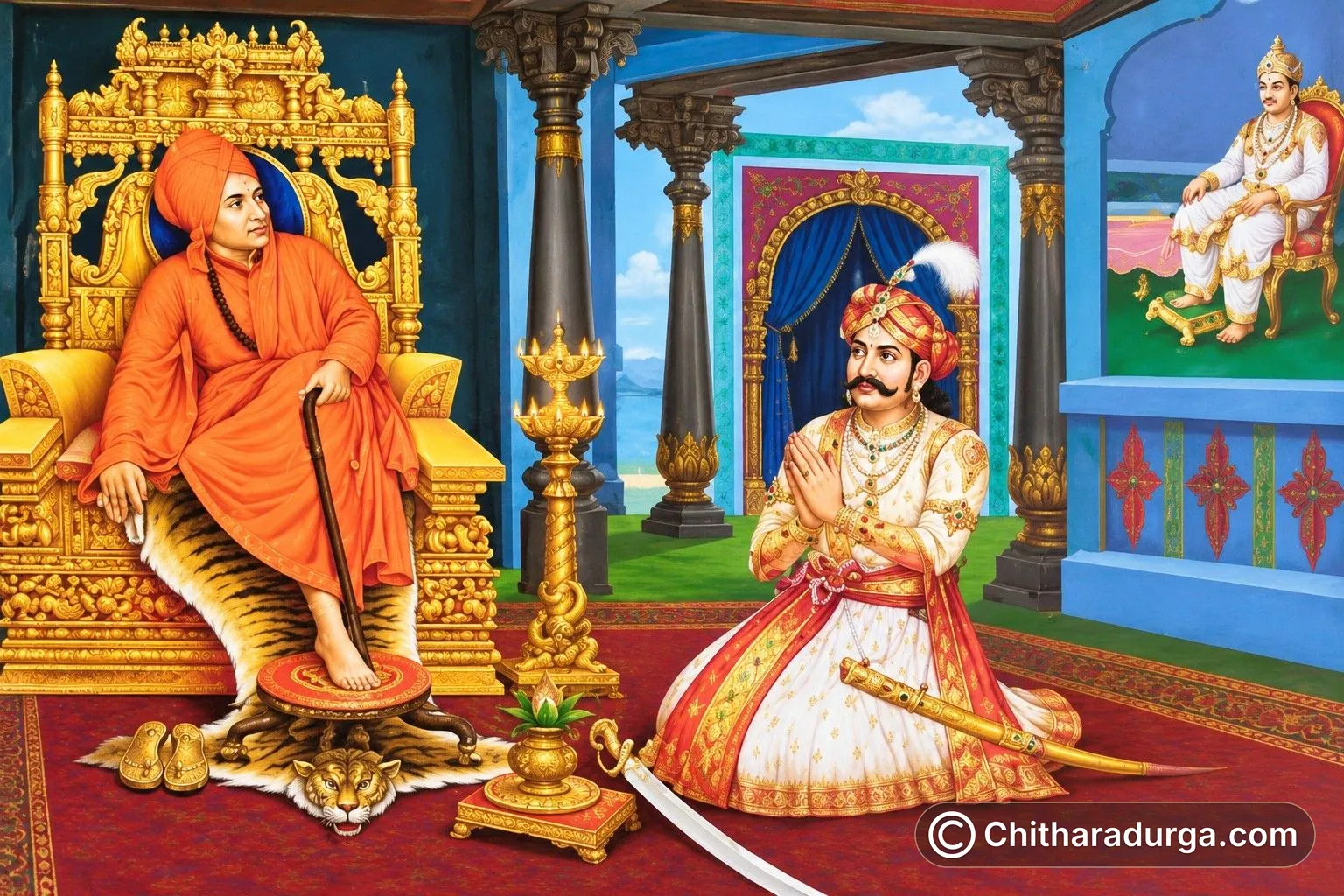
Meeting with Shanthaveera Murughesha
Another important episode associated with Bharamanna Nayaka's life was his meeting with Shanthaveera Murughesha.
This episode reveals another dimension of Bharamanna's personality. He was not remembered merely as a warrior carrying a sword into battle. His life was also connected with the spiritual and cultural traditions of his time.
The relationship between rulers and religious institutions played an important role in the social life of medieval and early-modern Karnataka. Bharamanna's association with such spiritual personalities and institutions forms part of this broader cultural landscape.
The Battle of Dodderi
The Battle of Dodderi is remembered among the significant military episodes of Bharamanna Nayaka's career.
His period was one in which regional rulers constantly had to defend their territories against neighbouring powers and invading armies. Political survival depended on military preparedness, strategic alliances and strong fortifications.
Bharamanna distinguished himself as a ruler who was willing to meet such threats directly.
His military reputation grew through these confrontations, strengthening his image as a fearless defender of Chitradurga.
War Against Dilawar Khan
Another celebrated episode was Bharamanna Nayaka's confrontation with Dilawar Khan, associated in the traditional account with the Bijapur forces.
Bharamanna's victory in this conflict became an important part of his martial reputation.
Such battles were not simply demonstrations of personal courage. The survival of Chitradurga depended upon the ruler's ability to protect its forts, population, agricultural resources and strategic routes.
Bharamanna's willingness to confront powerful opponents contributed to the title by which he came to be remembered — Samara Marthanda.
A Warrior Who Faced Many Enemies
Bharamanna Nayaka's reign was repeatedly tested by military threats.
Tradition remembers confrontations involving forces from Tarikere, Bidanur, the Nawab of Savanur and Maratha sardars, among others.
Yet Bharamanna did not allow repeated attacks to weaken the defensive strength of Chitradurga.
He understood an essential truth of warfare: courage alone could not protect a kingdom. Strong forts, secure gateways, reliable water supplies and well-developed settlements were equally necessary.
This is what makes Bharamanna's reign particularly important. The warrior and the builder existed in the same ruler.
Builder of Forts
Bharamanna Nayaka devoted considerable attention to fortifications.
Strong forts are associated with his rule at places including:
Anaji, Alur, Alaghatta, Siddavvana Durga and Basavana Kote.
These fortifications strengthened the defensive network surrounding Chitradurga's territory.
At a time when political boundaries were frequently challenged by military expeditions, forts served not only as military bases but also as centres of administration and refuge for local populations.
Strengthening Chitradurga Fort
Bharamanna's contribution to the fortifications of Chitradurga is also remembered through important stone gateways.
Among them are:
Hanumanthana Bagilu, Hidimbeshwarana Bagilu and Ekanathammana Bagilu.
These massive gateways were not merely entrances. They formed integral parts of a carefully planned defensive system.
The fort of Chitradurga evolved through the contributions of successive rulers, and Bharamanna Nayaka's period forms an important chapter in that continuing process of strengthening and expansion.
Water – The Foundation of Prosperity
One of the most remarkable aspects of Bharamanna Nayaka's administration was his attention to water conservation and irrigation.
In the dry landscape of Chitradurga, water meant survival.
Tanks, wells and ponds associated with his developmental activities include Bharamasagara, Bhimasamudra and Jampanna Nayakana Kote Kere.
Such projects served multiple purposes. They provided drinking water, supported agriculture, strengthened settlements and helped communities withstand periods of inadequate rainfall.
The ruler who built a reservoir was therefore doing more than constructing a public work — he was investing in the future of his people.
Establishment of Settlements
Bharamanna Nayaka's development policies also included the establishment and encouragement of settlements.
Places associated with this effort include:
Bharamasagara, Bharamanahalli and Chikka Siddavvanahalli.
Establishing settlements helped expand cultivation, encourage economic activity and strengthen the administrative presence of the Nayaka state.
These initiatives reveal Bharamanna not merely as a military ruler but as a leader concerned with the long-term growth of his territory.
Temples and Religious Heritage
Bharamanna Nayaka also supported religious architecture.
Temples associated with his period include shrines dedicated to Neelakanteshwara, Bhimeshwara, Chandramouleshwara and Hanumantha.
These temples were centres not merely of worship but of community and cultural life.
Their presence reflects the close relationship between political authority, religion, architecture and society during the Nayaka period.
Mutts, Palaces and Public Structures
Bharamanna's architectural legacy extended beyond forts and temples.
Tradition associates his reign with structures such as Murugi Matha, Bharamavvana Palace, Gali Mantapa and Bokkasa, along with other administrative and cultural constructions.
Gardens and ornamental structures also formed part of this development.
Shringara Thota and the mantapa at Mallappana Bavi demonstrate that construction during his period was not concerned only with warfare.
Security, spirituality, administration, water management and aesthetics all found expression in the built landscape.
Bharamanna – The Sword and the Builder
Bharamanna Nayaka's greatness lies in this combination.
He could wield the sword when Chitradurga was threatened, but he also understood that victory in war was meaningless if ordinary people did not have water, settlements, security and places of worship.
Between 1689 and 1721, the numerous works associated with his rule left visible marks across the region.
His legacy therefore survives not only in accounts of battles.
It survives in fort walls and gateways.
It survives in tanks and wells.
It survives in villages and temples.
And above all, it survives in the historical memory of Chitradurga.
Bharamanna Nayaka in Kannada Literature
The dramatic life of Bharamanna Nayaka naturally attracted Kannada writers.
The renowned novelist Ta. Ra. Su., whose historical novels gave new literary life to the history of Chitradurga's Palegars, portrayed this turbulent world through fiction.
The conflict involving Muddanna, the political intrigues within the fort, Bharamanna's rise, battles and personalities surrounding the Nayaka court provide the ingredients of an extraordinary historical drama.
Later literary treatments have continued to revisit this fascinating chapter, demonstrating how deeply Bharamanna's story remains embedded in Chitradurga's cultural imagination.
Death and Immortal Memory
Bichchugatthi Bharamanna Nayaka passed away on 20 May 1721.
But the death of a ruler does not necessarily end his presence in history.
More than three centuries later, the structures, settlements, reservoirs, traditions and stories associated with his reign continue to recall his name.
For Chitradurga, Bharamanna represents a ruler who combined courage with construction, warfare with administration, and political strength with public development.
He did not merely defend a kingdom.
He strengthened it.
He did not merely win battles.
He built the foundations that allowed society to endure beyond them.
The Samara Marthanda of Chitradurga
Bichchugatthi Bharamanna Nayaka stands among the most remarkable rulers in the history of the Chitradurga Nayakas.
His sword defended the land.
His forts guarded its people.
His reservoirs nourished its fields.
His temples enriched its spiritual life.
His settlements expanded its society.
His monuments stand in stone, but his greater monument survives in the memory of the people of Chitradurga.
That is why the name Bichchugatthi Bharamanna Nayaka — the Samara Marthanda of Chitradurga — continues to command respect centuries after his time.