Sri Murige Shanthaveera Swamiji – The Great Saint Who Gave the Murugha Tradition in Chitradurga
The Saint Who Transformed the Wandering Shoonya Peetha into a Permanent Spiritual Centre
The history of Chitradurga is not confined to its magnificent seven-walled fort, the valour of the Nayaka rulers and the battles fought for the land. Equally important is its rich spiritual, religious, social and cultural heritage shaped over centuries by saints, Sharanas and religious institutions.
Among the institutions that have profoundly influenced the cultural life of Chitradurga is the Sri Jagadguru Murugharajendra Brihanmatha, popularly known as Murugha Matha.
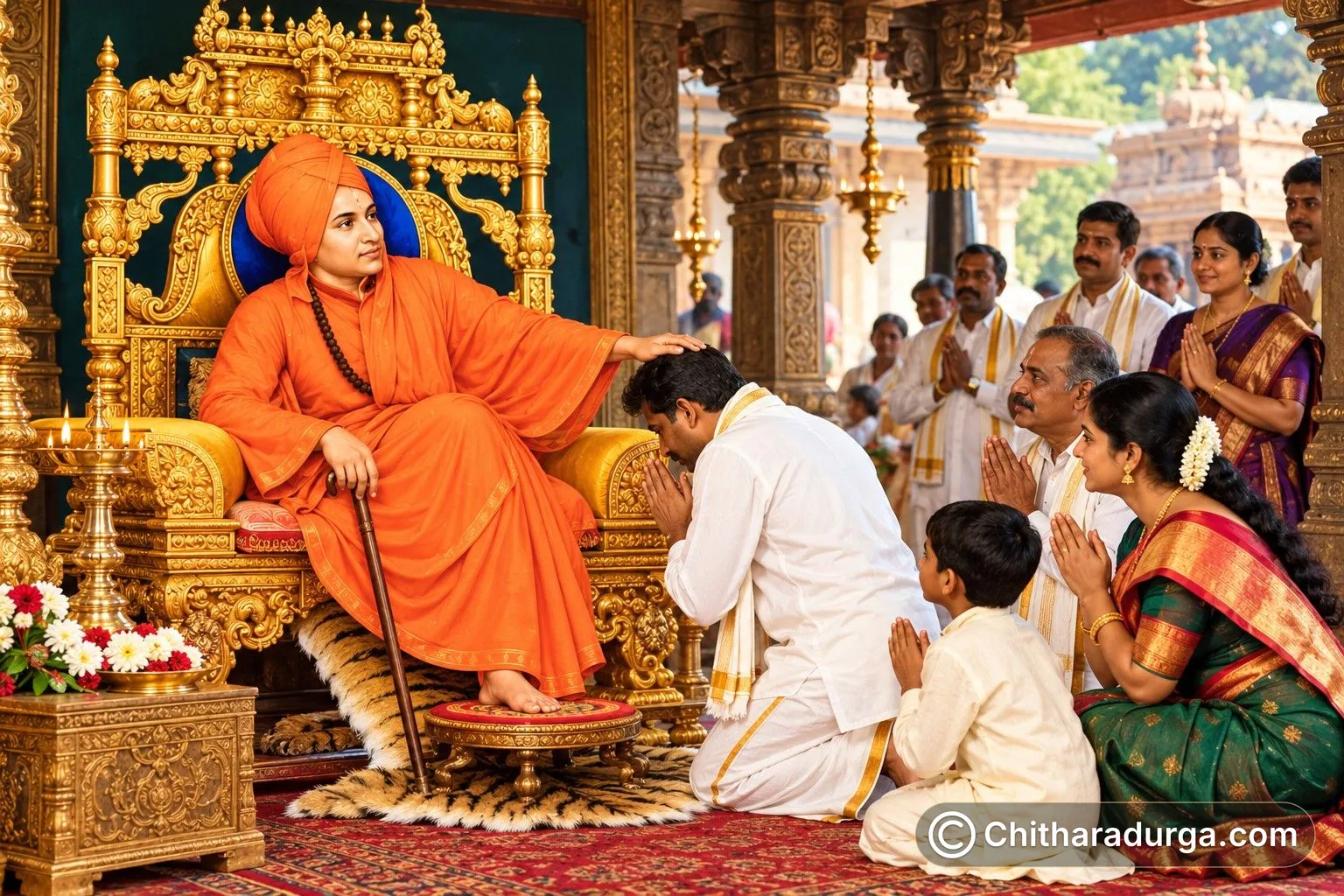
At the foundation of its permanent presence in Chitradurga stands the remarkable personality of Sri Murige Shanthaveera Desika, also known as Sri Murige Shanthaveera Swamiji or Murugha Shanthaveereshwara Swamiji.
He was the saint who transformed a long-established tradition of travelling spiritual teachers into a permanently rooted institution at Chitradurga.
The Great Saint of the Shoonya Peetha Tradition
The spiritual tradition associated with Murugha Matha traces its philosophical roots to the great Sharana movement of the 12th century.
The ideals of Basaveshwara and the spiritual tradition associated with Allama Prabhu, Channabasavanna and other Sharanas placed great emphasis on spiritual experience, equality, compassion, Kayaka, Dasoha and service to humanity.
The teachers of the Shoonya Peetha traditionally travelled from place to place rather than remaining permanently attached to a single centre. Through these journeys, they spread spiritual knowledge and Sharana philosophy among the people.
Sri Murige Shanthaveera Swamiji belonged to this travelling spiritual tradition.
For much of his life, he undertook religious journeys and carried the message of spiritual awareness to different regions.
A Scholar and Spiritual Master
Shanthaveera Swamiji was not merely a religious leader. He was remembered as a person of profound scholarship, spiritual attainment and philosophical understanding.
Traditions associated with the Matha record that during his religious journeys he received honour from several rulers and interacted with scholars of different traditions.
His reputation extended beyond the Chitradurga region. His learning and spiritual stature earned him respect in royal and scholarly circles.
His personality therefore represented a remarkable combination of scholarship, devotion, spiritual experience and service.
Arrival in Chitradurga
The closing years of the 17th century were an important period in Chitradurga's history.
At the time, Bichugatthi Bharamanna Nayaka, who ruled Chitradurga from 1689 to 1721, was strengthening the Nayaka kingdom.
It was during this historical period that Sri Murige Shanthaveera Swamiji became closely associated with Chitradurga.
Tradition records that Bharamanna Nayaka had immense devotion and respect for the Swamiji. He is said to have believed that the blessings of the saint had played an important role in his own rise to the throne.
The ruler therefore wished that the aged spiritual master should make Chitradurga his permanent abode.
Establishment of the Matha in Chitradurga
Soon after Bharamanna Nayaka came to power in 1689, arrangements were made for the establishment of a Matha for Shanthaveera Swamiji in the upper fort area of Chitradurga.
Historical traditions of the Matha also state that Bharamanna Nayaka provided Mathas for the Swamiji on the hill and below it towards the west.
Shanthaveera Swamiji had spent most of his life travelling. Remaining permanently in one place was therefore a significant departure from the earlier tradition.
By this time, however, he had reached advanced age. Respecting the devotion and request of Bharamanna Nayaka, he chose to remain in Chitradurga.
That decision became a turning point in the religious history of the region.
When the 'Chara' Peetha Became 'Sthira'
Before Shanthaveera Swamiji, the teachers of the Shoonya Peetha tradition had largely followed a wandering or Chara tradition.
The spiritual seat was not understood merely as a physical building. Wherever the Guru travelled, spiritual teaching, philosophical dialogue and service accompanied him.
With Shanthaveera Swamiji settling in Chitradurga, this wandering tradition acquired a permanent centre.
Thus, in the language of the tradition, the 'Chara' or mobile Shoonya Peetha became 'Sthira' — permanently established — at Chitradurga.
This development eventually helped make Chitradurga an important centre of the Murugha spiritual tradition.
Basava Philosophy and Service to Humanity
The significance of Shanthaveera Swamiji cannot be understood only through religious rituals or institutional history.
The wider tradition he represented was rooted in Sharana values — spiritual awareness combined with responsibility towards society.
The principles of Kayaka, Dasoha, equality, compassion, dignity of labour and service to humanity were central to the social philosophy inherited from the Sharana movement.
The purpose of spiritual life, in this understanding, was not withdrawal from society but the transformation and betterment of human life.
The Murugha tradition that developed in Chitradurga continued to carry these ideals into its religious, educational and social activities.
A Saint Respected by Rulers
Traditional accounts associated with Shanthaveera Swamiji state that he received honour from several rulers during his extensive religious journeys.
Among the names traditionally connected with him are rulers of Mysore and other kingdoms of southern India.
This wide recognition indicates that his influence was not restricted to a single village, town or kingdom.
Yet his final and most enduring association came to be with Chitradurga.
Bharamanna Nayaka's reverence for him created an important meeting point between the political history of the Chitradurga Nayakas and the spiritual history of the Shoonya Peetha.
Shanthaveera Swamiji as a Literary Scholar
Shanthaveera Swamiji is also associated with an important literary tradition.
Historical accounts of the Matha attribute several works to him, including compositions dealing with philosophy, spirituality and literature.
Among works associated with his name are Hammira Kavya or Rajendra Vijaya, Manurajendra Taravali, Kattige Taravali, Prabhulinga Kanda, Shabdaratnakara and Vairagya Shatpadi.
These literary associations reveal another dimension of his personality.
He was not simply a spiritual traveller or head of a religious institution; he belonged to a tradition in which philosophy, spirituality, language and literature were deeply interconnected.
The Beginning of a Great Institutional Tradition
After Shanthaveera Swamiji established himself in Chitradurga, the Murugha tradition gradually expanded.
He was succeeded by Sri Gurusidda Swamiji, popularly remembered as Immadi Murige Swamiji or Murige Swamiji II.
The successors continued to receive respect from the Nayaka rulers of Chitradurga, and the influence of the Matha spread to different regions.
Over time, numerous branch Mathas and Virakta Mathas developed.
In later centuries, the broader Murugha tradition expanded its activities into education, Dasoha, literature, social welfare and other areas of public service.
The permanent foundation established during the time of Shanthaveera Swamiji thus grew into a major religious and social institution.
Karthru Gaddige – The Final Resting Place
Sri Murige Shanthaveera Swamiji spent the final period of his life in Chitradurga.
The Matha's official lineage records his period as 1640–1703, while its historical tradition records that he attained Lingaikya on 5 July 1703.
His sacred resting place came to be known as Karthru Gaddige.
The very title Karthru reflects the special position accorded to him in the history of the Chitradurga Murugha tradition.
He is remembered not merely as one among a succession of pontiffs, but as the saint who gave a permanent geographical and institutional foundation to a tradition that would continue for centuries.
Bharamanna Nayaka and Shanthaveera Swamiji – A Meeting of Royal and Spiritual Traditions
The relationship between Bharamanna Nayaka and Shanthaveera Swamiji occupies a distinctive place in Chitradurga's history.
On one side stood a powerful Nayaka ruler strengthening his kingdom and fort.
On the other stood an aged spiritual master who had spent much of his life travelling and spreading spiritual wisdom.
Bharamanna Nayaka provided royal patronage and a permanent place for the saint, while Shanthaveera Swamiji brought with him the philosophical and spiritual heritage of the Shoonya Peetha.
Their association connected two major streams of Chitradurga's heritage — the history of the Nayaka rulers and the history of the Sharana spiritual tradition.
An Enduring Name in the History of Chitradurga
More than three centuries later, Sri Murige Shanthaveera Swamiji remains an important name in the religious and cultural history of Chitradurga.
He gave a permanent home to a travelling spiritual lineage.
He carried forward the philosophical heritage of the Sharanas.
He combined scholarship with spiritual experience.
And by settling in Chitradurga, he laid the foundation for an institution that would influence generations through religion, education, Dasoha, literature and social service.
The arrival of Sri Murige Shanthaveera Swamiji in Chitradurga was therefore more than the arrival of a saint. It marked the beginning of a permanent spiritual, social and cultural tradition that would become inseparable from the history of Chitradurga.
If the great fort represents the political courage and military heritage of Chitradurga, the legacy of Sri Murige Shanthaveera Swamiji represents another enduring dimension of the land — its spiritual heritage and Sharana culture.