Belagere Chandrashekara Shastri – The Unwritten Poet of Chitradurga
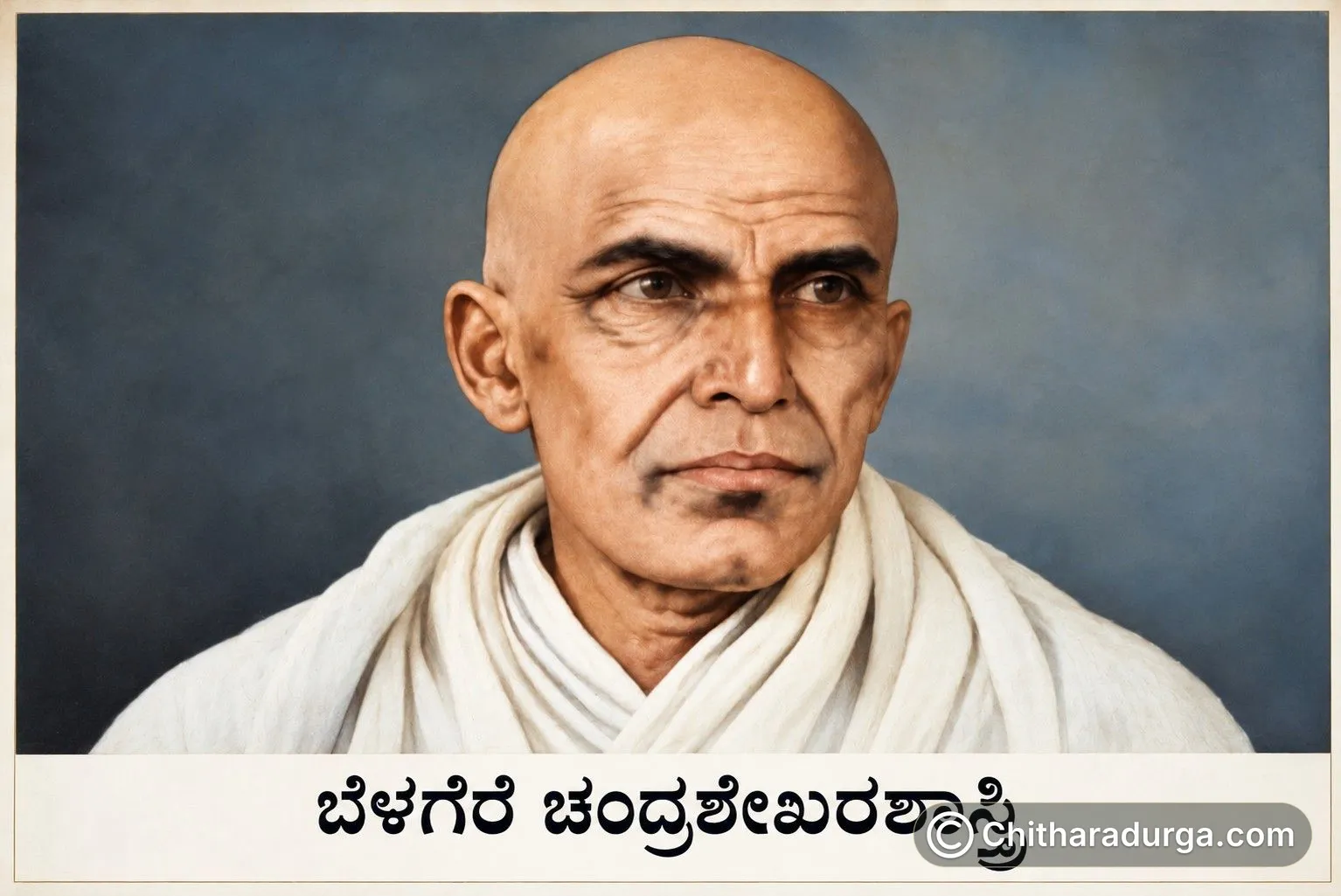
The literary history of Chitradurga is enriched not only by celebrated authors whose works survive in printed books, but also by extraordinary personalities whose creativity lived primarily through speech, song, memory and personal interaction.
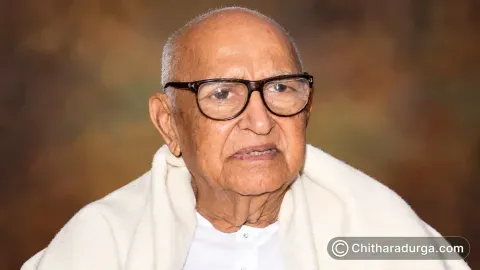
Among such rare figures stands Belagere Chandrashekara Shastri, an extempore poet, scholar, philosopher and lover of folk culture from Belagere in the Chitradurga region.
He was the father of the renowned writer, teacher and social worker Belagere Krishna Shastri, but Chandrashekara Shastri deserves recognition in his own right as a remarkable cultural personality.
He possessed an exceptional gift for poetry. Verses, songs, humorous compositions and philosophical thoughts flowed naturally from him. Yet he showed little interest in systematically writing down, preserving or publishing his creations.
His literature largely lived in his voice.
That makes Chandrashekara Shastri one of the fascinating personalities in the cultural history of Chitradurga — a poet remembered more through people than through books.
Born into a Scholarly Tradition
Belagere Chandrashekara Shastri lived from 1874 to 1966, spanning a remarkable period of social and cultural transformation in Karnataka.
He belonged to a family with a strong scholarly background. The intellectual atmosphere surrounding the family included Sanskrit learning, traditional scholarship, poetry, music and later modern Kannada literature.
His father, Appanna Bhatta, was remembered as a distinguished Sanskrit scholar who earned recognition in scholarly assemblies.
Chandrashekara Shastri inherited this intellectual tradition but developed a personality and philosophy distinctly his own.
From Vedic Learning to the World of Folk Culture
As a young man, Chandrashekara Shastri studied at a Vedic institution in Kanchi and acquired considerable traditional learning.
Yet his intellectual journey did not remain confined to classical scholarship.
He gradually became fascinated by the cultural richness of ordinary village people. He recognised that wisdom, philosophy, poetry and spirituality were not found only in Sanskrit texts or formal centres of learning.
They were also alive in folk songs, oral narratives, rural customs, humour, conversations and the everyday experiences of common people.
This openness towards both classical learning and folk wisdom became one of the defining features of his personality.
An Ashukavi – Poetry Born in the Moment
Chandrashekara Shastri was widely remembered as an Ashukavi, an extempore poet capable of composing poetry spontaneously.
For him, poetry did not necessarily begin with paper and pen.
A situation, a person, a humorous incident, a philosophical thought or a village gathering could inspire him instantly. Words would take rhythm, rhythm would turn into verse, and verse could become song.
His poetry belonged to the living moment.
He sang, composed and entertained. His verses could carry humour, affection, philosophy or observations about human nature.
People around him became his audience, and everyday life became his literary stage.
The Poet Who Did Not Care to Become an Author
Perhaps the most remarkable aspect of Chandrashekara Shastri's literary personality was his apparent lack of interest in becoming a conventional published author.
He possessed abundant poetic talent, but systematic literary writing did not attract him.
He could compose poetry effortlessly, yet preserving every composition for posterity did not appear to concern him.
Consequently, much of what he sang or composed remained within oral memory rather than entering printed literature.
This creates an unusual paradox.
Many writers survive because their books preserve their words.
Chandrashekara Shastri survived because people preserved his memory.
His life reminds us that literature does not exist only between the covers of books. It can also live in voices, conversations, songs, laughter and memories transmitted from one generation to another.
A Man Among Village People
Despite his learning, Chandrashekara Shastri did not isolate himself from ordinary rural society.
He mingled freely with villagers and participated in their songs, humour, conversations and celebrations. His scholarship did not create a barrier between himself and common people.
Instead, he became one among them.
In villages around Challakere, he reportedly became affectionately known as “Kadalekayi Shastri.”
His humour and spontaneous poetry entertained rural audiences and helped people momentarily forget the hardships of everyday life.
This quality distinguished him from the conventional image of a distant scholar. His learning was accompanied by accessibility, humour and affection for ordinary people.
A Philosophical and Avadhuta-like Personality
Those who remembered Chandrashekara Shastri frequently described a personality that was difficult to fit into conventional categories.
He possessed scholarship but apparently had little desire to display it.
He was knowledgeable in priestly traditions but did not make priesthood the centre of his livelihood.
He had extraordinary poetic ability but did not pursue literary fame.
He lived with a certain detachment from wealth, status and conventional ambition.
For these reasons, later writers portrayed him as having an Avadhuta-like temperament — spiritually inclined, unconventional, detached and difficult to define through ordinary measures of worldly success.
His philosophy seems to have been expressed less through formal preaching and more through the way he lived.
Friendship with Great Kannada Literary Personalities
Chandrashekara Shastri's personality attracted the attention of several prominent figures in Kannada literature.
He had associations with distinguished writers and intellectuals such as D. R. Bendre, D. V. Gundappa (DVG), Masti Venkatesha Iyengar, V. Seetharamaiah and G. P. Rajaratnam.
Among these relationships, his association with the great poet D. R. Bendre is particularly remembered.
Bendre was deeply impressed by Chandrashekara Shastri's unusual personality and poetic temperament. Their relationship represents an interesting meeting between two forms of literary creativity — one preserved through celebrated written poetry and the other flowing freely through spontaneous oral expression.
The fact that leading literary personalities valued Chandrashekara Shastri demonstrates that his lack of published books should not be mistaken for a lack of literary stature.
Inspiration Behind a Literary Character
An interesting literary connection further illustrates Chandrashekara Shastri's colourful personality.
The celebrated Kannada humorist Beechi reportedly acknowledged that Chandrashekara Shastri served as the inspiration for the character Brahmananda Shastri in his novel Saraswathi Samhara.
For a real-life personality to inspire a fictional character suggests how memorable and distinctive Chandrashekara Shastri must have appeared to those who encountered him.
His personality itself became a form of literature.
Father of an Extraordinary Literary Family
Chandrashekara Shastri's cultural influence did not end with him.
His family produced several individuals associated with literature, education, music and cultural life.
His son Belagere Krishna Shastri, born in Belagere in 1916, went on to become a distinguished teacher, writer, social worker and cultural personality.
Another son, Belagere Seetharama Shastri, known in literary circles by the pen name Ksheerasagara, became known as a writer and playwright.
His daughter Belagere Janakamma became a poet, while another daughter, Belagere Parvathamma, was associated with music and Gamaka.
Thus, the atmosphere Chandrashekara Shastri helped create within the family contributed to a remarkable literary and cultural lineage.
A Father's Dream for Rural Education
Chandrashekara Shastri's vision extended beyond poetry.
A deeply meaningful episode remembered in connection with his final years concerns education in rural areas.
He was concerned that children in the surrounding villages did not have sufficient opportunities for education. He is remembered as having urged his children to establish a school where children from Belagere and nearby villages could study.
That aspiration later found expression through the educational work of his family.
Belagere Krishna Shastri and his family carried forward the commitment to rural education, and the educational institution established at Belagere grew into an important centre serving generations of students.
In this sense, Chandrashekara Shastri left behind something more enduring than a collection of written poems — a vision that education should reach village children.
The Oral Poet of Chitradurga
The story of Belagere Chandrashekara Shastri raises an important question:
Must a poet necessarily leave behind books to be remembered as a poet?
His life suggests otherwise.
He composed spontaneously. He sang. He laughed with villagers. He shared thoughts and poetry with friends. He interacted with some of the finest literary minds of his era. His words travelled from person to person rather than from printing press to bookshelf.
Much of that spontaneous creativity may have disappeared with the passing of those who heard him.
Yet the memory of the man survived.
In that sense, Chandrashekara Shastri belonged to an older Indian oral tradition in which poetry was not merely something to be read — it was something to be heard, sung, experienced and remembered.
A Legacy Written in People, Not on Paper
Belagere Chandrashekara Shastri occupies an unusual and fascinating place in Chitradurga's cultural heritage.
He was traditionally educated yet fascinated by folk culture; deeply knowledgeable yet unpretentious; capable of extraordinary spontaneous poetry yet largely indifferent to publishing it; spiritually inclined yet closely connected with ordinary village people.
Perhaps the most fitting way to remember him is not simply as a writer who failed to record his compositions, but as a poet whose chosen manuscript was human memory.
His influence continued through his children, through the writers and intellectuals who knew him, through the educational vision inherited by his family, and through the cultural memory of Belagere.
Belagere Chandrashekara Shastri was a poet without the boundaries of a book — a spontaneous voice of rural Karnataka whose poetry, humour, philosophy and humanity became part of the cultural heritage of Chitradurga.