Gram Panchayats of Chitradurga District

Gram Panchayats of Chitradurga District
Gram Panchayats form the grassroots level of rural local governance in Chitradurga District. They are the institutions closest to people living in villages and play an important role in providing basic civic services, implementing government programmes and supporting the social and economic development of rural communities.
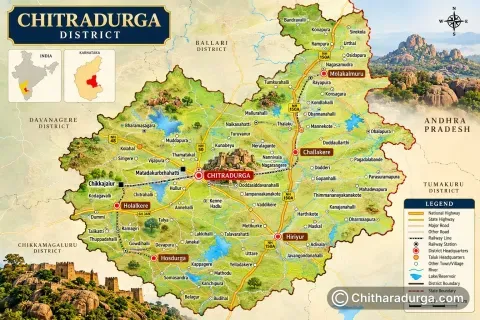
Chitradurga District has 189 Gram Panchayats, distributed across its six taluks — Chitradurga, Challakere, Hiriyur, Holalkere, Hosadurga and Molakalmuru. A Gram Panchayat may cover a single village or a group of villages notified under the Panchayat Raj framework.
Gram Panchayats at a Glance
Particular | Details |
|---|---|
District | Chitradurga |
Number of Taluks | 6 |
Number of Hoblis | 22 |
Number of Gram Panchayats | 189 |
Number of Villages | 1,063 |
Rural Local Governance System | Three-tier Panchayat Raj |
District-level Institution | Zilla Panchayat |
Taluk-level Institution | Taluk Panchayat |
Village-level Institution | Gram Panchayat |
Gram Panchayat Jurisdiction | Village or group of villages |
Taluk-wise Distribution of Gram Panchayats
The 189 Gram Panchayats of Chitradurga District are distributed among the six taluks as follows:
Sl. No. | Taluk | Number of Gram Panchayats | Share of District Total |
|---|---|---|---|
1 | Chitradurga | 38 | 20.1% |
2 | Challakere | 40 | 21.2% |
3 | Hiriyur | 33 | 17.5% |
4 | Holalkere | 29 | 15.3% |
5 | Hosadurga | 33 | 17.5% |
6 | Molakalmuru | 16 | 8.5% |
Total | 189 | 100% |
Among the six taluks, Challakere has the highest number of Gram Panchayats with 40, followed by Chitradurga with 38. Hiriyur and Hosadurga have 33 each, Holalkere has 29, and Molakalmuru has 16.
Panchayat Raj Structure
Rural local governance in Chitradurga follows Karnataka's three-tier Panchayat Raj system. The system distributes responsibilities among institutions at the district, taluk and village levels.
Level | Panchayat Raj Institution | Area of Administration | Principal Role |
|---|---|---|---|
District Level | Zilla Panchayat | Entire Chitradurga District | District-level rural development, planning and coordination |
Taluk Level | Taluk Panchayat | Respective Taluk | Coordination and implementation of development programmes |
Village Level | Gram Panchayat | Village / Group of Villages | Local governance, civic services and village development |
The structure can be represented as:
Zilla Panchayat → Taluk Panchayat → Gram Panchayat → Villages
This decentralised system enables decisions concerning local development to be taken closer to rural communities.
Gram Panchayat Administration
A Gram Panchayat consists of elected representatives from its Panchayat area. The President (Adhyaksha) and Vice-President (Upadhyaksha) are chosen in accordance with the provisions of Karnataka's Panchayat Raj legislation.
The elected body provides local leadership, while Panchayat officials and staff assist with administration, maintenance of records, implementation of resolutions, financial management and delivery of public services.
The Gram Panchayat also provides an important platform through which residents can participate in local governance.
Gram Sabha
An important component of grassroots democracy is the Gram Sabha, which provides residents with an opportunity to participate in matters concerning their village and local development.
The Gram Sabha strengthens transparency and public participation by enabling discussion of development requirements, government programmes, local priorities and other issues affecting the community.
It therefore serves as an important connection between citizens and their elected Gram Panchayat.
Major Functions of Gram Panchayats
Gram Panchayats perform a wide range of civic, developmental and administrative responsibilities. Their major areas of work can be summarised as follows:
Area | Major Responsibilities |
|---|---|
Drinking Water | Maintenance and management of local water-supply facilities |
Sanitation | Village cleanliness, sanitation facilities and drainage |
Roads | Construction, repair and maintenance of local public streets and roads within their responsibility |
Street Lighting | Provision and maintenance of street lights |
Waste Management | Identification of appropriate locations and arrangements for local waste disposal |
Public Health | Supporting sanitation, hygiene, immunisation and public-health initiatives |
Education | Supporting school enrolment and educational initiatives |
Birth & Death Records | Supporting registration and reporting as prescribed |
Community Assets | Maintenance of community properties and assets vested in the Panchayat |
Local Revenue | Assessment and collection of applicable taxes, rates and fees |
Government Schemes | Local implementation and facilitation of rural-development and welfare programmes |
Social Development | Activities supporting the social and economic well-being of residents |
Village Infrastructure | Development and maintenance of basic local infrastructure |
Environment | Local cleanliness, protection of community resources and biodiversity-related responsibilities |
Civic Infrastructure and Basic Services
One of the most visible responsibilities of a Gram Panchayat is the provision and maintenance of basic village infrastructure.
This includes local roads, drainage, sanitation, drinking-water facilities, street lighting and maintenance of community assets. These services directly influence the everyday quality of life of rural residents.
Gram Panchayats therefore serve not merely as administrative offices but as important local institutions responsible for the functioning and improvement of village communities.
Rural Development
Gram Panchayats are closely involved in implementing various rural-development programmes introduced by the Central and State Governments.
Depending on the programme and administrative framework, Panchayats may participate in initiatives relating to employment, housing, sanitation, drinking water, poverty alleviation, infrastructure, social security and community development.
They also coordinate with the Taluk Panchayat, Zilla Panchayat and different government departments for implementation and monitoring of development works.
Local Revenue and Financial Responsibilities
Gram Panchayats have responsibilities relating to local financial administration. They are empowered under the applicable Panchayat Raj framework to levy and collect specified taxes, rates and fees.
Government grants and funds released under various development programmes are also important sources for Panchayat activities.
Sound financial management enables Gram Panchayats to maintain local infrastructure, provide civic services and undertake development works.
Relationship with Taluk Panchayat
The Taluk Panchayat acts as the intermediate tier between the Gram Panchayats and Zilla Panchayat.
It coordinates development programmes across the Taluk and monitors various aspects of Gram Panchayat functioning. This can include matters relating to water supply, sanitation, taxation, school enrolment, immunisation and other development indicators.
The relationship between Gram Panchayats and Taluk Panchayats helps coordinate village-level requirements with broader Taluk-level planning.
Relationship with Zilla Panchayat
At the district level, the Chitradurga Zilla Panchayat is the apex Panchayat Raj institution.
It coordinates rural-development activities across all six taluks and works through its administration, development, accounts and planning sections.
The Zilla Panchayat therefore provides an important district-level framework connecting government programmes with Taluk Panchayats and the 189 Gram Panchayats operating across Chitradurga.
Rural Governance at a Glance
Administrative Unit | Number in Chitradurga District |
|---|---|
Taluks | 6 |
Hoblis | 22 |
Gram Panchayats | 189 |
Villages | 1,063 |
This network demonstrates the scale of rural administration in Chitradurga District. Gram Panchayats provide the essential grassroots connection through which local communities participate in governance and access many development programmes.
Importance of Gram Panchayats
Gram Panchayats are fundamental to decentralised democracy and rural development. Since they operate closest to village communities, they are well positioned to understand local requirements and identify priorities concerning water, sanitation, roads, public amenities and community development.
The 189 Gram Panchayats of Chitradurga District collectively connect its villages with the Taluk Panchayats, Zilla Panchayat and State Government. Through this three-tier system, rural citizens participate in local governance while development programmes and essential services can be planned and implemented closer to the communities they are intended to serve.
In this way, Gram Panchayats remain the foundation of rural local self-government in Chitradurga District.