Hoblis of Chitradurga District

Hoblis of Chitradurga District
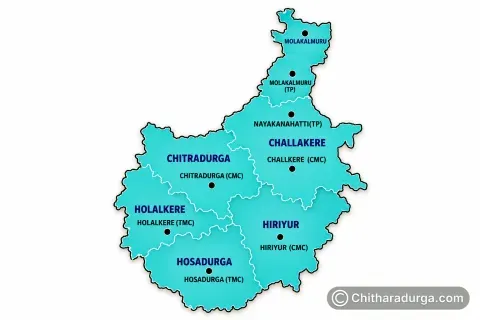
The Hobli is an important unit of revenue administration in Karnataka, functioning between the Taluk and Village levels. Chitradurga District is divided into 6 taluks and 22 hoblis, which together provide an organised administrative framework for hundreds of villages across the district.
A Hobli, also commonly referred to as a Revenue Circle, consists of a group of neighbouring villages. It plays an important role in land and revenue administration, maintenance of village records, citizen services, agricultural programmes and coordination between the Taluk administration and villages.
Administrative Structure
The revenue administrative structure can broadly be understood as:
District → Taluk → Hobli → Village
At the district level, revenue administration is headed by the Deputy Commissioner. At the Taluk level, the Tahsildar is the principal revenue officer. Hobli-level administration connects the Tahsildar's office with individual villages through Revenue Inspectors, Deputy Tahsildars, Village Accountants and other field-level officials.
The village is the basic administrative unit of the Revenue Department. A group of villages forms a Hobli, while a group of Hoblis constitutes a Taluk.
Hoblis of Chitradurga District – Taluk-wise
Chitradurga District has 22 Hoblis distributed across its six Taluks. The following table provides a convenient overview.
Taluk | Hoblis |
|---|---|
Chitradurga | Kasaba, Hireguntanur, Bharamasagara, Turuvanur |
Challakere | Kasaba, Nayakanahatti, Talaku, Parashurampura |
Hiriyur | Kasaba, Aimangala, Dharmapura, Javanagondanahalli |
Holalkere | Kasaba, B. Durga (Bharamannanayakana Durga), Ramagiri, Talya |
Hosadurga | Kasaba, Madadakere, Mattodu, Srirampura |
Molakalmuru | Devasamudra, Rampura |
Total | 22 Hoblis |
Chitradurga Taluk Hoblis
Chitradurga Taluk has four major revenue circles:
1. Kasaba Hobli
Kasaba Hobli covers the central area around Chitradurga and villages closely connected with the district headquarters. Because of its proximity to Chitradurga city, the region has strong administrative, commercial and transportation connections.
2. Hireguntanur Hobli
Hireguntanur Hobli consists of a number of predominantly rural settlements. Agriculture and village-based livelihoods are important to the region, while Hobli-level administration connects its villages with the Chitradurga Taluk administration.
3. Bharamasagara Hobli
Bharamasagara is an important rural centre in Chitradurga Taluk. The Hobli contains numerous agricultural villages and serves as an important link between these communities and Taluk-level government departments.
4. Turuvanur Hobli
Turuvanur Hobli covers another important rural part of Chitradurga Taluk. Turuvanur acts as a local service centre for surrounding villages and has its own importance in the historical and agricultural landscape of the district.
Challakere Taluk Hoblis
Challakere is geographically the largest Taluk in Chitradurga District and its rural administration is organised through four Hoblis.
1. Kasaba Hobli
Challakere Kasaba Hobli covers Challakere and surrounding areas. Challakere town serves as the Taluk headquarters and is an important commercial, educational and administrative centre.
2. Nayakanahatti Hobli
Nayakanahatti is an important religious and rural centre, particularly associated with Sri Guru Thipperudraswamy. It provides various services to a large number of surrounding villages.
3. Talaku Hobli
Talaku Hobli covers a predominantly rural and dryland agricultural region. Talaku functions as an important local centre connecting surrounding villages with Challakere Taluk administration.
4. Parashurampura Hobli
Parashurampura serves villages in the eastern part of the Taluk. Its geographical proximity to the Karnataka–Andhra Pradesh region has contributed to the distinctive cultural and linguistic character of the surrounding areas.
Hiriyur Taluk Hoblis
Hiriyur Taluk is divided into four Hoblis, covering its important agricultural and rural regions.
1. Kasaba Hobli
The Kasaba Hobli includes Hiriyur and villages surrounding the Taluk headquarters. Hiriyur is an important agricultural, commercial and transportation centre of Chitradurga District.
2. Aimangala Hobli
Aimangala, also written as Imangala in some records, serves a number of villages in Hiriyur Taluk. Agriculture and rural livelihoods form an important part of the local economy.
3. Dharmapura Hobli
Dharmapura Hobli covers an important agricultural region. Water resources, rainfall, groundwater and farming conditions have a major influence on the villages within this area.
4. Javanagondanahalli Hobli
Javanagondanahalli is another important rural administrative centre. Its Hobli-level administration connects surrounding villages with Hiriyur Taluk headquarters and various government services.
Holalkere Taluk Hoblis
Holalkere Taluk has four important revenue circles.
1. Kasaba Hobli
Holalkere Kasaba Hobli includes the Taluk headquarters and surrounding villages. Holalkere town serves as the principal administrative and commercial centre for the region.
2. B. Durga Hobli
B. Durga, referring to Bharamannanayakana Durga, is an important Hobli covering numerous villages. The region has agricultural as well as historical importance within Holalkere Taluk.
3. Ramagiri Hobli
Ramagiri Hobli comprises a large rural area centred around Ramagiri. Agriculture and allied rural activities are important to the communities of this region.
4. Talya Hobli
Talya Hobli serves another group of villages in Holalkere Taluk. Its revenue administration provides an important connection between village-level officials and the Taluk headquarters.
Hosadurga Taluk Hoblis
Hosadurga Taluk is divided into four Hoblis covering its extensive agricultural and rural landscape.
1. Kasaba Hobli
Hosadurga Kasaba Hobli covers the Taluk headquarters and many surrounding settlements. Hosadurga town serves as the main administrative and commercial centre.
2. Madadakere Hobli
Madadakere Hobli contains numerous rural settlements and agricultural lands. The area forms an important part of the rural economy of Hosadurga Taluk.
3. Mattodu Hobli
Mattodu is another important revenue circle consisting of several villages. Agriculture, rural infrastructure and government development programmes play an important role in this region.
4. Srirampura Hobli
Srirampura Hobli covers a significant group of villages in Hosadurga Taluk. Srirampura functions as a local administrative and service centre for surrounding rural communities.
Molakalmuru Taluk Hoblis
Molakalmuru forms the northeastern part of Chitradurga District. Its location near the Karnataka–Andhra Pradesh border gives the region a distinctive geographical and cultural identity.
1. Devasamudra Hobli
Devasamudra Hobli covers numerous villages within Molakalmuru Taluk. The area is characterised largely by dryland agriculture, rural settlements and the distinctive rocky terrain found in this part of the district.
2. Rampura Hobli
Rampura is an important rural centre of Molakalmuru Taluk. It provides commercial and administrative connectivity to villages in the surrounding region and plays an important role in the northeastern part of Chitradurga District.
Role of the Revenue Inspector
The Revenue Inspector (RI) is an important field-level official in the revenue administration system. Revenue Inspectors work under the Taluk revenue administration and coordinate closely with Village Accountants.
Their work is associated with field-level revenue administration, verification of land-related information, maintenance and inspection of records, government land matters, reporting from villages and implementation of instructions issued by higher revenue authorities.
The Revenue Inspector therefore provides an important administrative connection between the Tahsildar and Village Accountants.
Role of the Village Accountant
At the village level, the Village Accountant performs important functions connected with revenue records and local administration.
Village Accountants assist in maintaining and updating village-level revenue information, reporting crop and land details, supporting mutation and other revenue processes, and providing information required by the Taluk administration.
The network of Village Accountants working under Hobli and Taluk-level supervision helps the Revenue Department maintain administrative contact with villages throughout Chitradurga District.
Nada Kacheris – Citizen Services at Hobli Level
An important development in Karnataka's revenue administration is the establishment of Atalji Janasnehi Kendras, commonly known as Nada Kacheris.
These centres were created to make important Revenue Department services available closer to citizens, particularly in rural areas. Instead of travelling repeatedly to the Taluk or District headquarters, people can access several government services through these centres.
Services commonly associated with Nada Kacheris include applications for various revenue and social certificates, subject to the services currently notified by the Government.
The system has therefore strengthened the importance of the Hobli as a citizen-service centre in addition to its traditional revenue-administration role.
Hoblis and Agriculture
Hoblis are also important for agricultural administration in Chitradurga District.
Agricultural services are provided through Raitha Samparka Kendras (RSKs) at Hobli level. Agriculture Officers and Assistant Agriculture Officers work through these centres to take various departmental programmes closer to farmers.
These centres assist with agricultural information, government schemes, inputs, farm mechanisation programmes, crop-related guidance and other services provided by the Agriculture Department.
This is especially important in Chitradurga, where agriculture remains one of the principal livelihoods and large areas depend on rain-fed farming.
Importance of Hoblis to Citizens
The Hobli system is particularly important because it decentralises administration.
Without Hobli-level administration, residents of remote villages would often need to travel directly to their respective Taluk headquarters for routine administrative matters. Hobli centres help bring certain services and government officials closer to groups of villages.
For landowners and farmers, the Hobli is particularly relevant because Karnataka's land-record system identifies property through the hierarchy of:
District → Taluk → Hobli → Village → Survey Number
This makes the correct identification of the Hobli important while accessing land records and other property-related government services.
Hoblis – The Link Between Taluks and Villages
Although the Hobli is smaller than a Taluk, it has an important place in Chitradurga's administrative structure. It brings together neighbouring villages into manageable revenue circles and provides an intermediate administrative connection between village-level officials and Taluk authorities.
Across Chitradurga, Challakere, Hiriyur, Holalkere, Hosadurga and Molakalmuru, the district's 22 Hoblis help support revenue administration, citizen services, agricultural programmes and communication between government institutions and rural communities.
In this way, the Hobli system forms a vital part of the administrative network that connects the District Administration of Chitradurga with its Taluks, villages and people.