District Administration of Chitradurga
District Administration of Chitradurga
The District Administration of Chitradurga is the principal administrative machinery responsible for implementing government policies, maintaining revenue administration, coordinating development programmes and delivering essential public services throughout the district. Chitradurga city serves as the district headquarters and houses the Deputy Commissioner’s Office and several important district-level government departments.
The administration functions through a coordinated network extending from the district headquarters to taluks, hoblis and villages, helping government programmes and services reach people across both urban and rural areas.
Deputy Commissioner – Head of District Administration
The Deputy Commissioner (DC) is the head of the District Administration and holds a central position in the governance of Chitradurga District.
The Deputy Commissioner performs multiple administrative responsibilities and coordinates with various departments of the State Government. Important areas of responsibility include:
Revenue and land administration
Maintenance of land and government property records
Coordination of law and order
Election-related administration
Disaster management and emergency coordination
Implementation and monitoring of government programmes
Land acquisition and related administrative matters
Coordination among district-level government departments
Handling revenue appeals and specified quasi-judicial matters
The Deputy Commissioner also functions as the District Magistrate, with responsibilities connected to public order and district-level coordination.
Deputy Commissioner’s Office
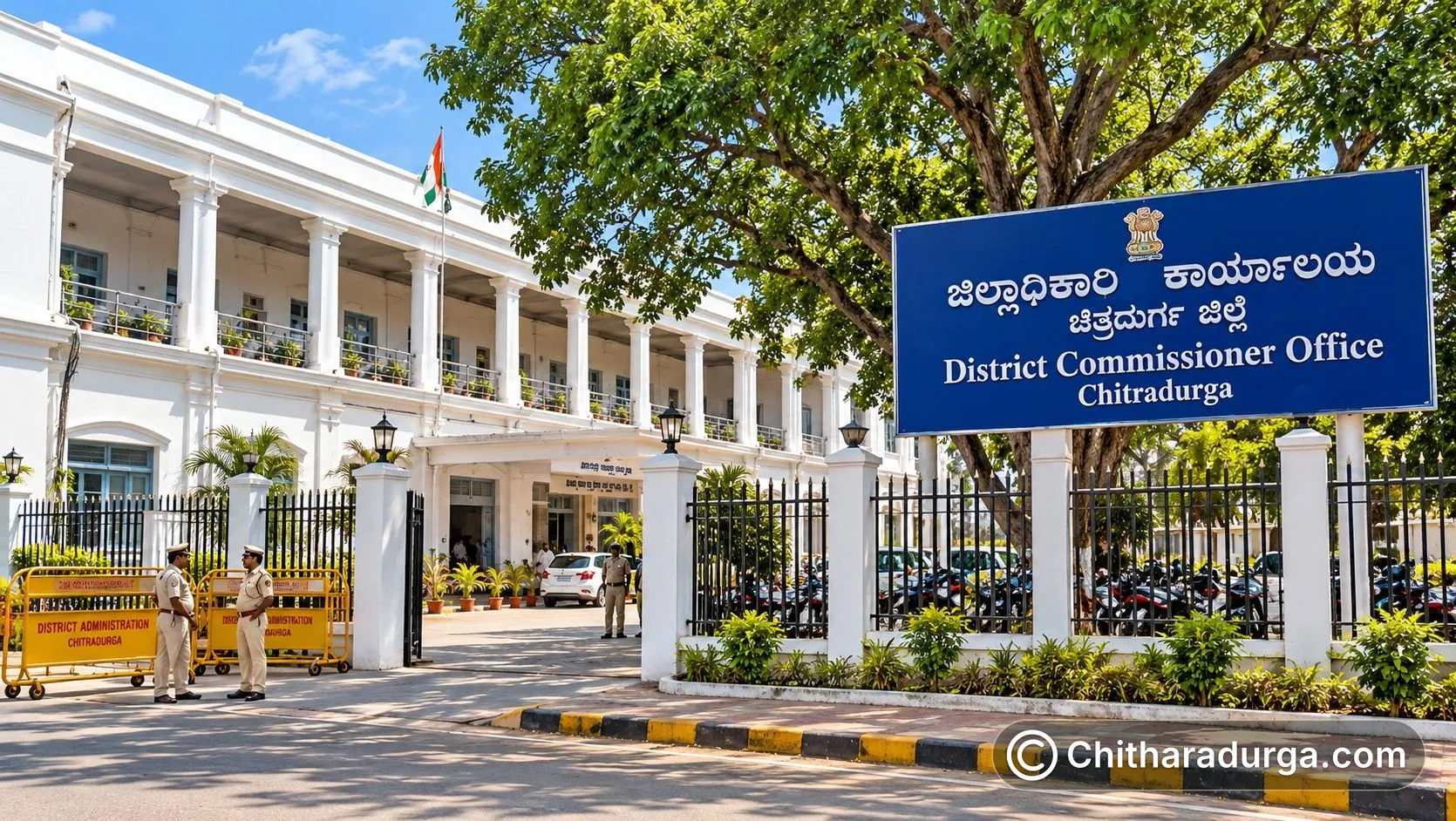
The Deputy Commissioner’s Office, often referred to as the Collectorate, is the administrative centre of Chitradurga District.
It consists of several branches responsible for different aspects of district administration. These branches are supervised by designated officers and administrative staff who handle revenue, judicial, election, establishment and other government functions.
The Deputy Commissioner is assisted by the Additional Deputy Commissioner, Assistant Commissioner, Tahsildars, Shirshtedars, Revenue Inspectors, Village Accountants and other officials working at different administrative levels.
This creates a structured administrative chain connecting the district headquarters with taluks, hoblis and villages.
Revenue Administration
Revenue administration is one of the most important responsibilities of the District Administration.
The Revenue Department deals with land records, government land, revenue collection, land-related matters, certificates and several other services required by citizens.
At the district level, the Deputy Commissioner supervises revenue administration. The Assistant Commissioner operates at the subdivision level, while Tahsildars head revenue administration within individual taluks.
Below the taluk level, Revenue Inspectors and Village Accountants help maintain the connection between government administration and villages.
This hierarchy enables land and revenue matters to be managed systematically from the village level to the district headquarters.
District Magistracy and Law & Order
The Deputy Commissioner, in the capacity of District Magistrate, plays an important coordinating role in maintaining peace and public order.
The District Administration works closely with the Superintendent of Police and the District Police during major public events, elections, emergencies, festivals, natural disasters and other situations requiring coordinated administration.
While policing and crime prevention are primarily handled by the Police Department, coordination between the civil administration and police is essential for maintaining public safety throughout the district.
Development Administration
District administration is not limited to revenue and regulatory responsibilities. An equally important objective is the social and economic development of Chitradurga District.
Government departments implement programmes covering areas such as:
Agriculture • Rural Development • Education • Healthcare • Drinking Water • Roads • Housing • Social Welfare • Women and Child Development • Employment • Irrigation • Urban Development • Food and Civil Supplies
The District Administration coordinates with these departments to help ensure that government schemes and development programmes are implemented effectively.
Zilla Panchayat and Rural Development
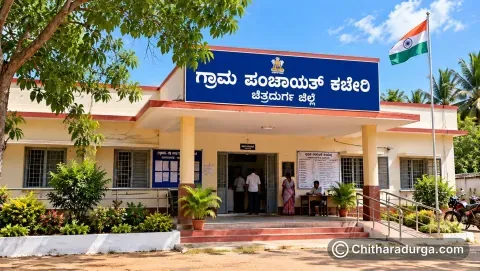
The Chitradurga Zilla Panchayat plays a major role in rural development and decentralised governance.
It represents the district tier of Karnataka's three-tier Panchayat Raj system, followed by Taluk Panchayats and Gram Panchayats.
Administratively, the Zilla Panchayat is headed by its Chief Executive Officer (CEO). Its work is organised into sections dealing with administration, development, accounts, planning and council-related matters.
The Zilla Panchayat coordinates numerous programmes involving rural development, drinking water, minor irrigation, roads and other development activities.
Taluk-Level Administration
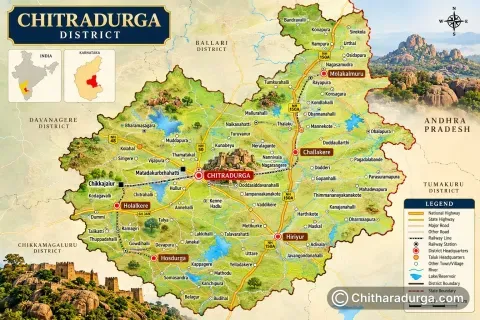
Chitradurga District consists of six taluks:
Chitradurga • Challakere • Hiriyur • Holalkere • Hosadurga • Molakalmuru
Each taluk has its own administrative structure, with the Tahsildar playing a major role in revenue administration.
Taluk offices bring government services closer to residents by dealing with revenue matters, certificates, land-related administration and several other citizen services.
The Taluk Panchayats constitute the intermediate tier of rural local governance and coordinate development programmes within their respective taluks.
Hobli and Village Administration
Below the taluk level, the district is divided into hoblis and villages.
Hoblis are important units of revenue administration and generally consist of groups of villages. Revenue Inspectors and other field-level officials assist in administering these areas.
At the village level, Village Accountants and local administrative institutions form an important connection between residents and higher levels of government.
This decentralised system enables administrative services to reach even remote villages of Chitradurga District.
Urban Administration
Urban governance in the district is carried out through municipal institutions under the framework of Karnataka's urban administration system.
Chitradurga District currently has urban local bodies serving Chitradurga, Challakere, Hiriyur, Holalkere, Hosadurga, Molakalmuru and Nayakanahatti.
These bodies are responsible for civic services such as sanitation, roads, drainage, street lighting, solid-waste management, property-related municipal services and development of public amenities.
The District Urban Development Cell (DUDC) at the district level helps coordinate urban-development programmes involving these local bodies.
Elections and Electoral Administration
The District Administration also has significant responsibilities during elections.
It coordinates the administrative arrangements required for elections to the Lok Sabha, Karnataka Legislative Assembly and local bodies, as applicable.
Responsibilities include electoral-roll related administration, polling arrangements, deployment and training of election personnel, coordination of polling stations, implementation of Election Commission directions and other statutory election duties.
Disaster Management
The District Administration plays a central coordinating role during natural disasters and other emergencies.
Given Chitradurga's semi-arid environment, drought and water scarcity can be important concerns in some years. The administration coordinates preparedness, relief and response activities with departments responsible for revenue, agriculture, health, police, fire and emergency services, local bodies and rural development.
Citizen Services
Modern district administration increasingly focuses on making government services accessible to citizens through both physical offices and digital platforms.
Residents can approach the relevant Deputy Commissioner's Office, Taluk Offices, Gram Panchayats, Municipal Offices and departmental offices depending on the service required.
Online government platforms have also made many services relating to certificates, land records, welfare schemes and other citizen requirements easier to access.
Coordination Among Government Departments
One of the most important functions of the District Administration is inter-departmental coordination.
Chitradurga has district-level offices covering agriculture, horticulture, animal husbandry, education, health, social welfare, backward classes welfare, women and child development, public works, food and civil supplies, transport, tourism, municipal administration, rural development and numerous other sectors.
The District Administration helps bring these departments together when programmes or public issues require coordinated action.
Connecting Government and the People
The strength of Chitradurga's administrative system lies in its multi-level structure.
From the Deputy Commissioner's Office at Chitradurga to Taluk Offices, Hobli-level administration, Gram Panchayats and village-level institutions, the system is designed to bring government administration closer to citizens.
Alongside the Zilla Panchayat, municipal bodies, police and various government departments, the District Administration plays a central role in governance, public welfare, development and delivery of essential services across Chitradurga District.