Rashtrakutas in Chitradurga
Rashtrakutas in Chitradurga
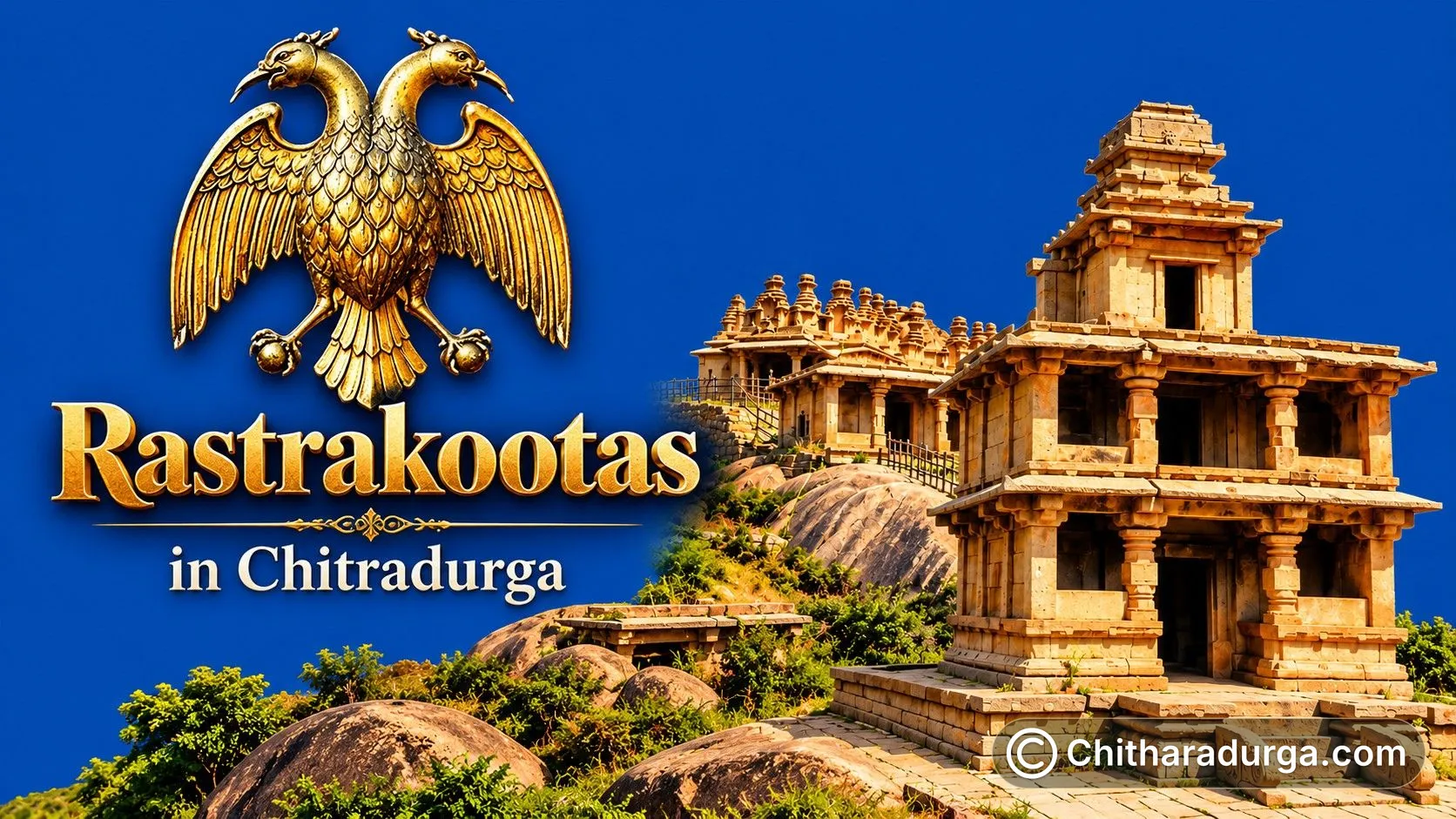
The Rashtrakutas were one of the most powerful dynasties of the Deccan and played an important role in the early medieval history of Karnataka. From the 8th to the 10th century CE, their empire extended across large parts of the Deccan and South India. The region corresponding to present-day Chitradurga district formed part of the wider political and cultural landscape influenced by Rashtrakuta authority.
Chitradurga under the Rashtrakutas
The Rashtrakutas rose to imperial power under Dantidurga in the 8th century after weakening the authority of the Badami Chalukyas. They established control over extensive territories in Karnataka and the Deccan, with Manyakheta (present-day Malkhed) later becoming their celebrated imperial capital.
Located in central Karnataka, the Chitradurga region occupied a strategically useful position between different parts of the Deccan. Its rocky terrain, agricultural settlements and routes connecting northern and southern Karnataka gave the region political and economic importance.
Administration and Local Chiefs
The Rashtrakutas governed their vast empire through a combination of imperial authority and regional administration. Provinces and smaller territorial divisions were administered by royal officials, feudatory chiefs and local authorities.
Village institutions played an important role in managing agricultural land, revenue and local affairs. Land grants to religious establishments, temples and individuals were also an important feature of the period. Such administrative traditions influenced the development of settlements in the wider Chitradurga region.
Religion and Temple Culture
The Rashtrakutas are remembered for their broad patronage of Hinduism and Jainism. Shaiva and Vaishnava traditions flourished alongside Jain religious institutions under different rulers and local patrons.
Temples and religious centres were important not only for worship but also for education, cultural activities and local economic life. The religious diversity encouraged during the Rashtrakuta age contributed to the broader cultural development of medieval Karnataka.
Kannada Literature and Culture
The Rashtrakuta period occupies a distinguished place in the history of Kannada literature. The famous Kavirajamarga, composed during the reign of Amoghavarsha I, is the earliest surviving major work on Kannada poetics and literary tradition.
Kannada and Sanskrit scholarship flourished under Rashtrakuta patronage. Writers, poets, Jain scholars and intellectuals contributed significantly to the literary and cultural heritage of Karnataka.
Agriculture, Trade and Economy
Agriculture formed the economic foundation of the region. Villages depended on cultivated land, tanks, wells and other local sources of water. Land grants and the expansion of agricultural settlements contributed to the development of rural communities.
The central location of the Chitradurga region also connected it with routes linking different parts of Karnataka and the Deccan. These routes supported the movement of agricultural products, livestock and other commodities.
Inscriptions and Historical Evidence
Stone and copper-plate inscriptions are important sources for understanding the Rashtrakuta period. They contain information about rulers, administrative divisions, local chiefs, land grants, religious institutions, taxation and village society.
Inscriptions and other archaeological remains from central Karnataka help historians understand the wider political and cultural environment in which the Chitradurga region developed during the Rashtrakuta age.
Legacy of the Rashtrakutas in Chitradurga
The Rashtrakuta period forms an important chapter in the early medieval history of Chitradurga. Their wider influence on administration, religion, Kannada culture, agriculture, settlements and regional political organization contributed to the historical development of central Karnataka.
By the late 10th century, Rashtrakuta power declined and the Kalyani Chalukyas (Western Chalukyas) emerged as the dominant power in much of Karnataka. They were followed in later centuries by the Hoysalas, Vijayanagara Empire and Chitradurga Nayakas.
Thus, the Rashtrakuta period represents an important early stage in the long historical transformation that eventually shaped medieval Chitradurga.