Sri T. S. Venkannaiah - A Great Scholar, Teacher and Architect of Modern Kannada Literary Culture
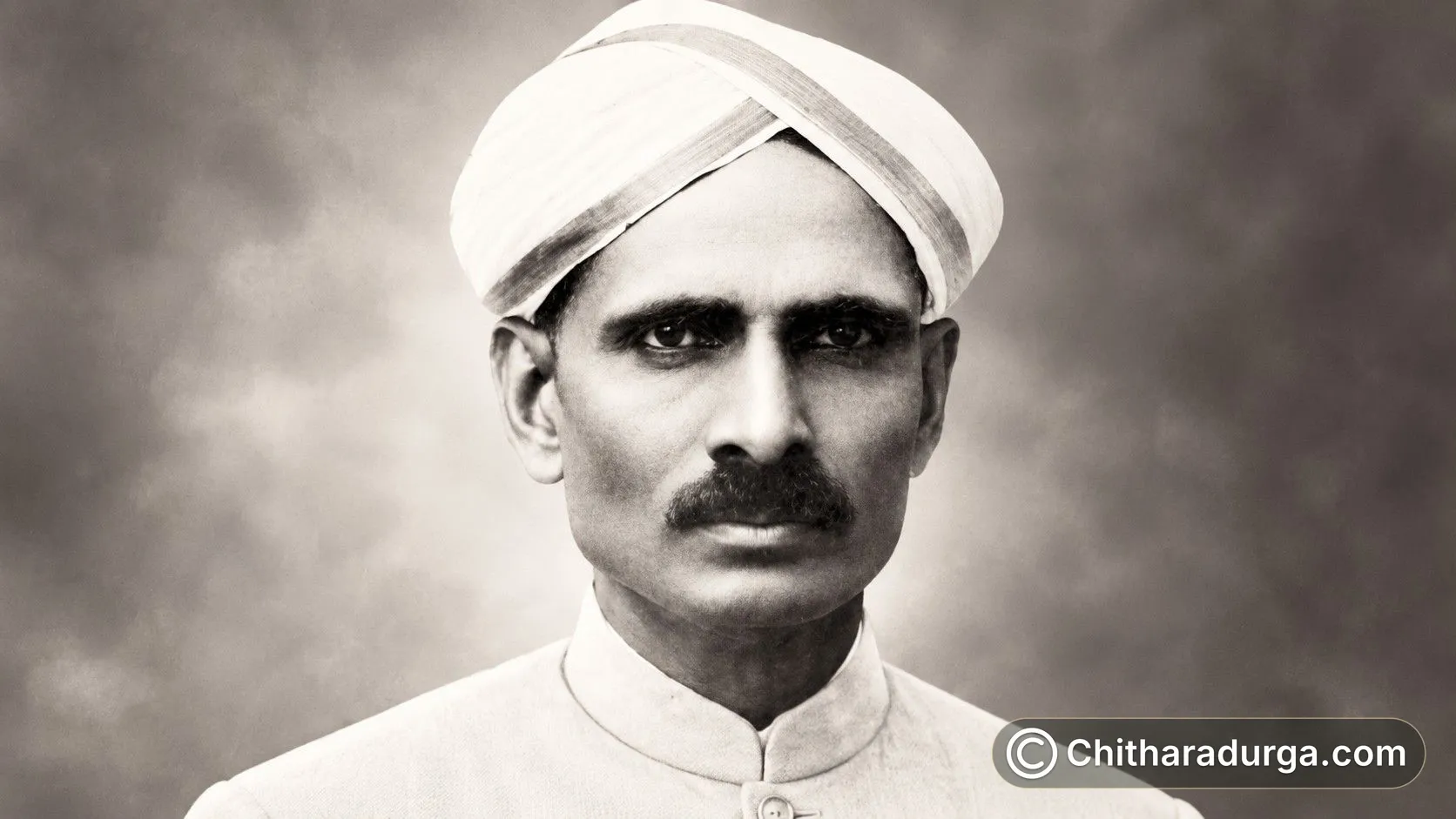
Taluku Subbanna Venkannaiah (T. S. Venkannaiah) was one of the distinguished scholars who played an important role in the renaissance of modern Kannada literature during the early decades of the twentieth century. Born on 1 October 1885 at Talaku village in Challakere Taluk of Chitradurga district, he rose from a rural background to become a respected scholar, teacher, editor, translator and literary mentor.
His contribution is particularly significant to Chitradurga district, for the small village of Talaku gave Karnataka a scholar whose influence reached the highest levels of Kannada education and literature.
Early Life and Education
Venkannaiah was born to Subbanna and Lakshmidevamma. His family environment encouraged an early acquaintance with the Ramayana, Mahabharata and other literary and spiritual works. His father Subbanna himself had literary interests and was known for his ability to compose poetry.
After his early schooling, Venkannaiah pursued higher education and eventually specialised in Kannada. He completed his B.A. and later obtained an M.A. in Kannada in 1914, at a time when pursuing advanced academic study in Kannada itself was far less common than it is today.
From Teacher to Professor
Venkannaiah began his teaching career with assignments at places including Dharwad, Doddaballapur and St. Joseph's College in Bangalore. In 1918, he became a lecturer in Kannada at Central College, Bangalore.
A major milestone came in 1927, when he became the first Professor of Kannada at the University of Mysore. He continued to serve the university and Kannada scholarship for the remainder of his life.
This achievement was important not merely for Venkannaiah personally. It represented the growing recognition of Kannada as a serious field of university-level literary and linguistic study.
A Teacher Who Created Writers
Perhaps one of Venkannaiah's greatest contributions was his ability to recognise, encourage and nurture literary talent.
Rather than concentrating only on producing a large body of his own writings, he devoted considerable energy to encouraging young writers and students. His influence helped create an intellectual environment in which modern Kannada literature could flourish.
Among his celebrated students was Kuvempu (K. V. Puttappa), who later became one of the greatest names in Kannada literature and Karnataka's Rashtrakavi. Kuvempu remembered his teacher with great affection and respect.
Thus, Venkannaiah's contribution cannot be measured simply by the books carrying his name. Part of his legacy lives through the writers and scholars whom he inspired.
‘Prabuddha Karnataka’ and the Kannada Renaissance
Venkannaiah, together with A. R. Krishnashastry, played an important role in the publication and development of ‘Prabuddha Karnataka’, a periodical that became highly influential in the growth of modern Kannada literature, particularly in the former Mysore region.
He was also closely involved with the Central College Karnataka Sangha in Bangalore and the Maharaja College Karnataka Sangha in Mysore.
Through literary activities, publications, student initiatives and encouragement of emerging writers, these institutions became important centres of Kannada intellectual life.
Master of Several Languages
Venkannaiah's scholarship was strengthened by his command of several languages.
In addition to Kannada and Sanskrit, he was familiar with Telugu, Tamil, Bengali and English. This multilingual ability enabled him to introduce Kannada readers to important works and ideas from other Indian literary traditions.
One notable example was ‘Pracheena Sahitya’, his Kannada translation of important writings of Rabindranath Tagore from Bengali. He was also involved in translating works connected with the life and teachings of Sri Ramakrishna Paramahamsa.
Preserving Ancient Kannada Literature
T. S. Venkannaiah was also an accomplished editor of classical Kannada texts.
His editorial work included important texts such as ‘Basavarajadevara Ragale’, ‘Karnataka Kadambari Sangraha’, ‘Harishchandra Kavya Sangraha’ and ‘Siddarama Chariteya Sangraha’. Some of these projects were undertaken jointly with other distinguished scholars.
Working in an era when manuscripts were difficult to locate and compare, such textual scholarship demanded enormous patience and linguistic knowledge.
He also contributed to revised editions of Pampa Bharata and Kumaravyasa Bharata, further strengthening the preservation and scholarly study of classical Kannada literature.
Contribution to Kannada Language Studies
Venkannaiah's scholarship extended beyond literature.
He contributed sections dealing with Old Kannada grammar and the history of the Kannada language to Kannada Kaipidi, an important academic publication of the University of Mysore.
His writings demonstrate his interest in understanding Kannada not merely as a literary medium but as a language with a deep historical evolution and classical heritage.
A Man Who Put Kannada Before Himself
Venkannaiah belonged to a generation that worked to secure dignity and academic recognition for Kannada.
His importance lies not only in what he personally wrote but also in what he enabled others to write.
He edited old texts, translated important works, encouraged new writers, supported Kannada associations, strengthened literary publications and taught a generation of students.
This made him an institution-builder as much as a scholar.
An Enduring Legacy
T. S. Venkannaiah passed away in 1939, leaving behind a remarkable intellectual legacy.
Kuvempu later edited a commemorative volume titled ‘Savi Nenapu’ in his honour — an indication of the affection and respect Venkannaiah commanded among his students and contemporaries.
For Talaku and Chitradurga, he remains a source of immense cultural pride. For the University of Mysore, he occupies a pioneering place in Kannada studies. For Kannada literature, he remains one of those rare teachers whose greatest achievement was helping an entire literary culture grow.
T. S. Venkannaiah did not merely teach Kannada; he nurtured writers, preserved its classics, strengthened its scholarship and helped prepare the ground on which modern Kannada literature flourished.