
Geographical Status of Chitradurga
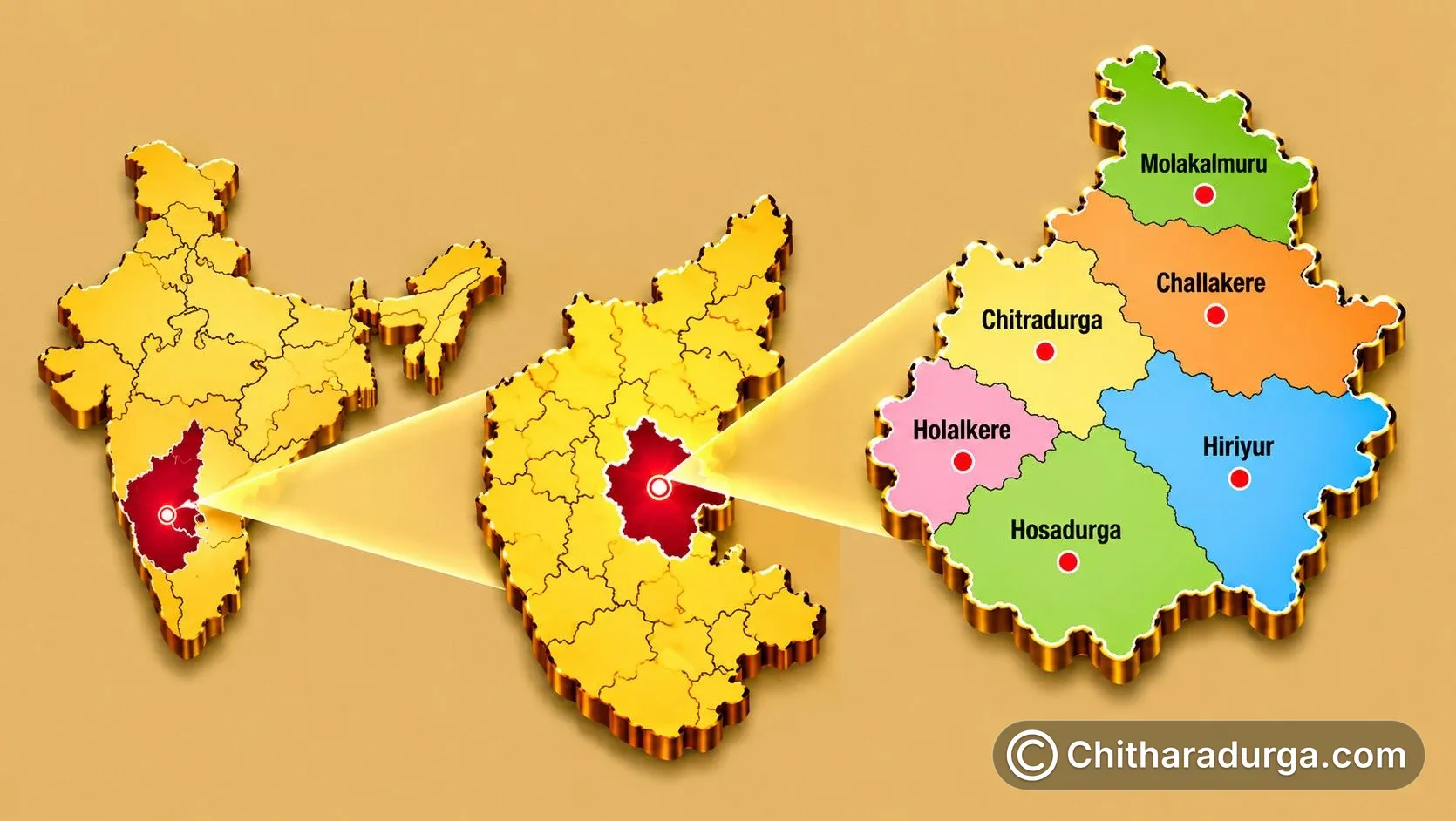
Geographical Status of Chitradurga
Chitradurga District is situated in the central part of Karnataka in southern India. Its strategic location on the Deccan Plateau gives the district a distinctive natural landscape characterised by rocky hills, extensive open plains, scattered valleys and massive natural boulder formations.
The district headquarters, Chitradurga city, is located approximately 200 kilometres northwest of Bengaluru and serves as an important connecting point between different regions of northern and southern Karnataka.
Location and Geographical Coordinates
Chitradurga District extends approximately between 13°34′ and 15°02′ North latitude and 75°37′ and 77°01′ East longitude. Its location in the interior of the Deccan Plateau has significantly influenced the district’s climate, vegetation, agricultural practices, water resources and settlement patterns.
Chitradurga city itself is surrounded by a chain of rocky hills. These natural hills and massive boulder formations played an important role in the construction and development of the historic Chitradurga Fort. The natural terrain was skilfully incorporated into the fort’s formidable defensive system.
Geographical Area
Chitradurga District covers an area of approximately 8,436 square kilometres, making it one of Karnataka’s significant interior districts. Administratively, the district comprises six taluks:
Chitradurga • Challakere • Hiriyur • Holalkere • Hosadurga • Molakalmuru
The terrain varies considerably across the district. While large areas consist of open plains and agricultural land, other parts are characterised by rocky hill ranges, ridges, valleys and exposed ancient rock formations.
Boundaries
Chitradurga occupies an important geographical position in central Karnataka. It is bordered by Davanagere District to the west, Ballari District to the north, Tumakuru District towards the south and southeast, and Chikkamagaluru District towards the southwest. The eastern part of the district extends towards Karnataka’s border region with Andhra Pradesh.
Historically, this geographical position made Chitradurga an important passage connecting different parts of the Deccan. Even today, major national and state highways passing through the district continue to strengthen its importance as a transportation, trade and commercial corridor.
The Deccan Plateau Landscape
Chitradurga forms part of the ancient Deccan Plateau, and its geographical identity is closely associated with its rugged rocky terrain. Throughout the district, visitors can see massive boulders, exposed rock formations, isolated hills and unusual natural geological formations.
The rocky hills surrounding Chitradurga city are particularly impressive. Rather than remaining separate from the historic fort, these hills became an integral part of its architecture and defensive design. Natural rocks, narrow passages and elevated positions were effectively incorporated into the fortifications. This provides a remarkable example of how geography influenced the history and military development of Chitradurga.
The district also contains elevated areas such as Jogimatti, along with numerous smaller hills and valleys that add further diversity to its natural landscape.
Climate and Geographical Conditions
Chitradurga lies in the interior of Karnataka, away from the coastal belt and the high-rainfall regions of the Western Ghats. As a result, much of the district experiences a semi-arid climate. Rainfall is generally limited and irregular, and many parts of the district depend on seasonal rainfall, tanks, reservoirs and groundwater for agriculture.
Another distinctive natural feature of Chitradurga is its windy environment. The expansive open plateau, gaps between the hills and local geographical conditions create favourable conditions for strong winds in several parts of the district.
This natural advantage has contributed to the establishment of numerous wind-energy projects, and wind turbines have become a familiar feature of the modern landscape in several parts of Chitradurga.
Strategic Importance of the Location
Chitradurga’s geographical location has played an important role throughout its history. Its rocky hills provided excellent natural defence, while its strategic position in the interior Deccan made the region important to rulers and kingdoms seeking control over major routes.
In modern times, Chitradurga’s central geographical position continues to provide significant advantages. Major road networks connect the district with Bengaluru, Tumakuru, Davanagere, Ballari and other important urban and commercial centres. These connections support the movement of people, agricultural produce, goods, trade and services.
Where Geography Meets History
Few places demonstrate the relationship between geography and history as clearly as Chitradurga. Here, ancient rocks became part of fortress walls, hills became watchpoints, valleys supported settlements, and the district’s strategic location transformed Chitradurga into an important gateway across Karnataka’s interior.
With its central geographical location, vast Deccan Plateau, dramatic rocky hills, open plains and wind-swept landscape, Chitradurga possesses a geographical character of its own.
Nature shaped this land over millions of years, and centuries of human civilisation enriched it with history, culture and life. In Chitradurga, the land itself tells its story.