Smt. Onake Obavva – The Fearless Heroine of Chitradurga
Onake Obavva – The Fearless Heroine of Chitradurga
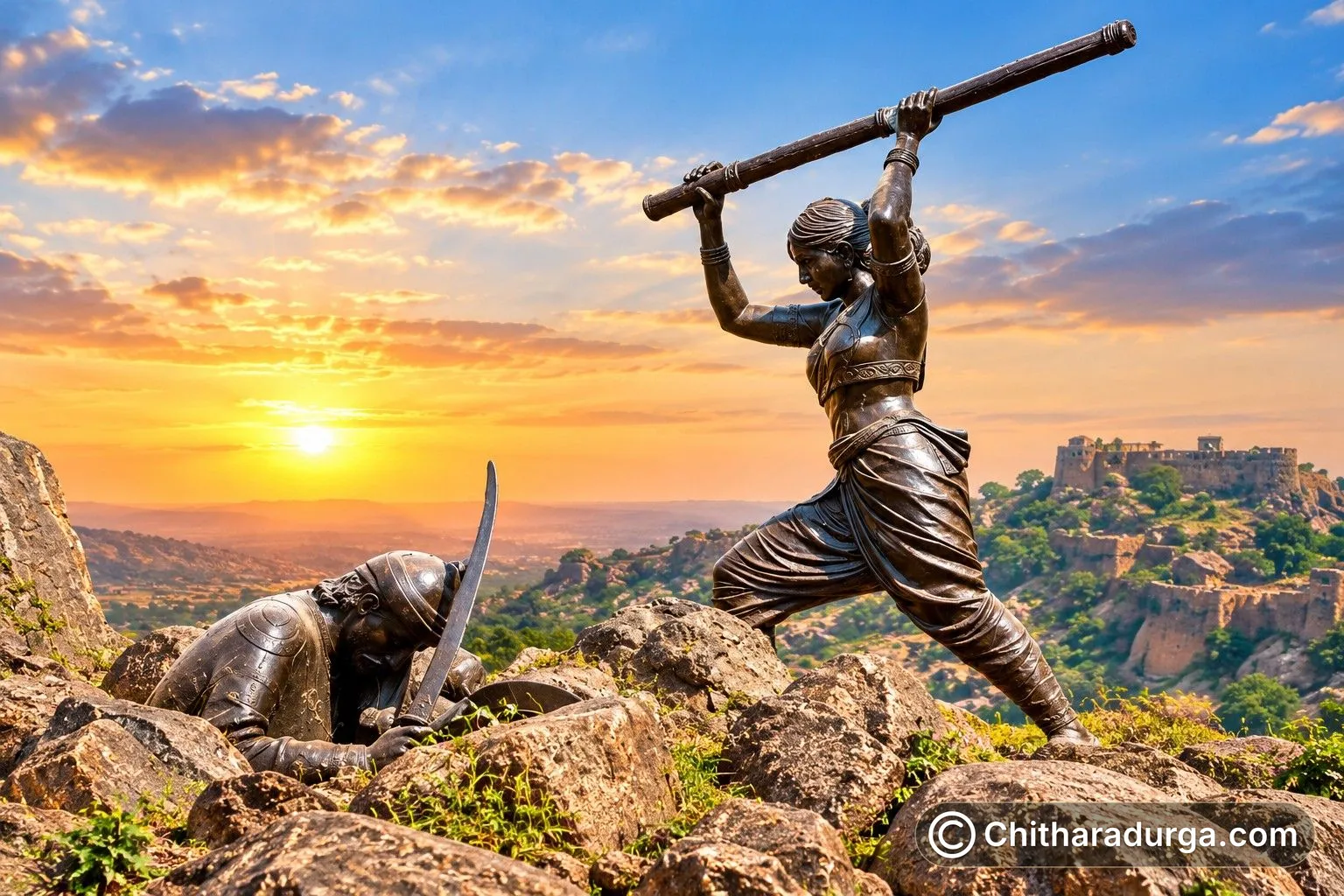
Onake Obavva is one of the most celebrated women in the history and folklore of Karnataka. Closely associated with the magnificent Chitradurga Fort, she is remembered for her extraordinary courage in defending the fort against enemy soldiers with nothing more than an onake—a traditional wooden pestle used for pounding grain.
Her story has been passed down through generations and has become an enduring symbol of courage, presence of mind, patriotism and resistance. The narrow opening in the fort traditionally associated with her heroic stand is known today as “Obavvana Kindi”, and remains one of Chitradurga's best-known historic landmarks.
Chitradurga – The Land of the Nayakas
The story of Onake Obavva belongs to the period when Chitradurga was ruled by the Nayakas of Chitradurga, a dynasty that controlled the region for several generations.
The rocky landscape surrounding Chitradurga provided a natural defensive advantage. Over time, its rulers strengthened the hill fortress with massive stone walls, gateways, watchtowers, reservoirs and several layers of fortifications.
The great Chitradurga Fort, popularly known as Kallina Kote — the Stone Fortress, eventually developed into a formidable defensive complex. Its system of fortifications included seven concentric defensive walls, contributing to its reputation as a difficult stronghold to capture.
It was against this dramatic backdrop of rocky hills, stone walls and military conflict that the story of Onake Obavva unfolded.
The Threat from Hyder Ali
During the eighteenth century, Hyder Ali, ruler of Mysore, sought to expand his authority over several territories in southern India, including Chitradurga.
At the time associated with Obavva's story, Chitradurga was ruled by Madakari Nayaka, the last major ruler of the Nayaka dynasty.
The strong fortifications of Chitradurga made a direct assault difficult. According to the traditional account, Hyder Ali's forces searched for weaknesses through which soldiers could enter the fort without attracting the attention of its defenders.
They are said to have discovered a small opening or crevice in the fortifications through which a soldier could squeeze into the fort one at a time.
That narrow passage would become forever associated with the name of Onake Obavva.
An Ordinary Woman Faced with an Extraordinary Moment
Onake Obavva was not a queen, commander or trained soldier.
Tradition remembers her as the wife of a guard connected with the fort, commonly identified as Kahale Mudda Hanuma. Her husband was reportedly serving on guard duty when the incident occurred.
According to the popular narrative, one day Obavva went to fetch drinking water while her husband was having his meal.
As she approached the water source, she noticed something unusual near a narrow opening in the fort wall.
Enemy soldiers were secretly entering the fort.
Obavva immediately understood the danger. If the soldiers succeeded in entering unnoticed, they could open the way for a larger attack and place the fort and its people at risk.
There was little time to seek assistance.
She had to act.
The Onake Becomes a Weapon
Obavva had no sword, spear or military weapon with her.
What she had was an onake, a long wooden pestle traditionally used in households for pounding grain.
According to the celebrated account, Obavva positioned herself beside the narrow passage and waited.
As an enemy soldier emerged through the opening, she struck him with the onake. She then moved the body aside so that the soldiers following behind would not immediately realise what had happened.
Another soldier entered.
Obavva struck again.
One after another, soldiers attempting to pass through the narrow opening were confronted by a woman they had never expected to find guarding the passage.
The confined space worked to her advantage: the soldiers could enter only individually, preventing them from overwhelming her as a group.
The story of a household pestle becoming a weapon of defence would eventually give her the name by which generations remember her:
Onake Obavva.
A Story of Extraordinary Courage
Popular tradition says that Obavva continued defending the opening and killed numerous enemy soldiers before her husband returned and discovered what was happening.
Accounts differ about some details of the incident, including the exact number of soldiers involved and the circumstances of Obavva's death. Like many episodes preserved through local history and oral tradition, parts of her story have acquired legendary dimensions over generations.
Yet the central image has remained remarkably powerful:
a woman standing alone at a narrow opening in the walls of Chitradurga Fort, defending her homeland with an ordinary household tool.
That image transformed Obavva from a figure in a local historical episode into one of Karnataka's enduring symbols of bravery.
Obavvana Kindi – A Passage into History
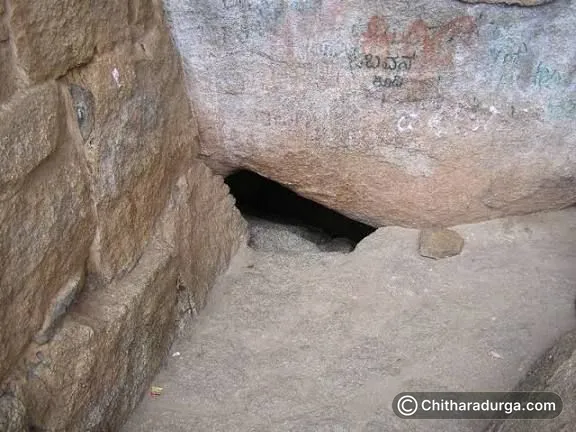
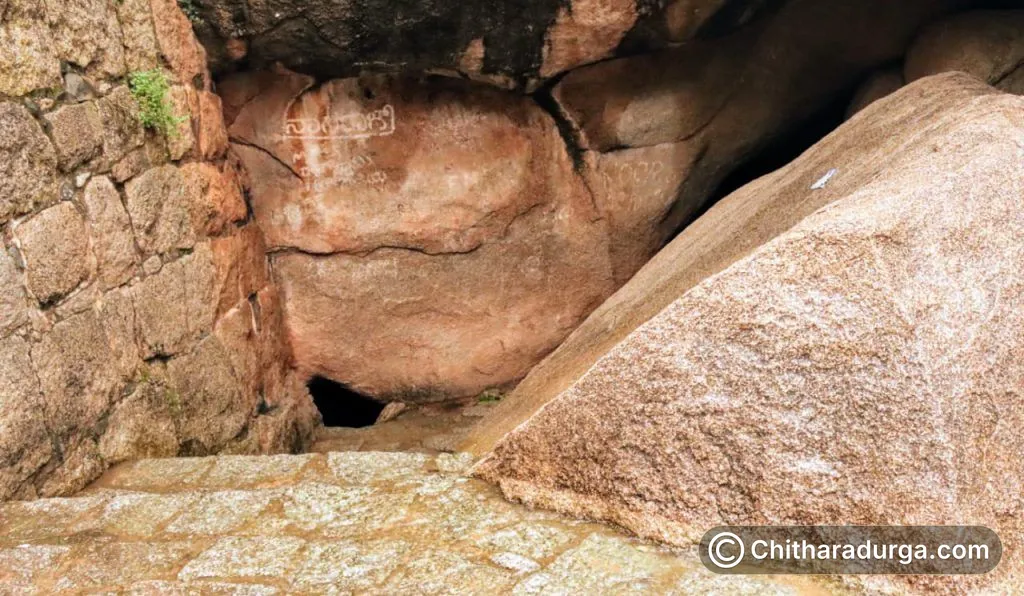
The narrow opening associated with Obavva's defence is popularly known as Obavvana Kindi.
In Kannada, kindi refers to a small opening or passage.
Located within the historic Chitradurga Fort, the site continues to be closely identified with her story and is a well-known attraction for visitors exploring the fort. Contemporary descriptions of Chitradurga Fort continue to identify Obavvana Kindi as the place associated with Onake Obavva's celebrated resistance.
For visitors, the location helps make the story tangible. The narrowness of the passage gives an immediate sense of how such a defensive action could have taken place—one person emerging at a time into a confined space.
Today, Obavvana Kindi is much more than a physical opening in a stone wall.
It has become a memorial to courage.
A Heroine Without a Throne
One of the most remarkable aspects of Onake Obavva's story is that she did not belong to royalty.
She commanded no army.
She held no official position of power.
She possessed no sophisticated weapon.
Yet when confronted with danger, she responded with extraordinary presence of mind and determination.
This is perhaps why her story continues to connect so strongly with people. Her heroism suggests that courage is not determined by social position, wealth or military rank.
In the decisive moment, an ordinary citizen could become the defender of an entire fortress.
A Symbol of Women's Courage
Over the centuries, Onake Obavva has grown into a powerful cultural symbol of women's courage and self-confidence in Karnataka.
Her name is invoked in literature, cultural programmes, public commemorations and initiatives intended to inspire women and young people.
The Government of Karnataka has also used her name for a self-defence training programme for girl students, reflecting the continuing association between Obavva and the ideals of courage and self-protection.
Her story therefore extends beyond the eighteenth-century walls of Chitradurga.
For many people today, Onake Obavva represents the idea that strength can emerge from unexpected places and that determination in a critical moment can leave a legacy lasting for centuries.
Onake Obavva and the Identity of Chitradurga
Few historical personalities are as closely identified with Chitradurga as Onake Obavva.
The imposing stone fort, the rocky hills and Obavvana Kindi together preserve the setting of her story. Even today, institutions and landmarks in Chitradurga bear her name, demonstrating how deeply she has become embedded in the district's cultural memory. Karnataka government records, for example, identify institutions and locations in Chitradurga carrying the name Onake Obavva.
For the people of Chitradurga, her story is more than a tale from the past.
It forms part of the identity of a land renowned for its forts, warriors, rulers and resistance.
History, Memory and Legend
The story of Onake Obavva has been transmitted through generations through oral tradition, regional histories, literature and popular culture.
As a result, some details vary between accounts. The exact date of the incident, the number of enemy soldiers killed and certain circumstances surrounding her final moments are not uniformly documented in surviving historical sources.
It is therefore useful to distinguish between the historical setting—the Nayakas of Chitradurga, the fortress, the conflicts involving Hyder Ali—and details preserved primarily through popular tradition.
This uncertainty does not diminish Obavva's cultural importance.
Instead, it demonstrates how a historic act of resistance can become part of the collective memory of a people and continue to inspire generations long after the original event.
The Legacy of Onake Obavva
Onake Obavva's legacy rests on a remarkably simple but powerful story.
When danger appeared at the walls of her home, she did not wait for someone else to act.
She used what was available.
She defended the fort.
And her courage became immortal.
From an ordinary woman living within the walls of Chitradurga Fort, she became one of Karnataka's most recognizable heroines.
Her story continues to communicate timeless values:
Courage in the face of danger.
Presence of mind during a crisis.
Love for one's land and community.
Determination against overwhelming odds.
The strength and capability of women.
The Brave Heart of Chitradurga
Chitradurga is a land of massive stone walls, ancient temples, rocky hills and centuries of history. But among all its stories, the memory of a woman standing beside a tiny opening in the fort occupies a special place.
Onake Obavva did not need a crown to become a heroine. She did not need an army to demonstrate courage.
Armed with an ordinary wooden pestle and extraordinary determination, she became a symbol whose name has survived for generations.
Today, Obavvana Kindi continues to remind visitors that some of history's most memorable acts of courage are performed not by kings or commanders, but by ordinary people who rise to extraordinary circumstances.
For Chitradurga, Onake Obavva is not merely a character from the past.
She is a lasting symbol of the courage, resilience and fighting spirit of Chitradurga—and one of Karnataka's most treasured heroines.