District Profile
Chitradurga District Profile
Historical Identity
Chitradurga possesses a remarkable historical legacy that stretches from prehistoric human settlements to the modern era. Archaeological remains, inscriptions, monuments, forts and other historical traces belonging to different periods bear testimony to the district’s long and fascinating past.
Important archaeological sites such as Brahmagiri and Chandravalli provide valuable evidence for understanding ancient life and civilisation in the region. Archaeological discoveries at Chandravalli offer important insights into early settlements, trade and social life. Brahmagiri holds particular historical significance for its prehistoric remains and the presence of an inscription of Emperor Ashoka.
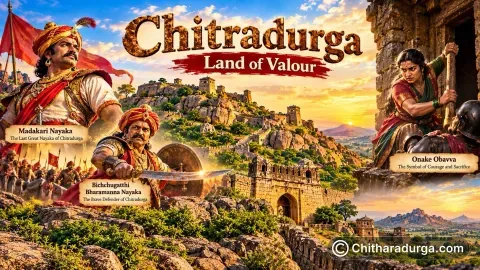
In the centuries that followed, the region came under the rule or influence of several major dynasties, including the Satavahanas, Kadambas, Chalukyas, Rashtrakutas, Hoysalas and the Vijayanagara Empire. The subsequent rise of the Nayakas of Chitradurga opened a new and significant chapter in the district’s history.
Geographical Character
Chitradurga has a distinctive natural landscape that immediately sets it apart. Large parts of the district are characterised by granite hills, rocky outcrops, valleys and expansive open plains, creating a geographical identity unlike many other regions of Karnataka.
The massive boulder formations and rocky hills surrounding Chitradurga city are among the district’s most striking natural features. Historically, rulers made strategic use of this rugged terrain to construct fortifications and defensive systems, demonstrating the close relationship between Chitradurga’s geography and its military history.
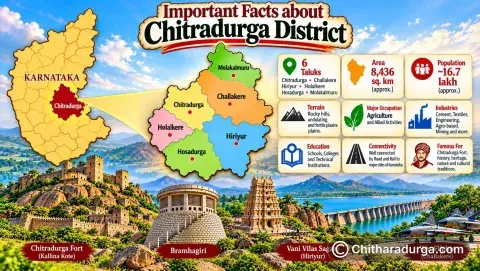
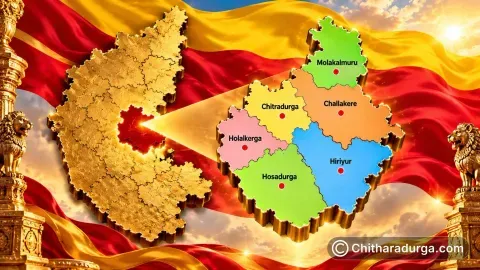
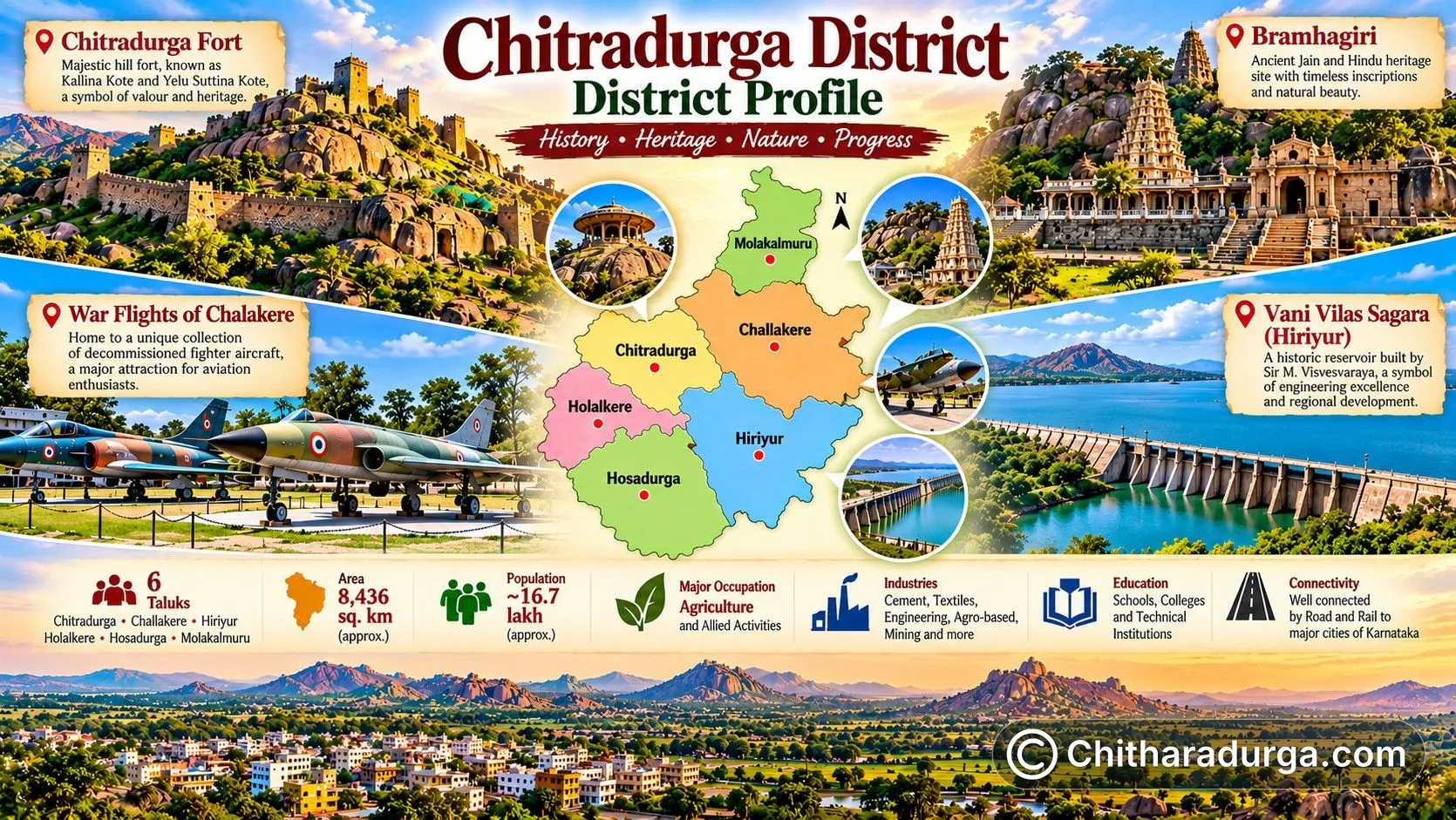
The present-day district covers an area of approximately 8,436 square kilometres and is divided into six taluks.
Heritage and Tourism
The most celebrated heritage and tourist attraction of the district is undoubtedly Chitradurga Fort. Built, strengthened and expanded during different historical periods, this magnificent hill fortress ingeniously combines natural hills and massive boulders with sophisticated man-made defensive structures. Today, it stands among Karnataka’s most important monuments of historical, architectural and military heritage.
Other important historical, cultural and natural destinations include Chandravalli, Brahmagiri, Ashoka Siddapura, Jatinga-Rameshwara, Vani Vilas Sagara and Jogimatti. In addition, numerous ancient temples, monasteries, forts, inscriptions and archaeological sites scattered across the district further enrich Chitradurga’s heritage landscape.
Together, these attractions make Chitradurga an important destination for heritage tourism, archaeological exploration, nature tourism, pilgrimage and cultural study.
Culture and Folklore
Chitradurga possesses a particularly rich oral and folk tradition. Folk songs, oral epics, devotional traditions, community customs and local narratives passed down through generations continue to preserve the social and cultural memory of the district.
Among the notable personalities associated with Chitradurga’s folk heritage, Siriyajji occupies a special place. Folk artists and custodians of oral traditions such as her have played an important role in preserving and transmitting thousands of folk verses, songs, stories and traditions to later generations. Various folk and performing arts also continue to thrive across different parts of the district.
Chitradurga has also made significant contributions to Kannada literature, theatre, scholarship, education and historical research. Its intellectual and cultural heritage therefore extends far beyond its celebrated military history and the stories of its great fort, embracing literature, folklore, performing arts and traditions of knowledge.
Agriculture and Rural Life
A large part of Chitradurga’s social and economic life has traditionally been closely connected with agriculture, livestock rearing and rural occupations. The district’s semi-arid climatic conditions have played an important role in shaping agricultural practices, crop choices, water-conservation systems and rural settlement patterns.
The historic tanks, reservoirs and traditional water-management systems found across the district demonstrate how local communities adapted to the region’s climatic conditions over generations.
Vani Vilas Sagara near Hiriyur is one of the best-known examples of the region’s long association with water management and irrigation. Reflecting the importance of water to agriculture and rural life, the reservoir has become one of the district’s prominent landmarks.
Chitradurga – Towards a New Identity
Modern Chitradurga is gradually adding new dimensions to its traditional identity. Alongside agriculture, trade and small-scale businesses, parts of the district are gaining importance in the fields of science, technology, renewable energy, education and infrastructure development.
In particular, the district’s expansive open terrain and climatic conditions have created opportunities for the development of renewable energy, including wind and solar power. Institutions associated with science and technology, along with emerging infrastructure projects, are adding a new dimension to Chitradurga’s contemporary identity.
The coexistence of heritage and progress gives present-day Chitradurga its distinctive character. While preserving and respecting its ancient roots, historical monuments and cultural traditions, the district is also participating in Karnataka’s evolving economic, scientific and technological landscape.
Preserving the legacy of its past while moving confidently towards the future, Chitradurga is a distinctive district where history and modern development come together on the same land.