
History Overview
History Overview of Chitradurga District
By Raghavendra Padmashali · 19 November 2026
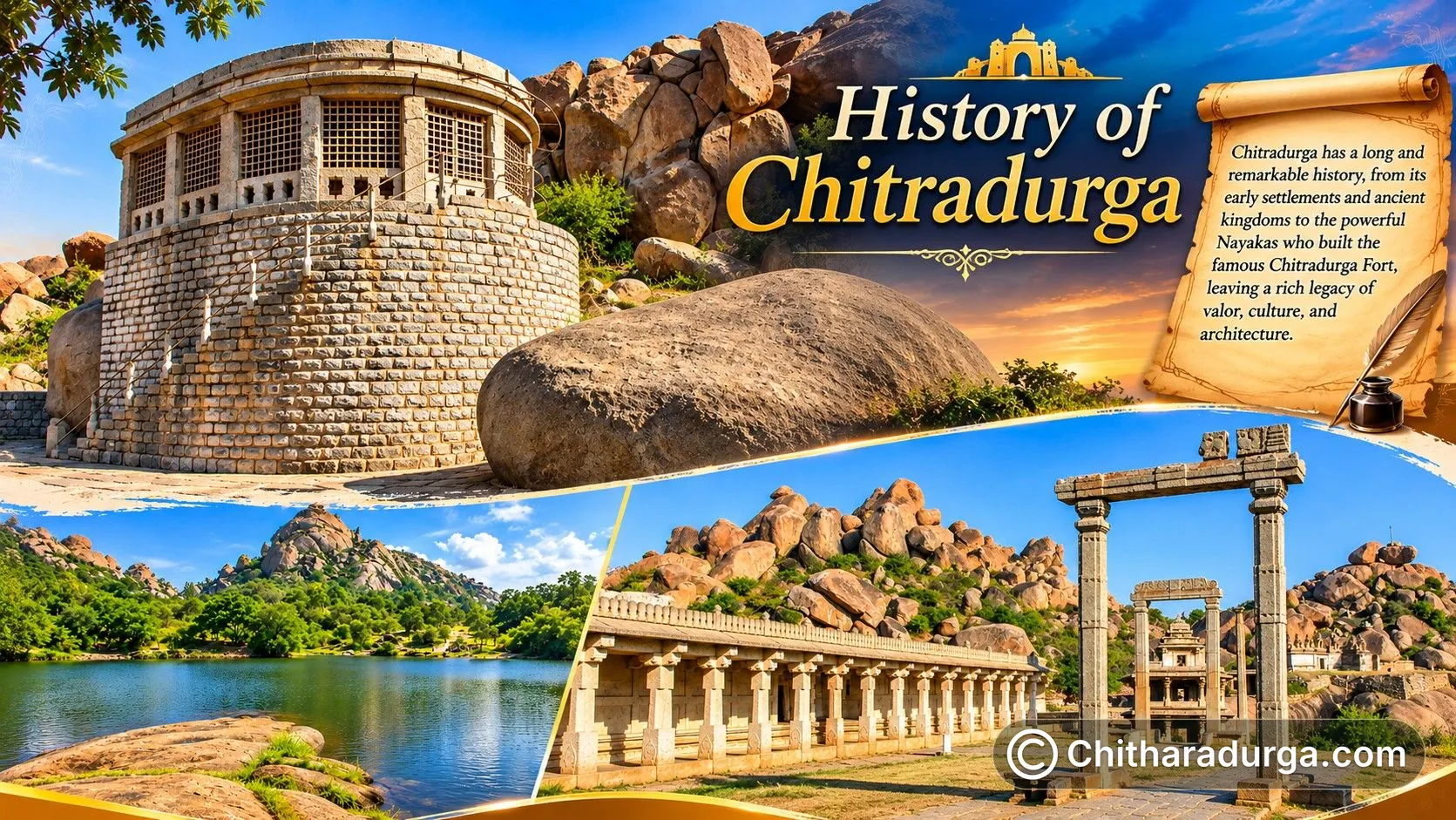
Chitradurga, one of Karnataka's most historically significant districts, is renowned for its ancient civilization, magnificent stone fortress, heroic legends, and rich cultural heritage. Surrounded by rocky hills, massive granite formations, picturesque valleys, and historical monuments, the region has a remarkable history extending thousands of years into the prehistoric period. Traditional names associated with Chitradurga include Hidimbapattana, Soolgallu, Bemmattanakallu, Chitrakaldurga, and Chatrakaldurga. More than a historic city, Chitradurga represents the courage, resilience, cultural diversity, and enduring spirit of Karnataka.
Prehistoric Period and Ancient Civilization: Archaeological discoveries reveal that human habitation in Chitradurga district dates back to the Stone Age. Brahmagiri in Molakalmuru taluk and Chandravalli near Chitradurga are among the region's most important archaeological sites. Excavations have uncovered Neolithic stone implements, pottery, Megalithic burial structures, iron tools, and remains of ancient settlements. The rock edicts of Emperor Ashoka discovered at Brahmagiri and nearby Siddapura and Jatinga-Rameshwara provide evidence of Mauryan influence during the third century BCE. These discoveries establish Chitradurga as an important region for understanding the prehistoric and early historic development of southern India.
Ancient and Medieval Dynasties: Following the Mauryan period, the Chitradurga region came under the influence of several powerful dynasties, including the Satavahanas, Kadambas, Badami Chalukyas, Rashtrakutas, Western Chalukyas of Kalyana, and Hoysalas. These rulers contributed to the development of agriculture, trade, religious institutions, temples, and regional administration. During the Vijayanagara Empire, Chitradurga emerged as an important military and administrative centre. Following the decline of Vijayanagara power in the sixteenth century, local chieftains known as the Nayakas or Palegars strengthened their authority, beginning one of the most celebrated chapters in the district's history.
The Glorious Era of the Chitradurga Nayakas: The Nayaka period occupies a special place in Chitradurga's historical identity. Prominent rulers included Timmanna Nayaka, Obanna Nayaka, Kasturi Rangappa Nayaka, Bharamanna Nayaka, Hiri Madakari Nayaka, and Madakari Nayaka V. They strengthened the region's administration, military organization, and defensive infrastructure. The magnificent Chitradurga Fort, with its seven defensive enclosures, massive gateways, watchtowers, and natural rocky barriers, became a formidable stronghold. One of the most celebrated figures of this era is Onake Obavva, whose extraordinary courage in confronting enemy soldiers with a wooden pestle became a lasting symbol of bravery in Karnataka's history.
Hyder Ali, Mysore Rule, and the British Period: During the eighteenth century, Chitradurga became a strategic target of Hyder Ali, the powerful ruler of Mysore. After several military campaigns and prolonged conflicts, Hyder Ali captured Chitradurga Fort in 1779, bringing the rule of Madakari Nayaka V to an end. The region subsequently came under Mysore's administration and retained its military significance during the reign of Tipu Sultan. Following Tipu Sultan's defeat in 1799, the Wodeyar dynasty was restored to the throne of Mysore under British paramountcy. Chitradurga remained part of the princely state of Mysore, experiencing gradual changes in administration, transportation, education, and public institutions.
Freedom Struggle and Modern Chitradurga: The people of Chitradurga district also contributed to India's struggle for independence. Nationalist movements inspired by Mahatma Gandhi, including the Swadeshi Movement, Non-Cooperation Movement, and Quit India Movement, encouraged political awareness and public participation across the region. After Indian independence in 1947, Chitradurga continued as part of Mysore State, which was renamed Karnataka in 1973. Today, Chitradurga Fort, Chandravalli, Brahmagiri, Vani Vilas Sagar, ancient temples, and numerous historical monuments preserve the district's remarkable heritage. From prehistoric settlements to modern development, Chitradurga's history remains a living testimony to Karnataka's courage, cultural achievements, and enduring traditions.