
Ancient History
Mauryan period in Chitradurga
By Raghavendra Padmashali · 29 October 2026
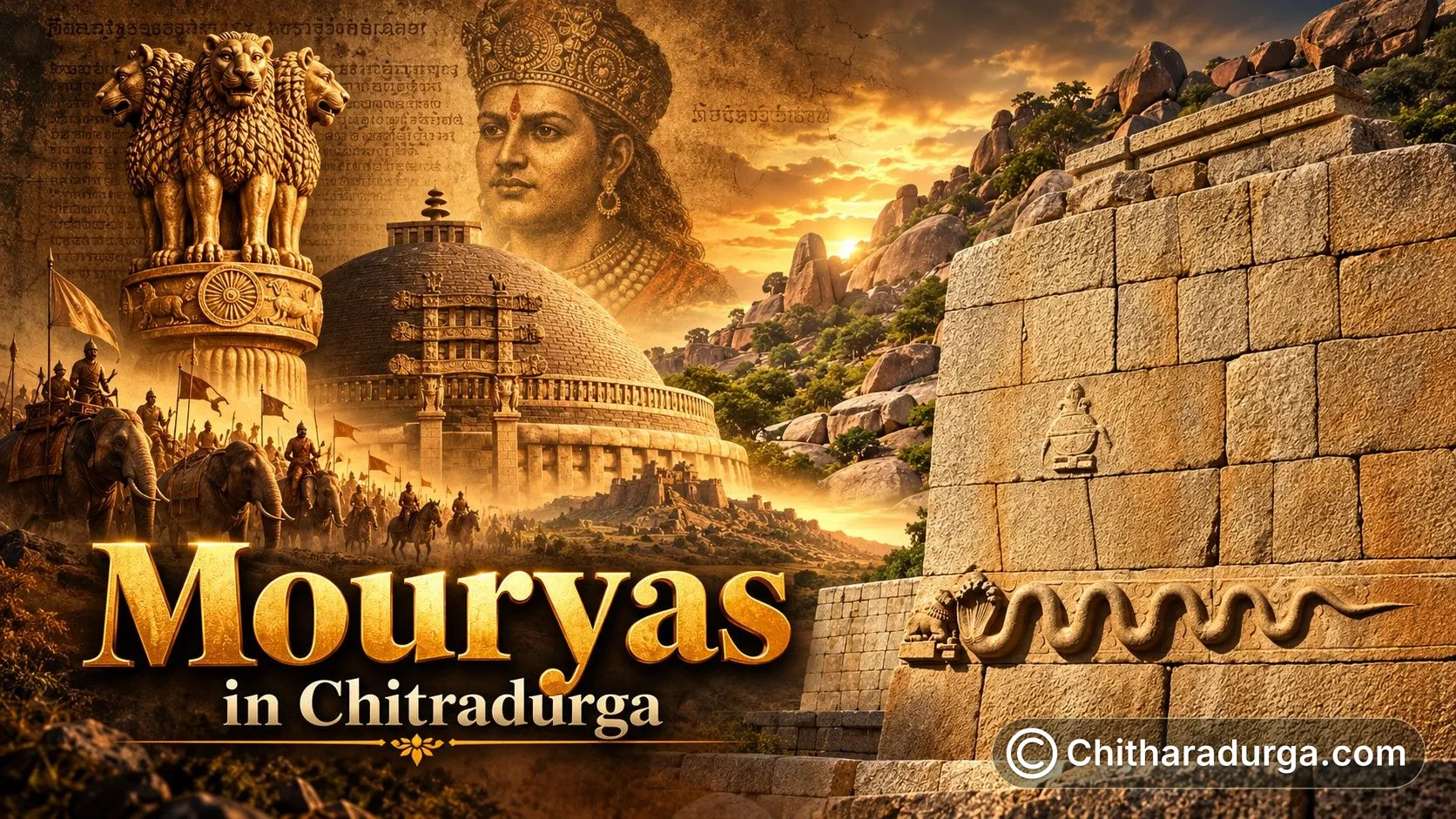
Mauryan period in Chitradurga
The Mauryan period represents one of the earliest historically documented chapters in the ancient history of Chitradurga. During the 3rd century BCE, parts of present-day Karnataka were connected with the vast Mauryan Empire. The most important evidence for this connection in the Chitradurga region comes from the Ashokan inscriptions discovered at Brahmagiri, Siddapura and Jatinga-Rameshwara.
These inscriptions provide valuable evidence that the Chitradurga region was connected with the political, administrative and cultural world of the Mauryan Empire during the reign of Emperor Ashoka.
The Mauryan Empire and South India
The Mauryan Empire emerged in northern India under Chandragupta Maurya in the late 4th century BCE and developed into one of the largest empires of ancient India. It expanded further under his successors, including Bindusara and Ashoka.
By the reign of Ashoka in the 3rd century BCE, Mauryan authority or influence extended into large parts of the Deccan. The inscriptions found in Karnataka provide important evidence for the southern reach of the Mauryan political system.
Ashoka and Chitradurga
The strongest evidence connecting Chitradurga with the Mauryan age comes from inscriptions associated with Emperor Ashoka. Ashoka is remembered not only as a powerful Mauryan ruler but also for promoting Dhamma, an ethical policy emphasizing moral conduct, compassion, respect, restraint and concern for the welfare of people.
Instead of limiting his messages to the imperial capital, Ashoka had his teachings engraved on rocks and pillars across different parts of his empire and areas under its influence.
The presence of such inscriptions in the Chitradurga region gives it a special place in the study of Mauryan history in southern India.
Brahmagiri – A Major Mauryan-Age Site
Brahmagiri, in the present-day Chitradurga district, is one of Karnataka's most important archaeological sites. The discovery of Ashokan Minor Rock Edicts here provided direct epigraphic evidence linking the region with Ashoka's reign.
The Brahmagiri inscription is particularly important because it contains a reference to “Devanampiya Asoka”, helping establish the identification of the title Devanampiya Piyadasi with Emperor Ashoka.
Brahmagiri is also important for its prehistoric and early historic archaeological remains, demonstrating that the area had a long history of human occupation before and during the Mauryan age.
Siddapura and Jatinga-Rameshwara Inscriptions
Ashokan inscriptions have also been discovered at Siddapura and Jatinga-Rameshwara in the same broader archaeological region.
Together with Brahmagiri, these sites form an important group of Ashokan inscription locations in Karnataka. Their presence indicates that this part of central Karnataka had significance within the southern sphere of Mauryan administration and communication.
Isila and Mauryan Administration
The Ashokan inscriptions of the region refer to a place called Isila, which is generally understood to have been an administrative centre associated with the southern Mauryan territories.
The inscriptions also refer to officials connected with the administration of the region. This suggests that the Mauryan state maintained mechanisms for communicating royal instructions to distant areas.
Although the precise location and administrative extent of ancient Isila continue to be subjects of historical study, these records provide valuable insight into the organization of the region during Ashoka's reign.
Dhamma and Buddhist Influence
Ashoka's inscriptions were intended to communicate the principles of Dhamma. They encouraged respect for parents and elders, kindness toward living beings, proper conduct, moderation and harmonious relations among people.
Ashoka's personal association with Buddhism also contributed to the wider spread of Buddhist ideas. The inscriptions found in the Chitradurga region therefore represent not only political evidence but also an important stage in the cultural and religious history of ancient Karnataka.
Brahmagiri and Archaeological Importance
Brahmagiri is significant not only because of Ashoka's inscriptions. Archaeological excavations have revealed evidence from different stages of human history, including prehistoric and early historic cultures.
This makes the Brahmagiri region especially valuable for understanding the transition from prehistoric communities to more organized societies connected with larger kingdoms and administrative systems.
Importance of the Mauryan Period in Chitradurga
The Mauryan period is a landmark in Chitradurga's ancient history because it provides some of the earliest direct written evidence for the region.
The Ashokan inscriptions at Brahmagiri, Siddapura and Jatinga-Rameshwara demonstrate Chitradurga's connection with one of ancient India's greatest empires. They also reveal the region's participation in wider networks of administration, communication, ethical thought and cultural exchange.
Decline of Mauryan Power
After Ashoka's death in the 3rd century BCE, Mauryan power gradually weakened. Eventually, the empire fragmented and regional political powers became increasingly important across the Deccan.
In the following centuries, the Deccan witnessed the rise of dynasties such as the Satavahanas, while later regional powers including the Kadambas played an important role in Karnataka's political development.
Legacy of the Mauryas in Chitradurga
The greatest legacy of the Mauryan age in Chitradurga survives through the Ashokan inscriptions and archaeological heritage of the Brahmagiri region. These remains place Chitradurga firmly on the historical map of ancient India.
Long before the famous Chitradurga Fort and the rise of the Nayakas, the region had already been connected with a major imperial system and important cultural developments.
Thus, the Mauryan period forms one of the earliest and most significant documented chapters in the long history of Chitradurga.