
Ancient History
Shatavahana Period in Chitradurga
By Raghavendra Padmashali · 29 October 2026
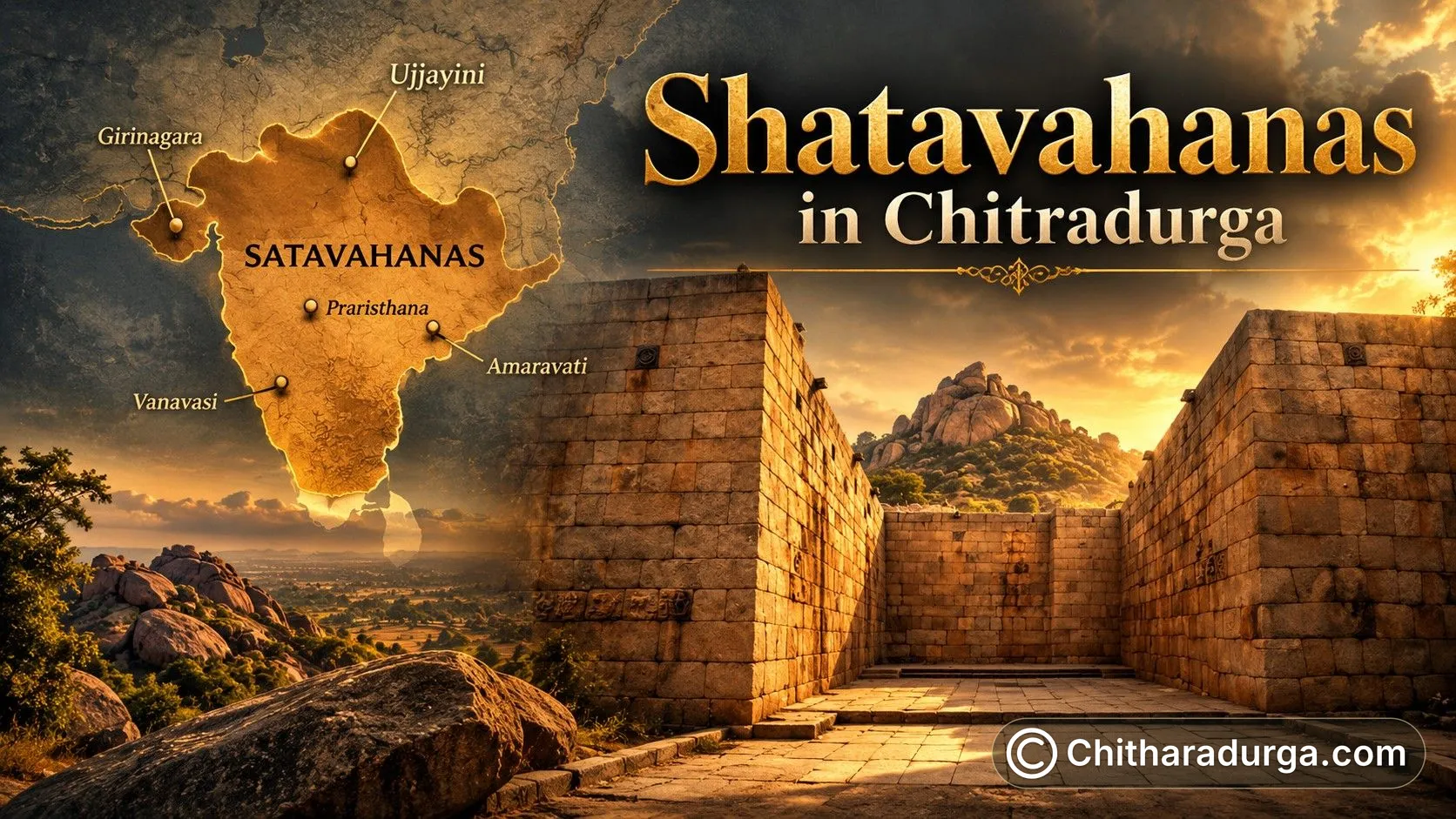
Satavahana Period in Chitradurga
The Satavahanas were one of the most important dynasties of ancient Deccan India. They rose to power after the decline of the Mauryan Empire and ruled extensive territories of the Deccan for several centuries, broadly between the late centuries BCE and the early centuries CE. During this period, the region corresponding to present-day Chitradurga district became part of the wider political, economic and cultural developments taking place across the Deccan.
The archaeological site of Chandravalli, located near Chitradurga, provides particularly important evidence for understanding the region during the Satavahana and early historic periods.
Rise of the Satavahanas
Following the weakening of Mauryan authority, several regional powers emerged in the Deccan. Among them, the Satavahanas established one of the most influential kingdoms. Their territory at different times extended across parts of present-day Maharashtra, Telangana, Andhra Pradesh, Karnataka and Madhya Pradesh.
Important Satavahana rulers included Satakarni rulers and Gautamiputra Satakarni, under whom the dynasty became a major political force in the Deccan.
Chitradurga during the Satavahana Age
Chitradurga's location in central Karnataka gave it access to routes connecting different parts of the Deccan and southern India. During the early historic period, settlements in this region participated in wider networks of agriculture, trade and cultural exchange.
Rather than viewing the whole of present-day Chitradurga district as continuously administered directly by one dynasty, the Satavahana period can be understood through the wider political influence and commercial networks that connected this region with the Deccan.
Chandravalli – An Important Early Historic Centre
Chandravalli is one of the most important archaeological sites associated with the ancient history of Chitradurga. Situated near the rocky hills of Chitradurga, the site preserves evidence of habitation extending across different historical periods.
Archaeological excavations at Chandravalli have uncovered pottery, coins, beads and other antiquities. These discoveries demonstrate the existence of an active settlement with connections to wider economic and cultural networks.
The evidence from Chandravalli makes it clear that ancient Chitradurga was connected with broader developments in the Deccan rather than existing as an isolated inland settlement.
Trade and Economic Connections
Trade expanded considerably across the Deccan during the Satavahana period. Inland routes connected agricultural settlements, market centres and larger commercial regions, while long-distance trade linked the Deccan with coastal ports.
Chitradurga's central location would have placed settlements in the region within these wider networks of movement and exchange. Archaeological finds from Chandravalli provide evidence of commercial activity and contacts beyond the immediate locality.
Agriculture, cattle rearing, crafts and local trade formed important parts of the regional economy.
Agriculture and Settlement Development
Agriculture remained the foundation of everyday economic life. Villages developed near cultivable land and reliable sources of water. Tanks, wells, streams and natural water-storage areas were important in the relatively dry environment of central Karnataka.
As agricultural production increased, permanent settlements expanded and local exchange networks developed. These processes contributed to the gradual transformation of Chitradurga into an increasingly organized early historic region.
Religion and Cultural Life
The Satavahana age was marked by the growth of several religious traditions. Buddhism received significant patronage in different parts of the Deccan, while Brahmanical traditions also flourished.
Chitradurga had already been exposed to Buddhist ideas during the Mauryan period, as indicated by Ashokan inscriptions in the Brahmagiri region. The subsequent Satavahana age formed part of the broader religious and cultural transformation of the Deccan.
Coins and Archaeological Evidence
Coins are particularly important for reconstructing the economic and political history of the early historic period. Coin finds, pottery, beads and other objects from archaeological sites help historians understand trade, settlement patterns and cultural contacts.
The discoveries at Chandravalli are therefore valuable not only for the history of Chitradurga but also for understanding central Karnataka's connections with the wider ancient Deccan.
Importance of the Satavahana Period in Chitradurga
The importance of the Satavahana period in Chitradurga lies in the growth of settlements, agriculture, trade and wider cultural connections. Archaeological evidence, especially from Chandravalli, indicates that the region participated actively in the economic and cultural networks of early historic South India.
The period helped bridge the age of Mauryan influence and the emergence of later regional kingdoms in Karnataka.
Legacy of the Satavahana Period
The Satavahana age represents an important chapter in the ancient history of Chitradurga. The development of settlements, agricultural communities, trade routes and cultural contacts during this period helped prepare the region for later political transformations.
In the centuries that followed, different regional powers, including the Kadambas and other early Karnataka dynasties, influenced central Karnataka. They were eventually followed by powerful medieval kingdoms such as the Badami Chalukyas and Rashtrakutas.
Thus, the Satavahana period, together with the archaeological heritage of Chandravalli, demonstrates that Chitradurga was part of a dynamic network of settlement, trade and cultural interaction in ancient Deccan India.