
Medieval History
Badami Chalukyas in Chitradurga
By Raghavendra Padmashali · 29 October 2026
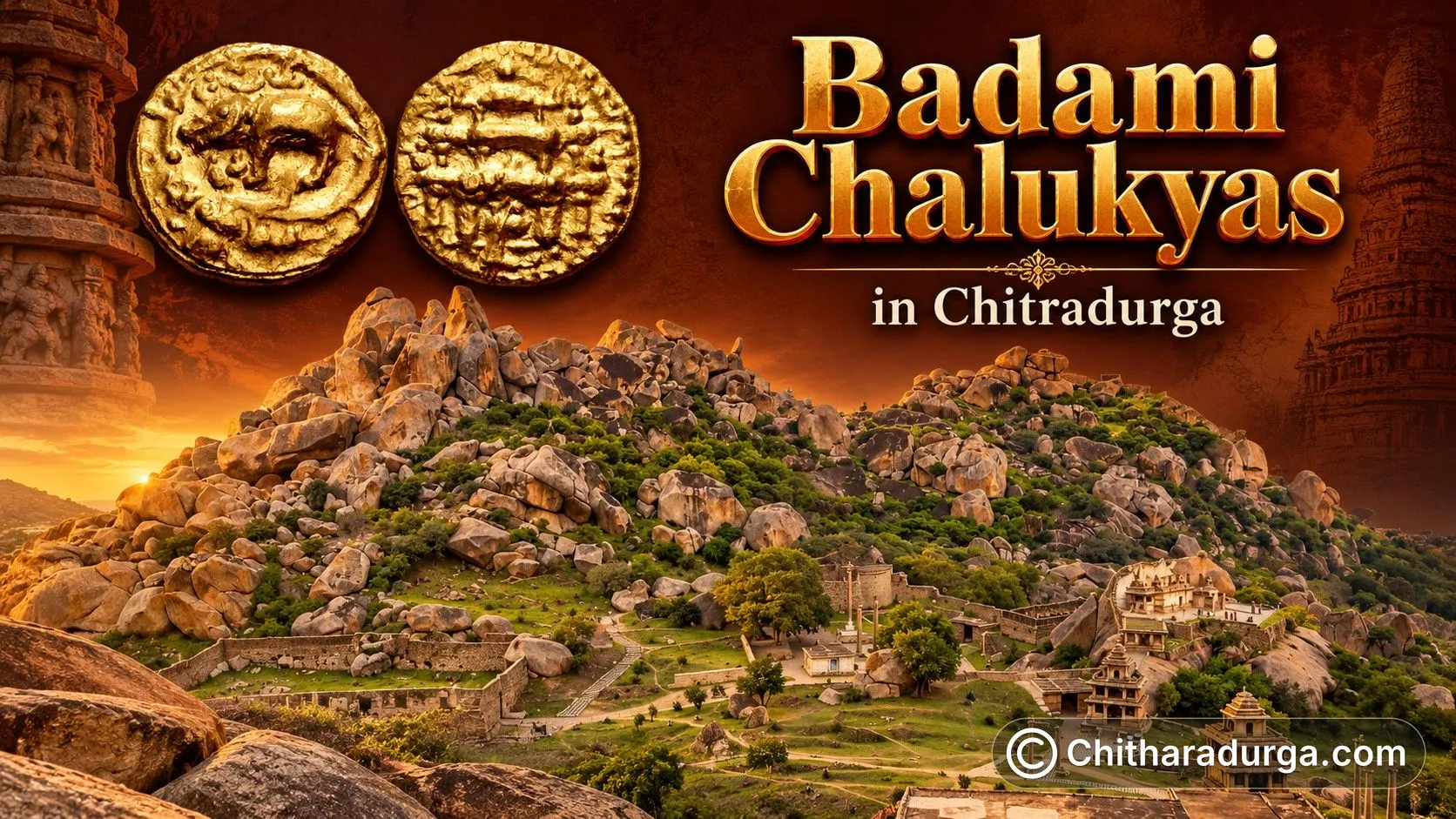
Badami Chalukyas in Chitradurga
The Badami Chalukyas, also known as the Early Chalukyas of Badami, were one of the most influential dynasties in the early medieval history of Karnataka. From the 6th to the 8th century CE, they established a powerful kingdom across much of the Deccan. The region corresponding to present-day Chitradurga district formed part of the wider political and cultural landscape influenced by the Chalukyas.
Chitradurga under the Badami Chalukyas
The Chalukyas established their power with Vatapi (present-day Badami) as their capital. Under rulers such as Pulakeshin I, Kirtivarman I, Mangalesha and Pulakeshin II, the kingdom expanded across large parts of Karnataka and the Deccan.
Located in central Karnataka, the Chitradurga region occupied a strategically important position. Its rocky hills, agricultural settlements and routes connecting northern and southern Karnataka made it significant for regional administration, communication and military movement.
Administration and Local Governance
The Badami Chalukyas administered their territories through provincial and local administrative divisions. Royal officials and subordinate chiefs helped maintain political authority, collect revenue and supervise local affairs.
Villages formed the foundation of the rural economy. Agriculture, land revenue and local institutions played an important role in maintaining settlements. Grants of land to religious institutions and learned persons were also a feature of the period.
Temple Architecture and Art
One of the greatest achievements of the Badami Chalukyas was their contribution to Indian temple architecture. Their monuments at Badami, Aihole, Pattadakal and Mahakuta demonstrate important experiments in rock-cut and structural temple architecture.
The Chalukyan period witnessed interaction between northern and southern architectural traditions, contributing to the development of distinctive Deccan temple styles. The artistic traditions that flourished under them influenced temple construction in many parts of Karnataka and provided a foundation for later architectural developments under the Kalyani Chalukyas and Hoysalas.
Religion and Cultural Life
The Badami Chalukyas supported several religious traditions, including Shaivism, Vaishnavism and Jainism. Their monuments reflect a diverse religious environment and demonstrate the importance of temples and religious institutions in the cultural life of the period.
Sanskrit and early Kannada traditions also developed during Chalukya rule. Inscriptions provide valuable evidence of political events, religious patronage, land grants and the growing use of Kannada in administration and public records.
Agriculture, Trade and Regional Connections
Agriculture was the main economic activity in the Chitradurga region. Tanks, wells and other local water sources supported cultivation in the semi-arid landscape. Villages developed around agricultural lands and water resources.
Chitradurga's location in central Karnataka also placed it along routes connecting different parts of the Deccan. Such routes encouraged the movement of people, military forces, agricultural produce and commercial goods.
Inscriptions and Historical Evidence
Stone and copper-plate inscriptions are important sources for studying the Badami Chalukya period. They provide information about rulers, administrative divisions, local chiefs, religious grants, villages and social conditions.
Inscriptions and archaeological remains from different parts of Karnataka help place the Chitradurga region within the broader political and cultural world of the Early Chalukyas.
Legacy of the Badami Chalukyas in Chitradurga
The Badami Chalukya period represents an important early chapter in the historical development of Chitradurga. Their broader influence on administration, temple culture, religion, agriculture, regional communication and Kannada epigraphic traditions contributed to the development of central Karnataka.
In the 8th century, Badami Chalukya power declined and the Rashtrakutas emerged as the dominant imperial power in the Deccan. In later centuries, the region came under the influence of the Kalyani Chalukyas, Hoysalas and Vijayanagara Empire, eventually leading to the rise of the Chitradurga Nayakas.
Thus, the Badami Chalukya age forms an important link in the long historical journey that shaped Chitradurga's medieval political and cultural identity.