
Vijayanagara Era
Fall of the Vijayanagara Empire
By Raghavendra Padmashali · 29 October 2026
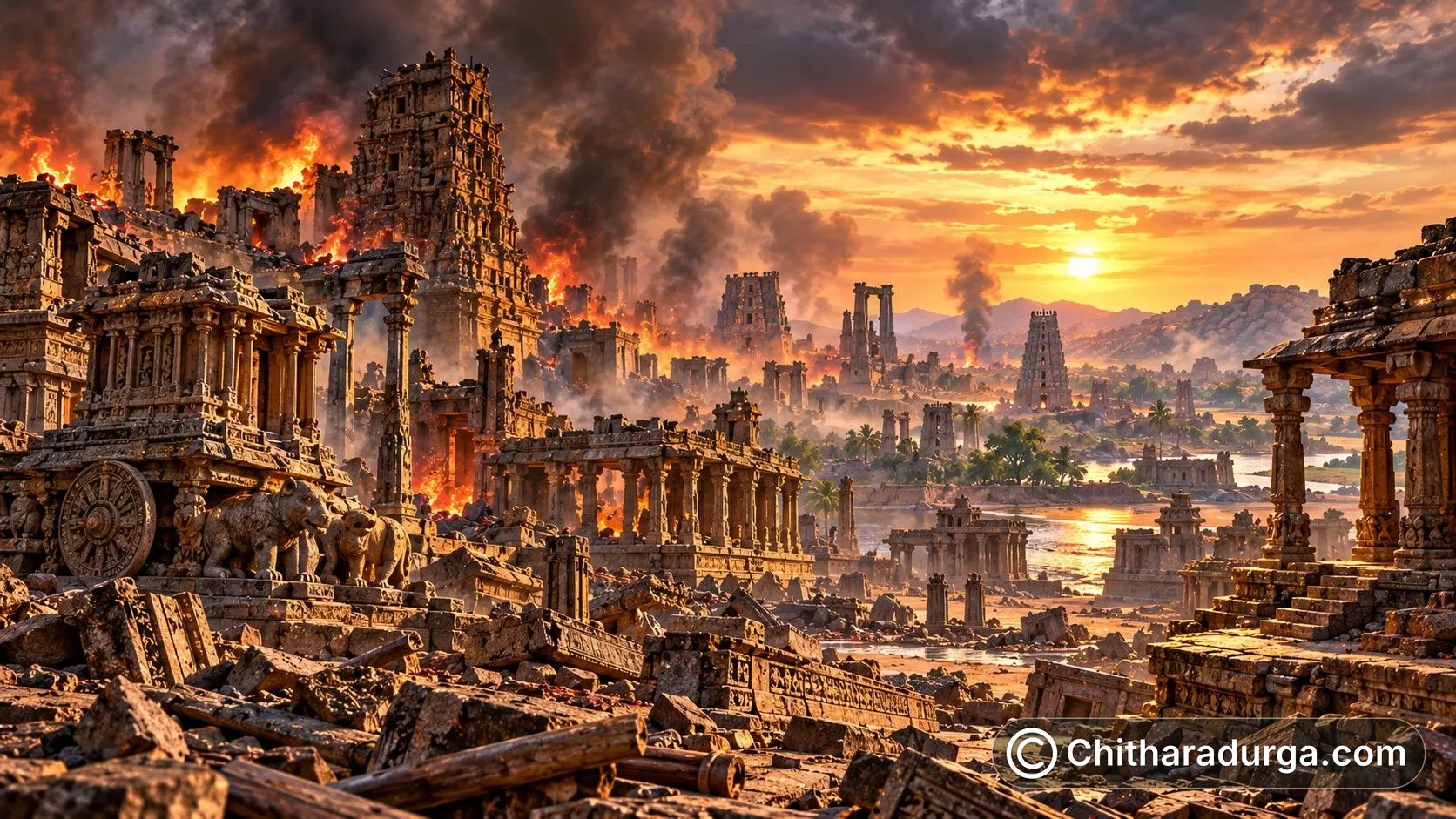
Fall of the Vijayanagara Empire
The Vijayanagara Empire, founded in 1336, became one of the most powerful kingdoms of South India. For more than two centuries, it played a major role in the political, military, economic and cultural history of the Deccan and South India. However, internal rivalries, continuous warfare and the growing power of the Deccan Sultanates gradually weakened the empire.
The decisive turning point came with the Battle of Talikota in 1565. The forces of Vijayanagara, led by Aliya Rama Raya, confronted an alliance of the Deccan Sultanates. Vijayanagara suffered a major defeat, and Rama Raya was captured and killed during the battle.
Following the defeat, the victorious armies advanced towards Vijayanagara (Hampi). The great imperial capital was extensively plundered and devastated. Although the empire did not disappear immediately, it never recovered its former political and military strength. The rulers later shifted their centres of power to places such as Penukonda, Chandragiri and Vellore.
As central authority weakened, many provincial governors, Nayakas and Palegars became increasingly independent. Regional powers such as the Nayakas of Madurai, Thanjavur and Gingee strengthened their own kingdoms, while several Palegar families in Karnataka consolidated control over their territories.
This political transformation also created conditions for the Chitradurga Nayakas to strengthen their authority. Emerging from the Vijayanagara military-administrative tradition, the Chitradurga Palegars gradually developed into an important regional power in central Karnataka.
Thus, the Battle of Talikota marked not the immediate end, but the beginning of the long decline of the Vijayanagara Empire. Its political power faded over time, while its remarkable legacy in architecture, art, literature, administration and culture continued to influence South India for centuries.